Yellowstone was the first national park. Yosemite was the first idea. Lincoln signed it away to California in 1864, in the middle of the Civil War, eight years before anyone used the phrase "national park" at all.
Yosemite is one of 63 national parks in ParkStamp, and like every park it has original stamp designs drawn in the WPA poster tradition. Each one is an illustration of a specific place you can go stand.
Recording the visit is free. Check in at the park, add a trip from years ago, or let the app read the dates off photos already on your phone.
The real NPS boundary, with the roads and towns you would actually use to get there.
Yosemite, for people who count parks
First in idea, third in law, and for sixteen years a state park inside a national one.
June 30, 1864. Lincoln signs the Yosemite Grant Act, handing Yosemite Valley and the Mariposa Big Tree Grove to California to be held for public use and to be inalienable for all time. It is the first time the federal government set land aside specifically for preservation. It did not create a national park, because the land went to a state. It created the country's first state park, and the argument that made every later park possible.
Yellowstone got the title in 1872 for a mundane reason: Wyoming was still a territory, so there was no state to hand it to and the land stayed federal.
Yosemite became a national park on October 1, 1890, after John Muir and the editor Robert Underwood Johnson ran a magazine campaign for it. But the 1890 park was the high country around the valley. The valley floor and the sequoia grove were still California's. For sixteen years Yosemite was a national park with a state park sitting in the middle of it, and the state was managing it badly. California gave them back in 1906 and Roosevelt signed the acceptance.
The camping trip that fixed it. In May 1903 Muir took Roosevelt into the park for three nights, largely without the presidential entourage. They slept under the Grizzly Giant in the Mariposa Grove, then near Glacier Point on about five feet of snow, where it snowed on them overnight. Roosevelt's reaction, recorded at the time: "This is bullier yet." Muir said afterward that he had stuffed him pretty well regarding the timber thieves.
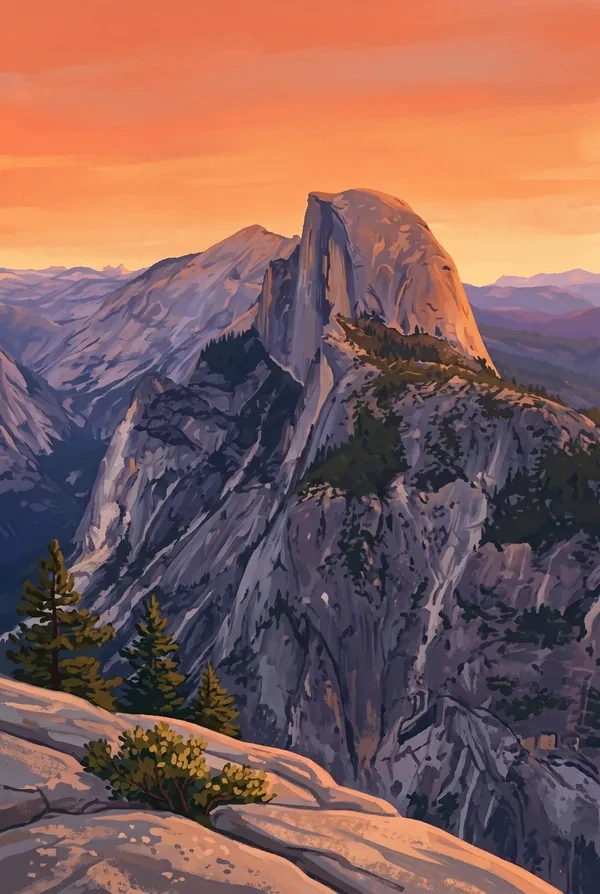
Half Dome's other half was never there. The name has convinced generations of visitors that something sheared it in two. Geologists estimate as much as 80% of the "missing" half is still standing. The northwest face is a cliff because a set of near-vertical cracks happened to run through the rock there and ice plucked along them. From Washburn Point it does not read as half a dome at all, but as a thin ridge. And the glaciers never went over the top of it, so no glacier could have taken anything.
A bear problem solved, an owl found only here, and sheep in trouble again.
Black bears, and one of the best conservation-management numbers anywhere. In 1998 the park logged about 1,600 human-bear incidents and $660,000 in property damage, much of it bears tearing open parked cars. In 2015 it logged 76 incidents and $4,909. That is a 95% drop in incidents and a 99% drop in damage. It took bear-proof lockers at every campsite and trailhead, mandatory canisters in the backcountry, GPS collars, an education campaign, and about half a million dollars a year. Improper food storage can cost you a $5,000 fine and your car being impounded.
Great gray owls, and 65% of California's are here. The whole state holds only an estimated 200 to 300. In 2010 genetic work showed Yosemite's birds are a distinct subspecies, isolated at the southern edge of the species' range. North America's tallest owl, up to two feet with a five-foot wingspan, hunting the edges where forest meets meadow.
Sierra Nevada bighorn sheep, and this one is not a success story yet. Listed endangered in 2000 when about 100 animals remained in the entire subspecies. They had been gone from Yosemite's Cathedral Range for over a century and were brought back in March 2015. Then came the record winter of 2022-23. As of late 2023 California's wildlife department reported no ewes known to have survived in that herd. Surveyors were finding only rams.
Giant sequoias, and the Grizzly Giant is younger than you think. Sequoias are the largest trees on Earth by volume, though not the tallest or the oldest. The Grizzly Giant in the Mariposa Grove is around 2,900 years old, not the 8,000 to 10,000 that got claimed a century ago. It stands 209 feet tall and 96 feet around at the base. It is also the tree Roosevelt and Muir slept under in 1903, and one of the two things the 1864 Grant was written to protect.
The Yosemite designs
Pick the one that matches the park you actually saw.
Half Dome
About 8,800 feet at the summit, some 4,800 above the valley floor. The last 400 feet are bare polished granite climbed between two steel cables with wooden planks for footholds. George Anderson got up it first in October 1875 by drilling eyebolts as he went; Muir followed within weeks. The permanent cables went in in 1919, and since 2010 the Park Service has capped how many people can be on them each day; nps.gov has the current system. Nearly every fatal fall from the cables has happened when the rock was wet.
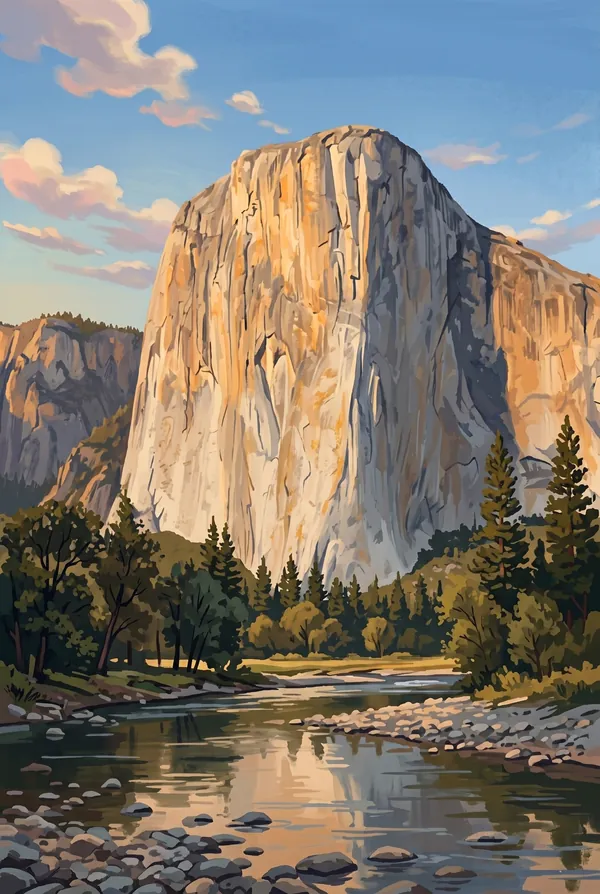
El Capitan
Three thousand vertical feet of granite, and the most important big wall on Earth. Warren Harding and two partners took 47 days spread over 18 months to climb The Nose in 1958 and proved multi-day walls were possible. Tommy Caldwell and Kevin Jorgeson free-climbed the Dawn Wall in 2015 after 19 days living on the face. In June 2017 Alex Honnold climbed it with no rope in three hours and 56 minutes.
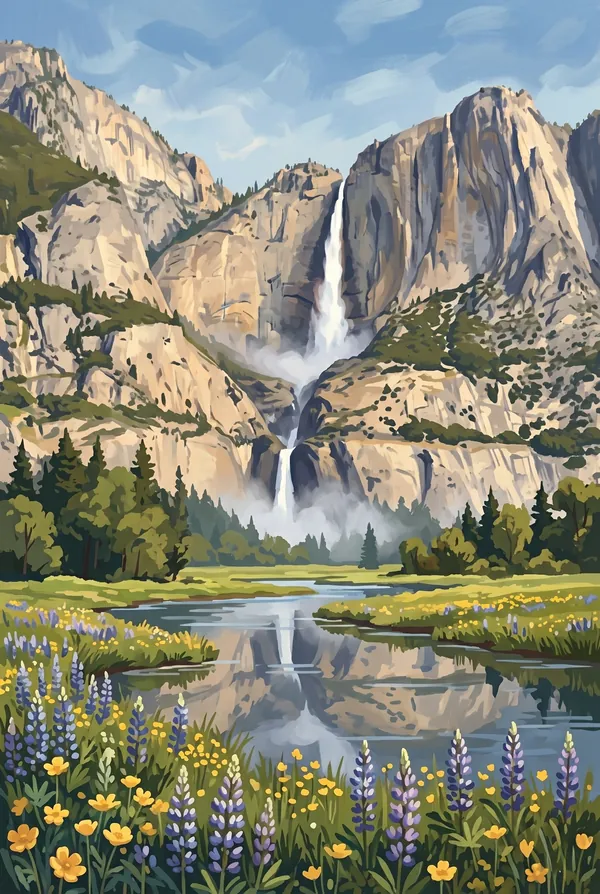
Yosemite Falls
A total drop of 2,425 feet in three stages, the upper fall alone plunging 1,430. It is the tallest waterfall in California and among the tallest in North America, though the "fifth tallest in the world" line is disputed because the total counts six separate leaps. The part nobody expects: it runs dry. It is fed entirely by snowmelt, and in all but the wettest years it stops altogether by late summer.
How to record your Yosemite visit
Free, and it works whether you are standing there now or remembering a trip from years ago.
1
Check In at the park
Open ParkStamp inside the park boundary and check in. The app confirms you are actually there and logs the date.
2
Or Stamp It later
Already been? Pick the date yourself. Trips from decades ago count the same as last weekend.
3
Or scan your photos
Let ParkStamp read the dates and locations off photos already on your phone. Most people find parks they had forgotten.
Yosemite, asked and answered
Quick answers, for people planning a trip and people remembering one.
When is the best time to visit Yosemite?
May for the waterfalls, when the snowmelt is loudest and Yosemite Falls looks like the photographs. September and October for quieter granite and a swimmable Merced. The Tioga Road high country runs on a summer-only season. Late February is for the photographers, when Horsetail Fall catches the sunset and glows.
How many days do you need at Yosemite?
Two days for the Valley: one for the icons from the floor, Tunnel View, Yosemite Falls, El Capitan meadow, and one to climb out of it, the Mist Trail to Vernal and Nevada Falls. Add a third in season for Tioga Road and Tuolumne Meadows, a higher, emptier, entirely different park.
How busy is Yosemite?
Yosemite National Park logged 4.28 million visits in 2025, the 5th busiest of the 63 national parks. That makes it one of the busiest parks in the system, and early mornings are the quiet hours.
What does the Yosemite stamp show?
The lead Yosemite design is Half Dome. About 8,800 feet at the summit, some 4,800 above the valley floor. The last 400 feet are bare polished granite climbed between two steel cables with wooden planks for footholds. George Anderson got up it first in October 1875 by drilling eyebolts as he went; Muir followed within weeks. The permanent cables went in in 1919, and since 2010 the Park Service has capped how many people can be on them each day; nps.gov has the current system. Nearly every fatal fall from the cables has happened when the rock was wet. The other two designs are El Capitan and Yosemite Falls.
Is the Yosemite stamp free?
Recording your Yosemite visit is always free: check in at the park, add an old trip, or let the photo scan find it. The full-color art is the paid part, $3.99 one-time with three Yosemite designs to choose from, and the first stamp you collect in ParkStamp is free.
Can I add a Yosemite trip from years ago?
Yes. Open Yosemite in ParkStamp, tap Stamp It, and set the date yourself; a visit from decades ago counts the same as last weekend. If you still have photos from the trip, the photo scan can find and date it from their location tags, without your photos ever leaving your phone.
Do I have to be at Yosemite to get the stamp?
No. Check In is for when you are standing inside Yosemite, and it confirms you are actually there. Stamp It records any past visit on your honor, with your dates. Both are free and put the same stamp in your StampBook.
Start your StampBook with Yosemite
Free on iOS and Android. Your first stamp is on us.