The tallest living things on Earth grow here, in a fog belt a few miles wide along the Pacific. The park's plural name is not a typo: it is one national park and three California state parks run as a single unit, an arrangement that exists because by the time the federal government showed up, most of the trees were already gone.
Redwood is one of 63 national parks in ParkStamp, and every park in the app carries original stamp art drawn in the WPA poster tradition. Each design is a picture of a real, specific place inside the park, not a generic tree.
Recording your visit costs nothing. Check in when you are there, log a trip from any year past, or let the app pull the dates and places from photos already sitting on your phone.
The real NPS boundary, with the roads and towns you would actually use to get there.
Redwood, for people who count parks
The federal government arrived ninety years late, and the name admits it.
Old-growth coast redwood once covered about two million acres of the Northern California coast. Industrial logging that began with the Gold Rush removed roughly 95 percent of it. What survives today is a scatter of remnants, and these parks hold about 45 percent of all the old growth left anywhere.
The state got there first. Save the Redwoods League formed in 1918 and spent decades buying groves one memorial stand at a time, which became Jedediah Smith, Del Norte Coast and Prairie Creek Redwoods State Parks in the 1920s. A national park was proposed as early as that and went nowhere for half a century.
What finally moved Congress was a measurement. A National Geographic expedition in 1963 and 1964 surveyed the unprotected timberland along Redwood Creek and found the tallest tree then known on Earth standing in a grove slated, like everything around it, for eventual harvest. The magazine put the discovery on its cover, and Lyndon Johnson signed the park into law on October 2, 1968, with the chainsaws still working the slopes above.
The 1978 expansion bought clearcuts on purpose. Logging upstream was loading Redwood Creek with sediment that threatened the protected groves below, so Congress added 48,000 acres, much of it already cut over, and the Park Service began one of the largest watershed restorations ever attempted: pulling out hundreds of miles of logging roads and replanting the slopes. In 1994 the national park and the three state parks merged their management into one system, which is why the name on the sign is plural. UNESCO had already made the whole complex a World Heritage Site in 1980.
The tallest tree on Earth is in here somewhere. Hyperion, found in 2006 measuring just under 380 feet, grows at a location the park does not publish. There is no sign, no trail, and no reason to look: from the ground, a 380-foot redwood and a 350-foot redwood are the same tree.
A forest that drinks fog and keeps some of its animals a hundred yards off the ground.
The trees water themselves with fog. Coast redwoods live only in the summer fog zone along the Pacific, and for good reason: their canopies comb water out of the marine layer and drip it onto their own roots, supplying a large share of the forest's water in the rainless California summer. The species survives almost nowhere outside the fog line.
There is a second forest in the canopy. Centuries of fallen needles collect in the crooks of old redwoods and rot into aerial soil mats that support ferns, huckleberry bushes, even other trees. The wandering salamander can live out its whole life up there, hundreds of feet above the ground, without ever descending.
The marbled murrelet is the strangest tenant. A small seabird that feeds on the ocean and nests on the wide, mossy limbs of old-growth conifers, flying inland at dawn and dusk. Its nest was one of the last in North America to be documented (science did not confirm one until 1974), and its dependence on old growth made it central to the fight over what was left of these forests.
Roosevelt elk, the biggest-bodied elk in North America, graze the meadows at Prairie Creek and along the Klamath. The herds here were nearly hunted out a century ago, and protecting them was part of the original case for the state parks. Bulls run to a thousand pounds; give them the meadow.
The Redwood designs
Pick the one that matches the park you actually saw.
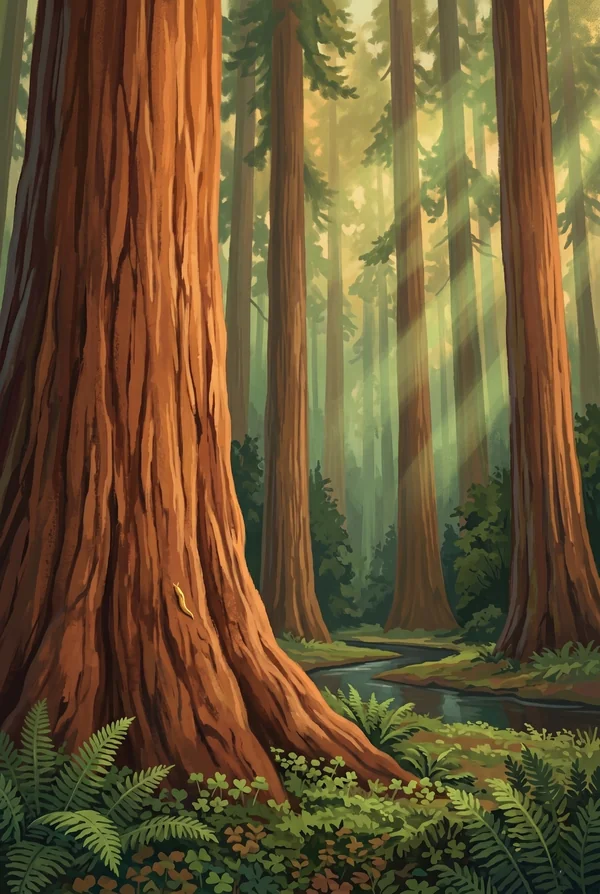
Tall Trees Grove
An alluvial flat on a bend of Redwood Creek where the National Geographic survey of the 1960s measured the tallest tree then known on Earth, the discovery that finally produced the park. A long gravel road and a steep walk down keep it one of the quietest old-growth groves anywhere, which is the reason to make it your stamp.
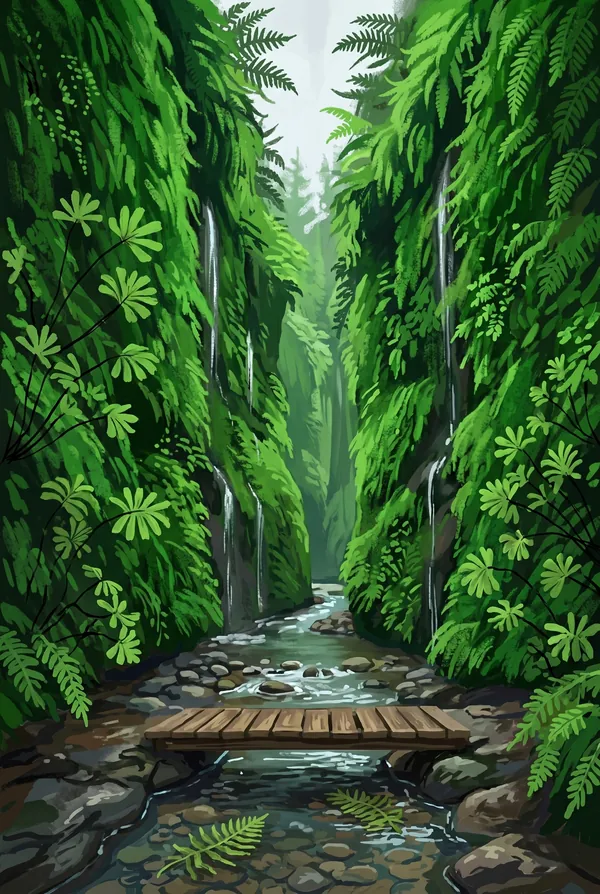
Fern Canyon
A narrow slot cut by Home Creek through soft coastal sediment, its vertical fifty-foot walls sheathed entirely in ferns from lineages far older than the redwoods above. You walk the creek bed itself between green walls that seep and drip year-round. Steven Spielberg borrowed it for The Lost World, and it looks the part.
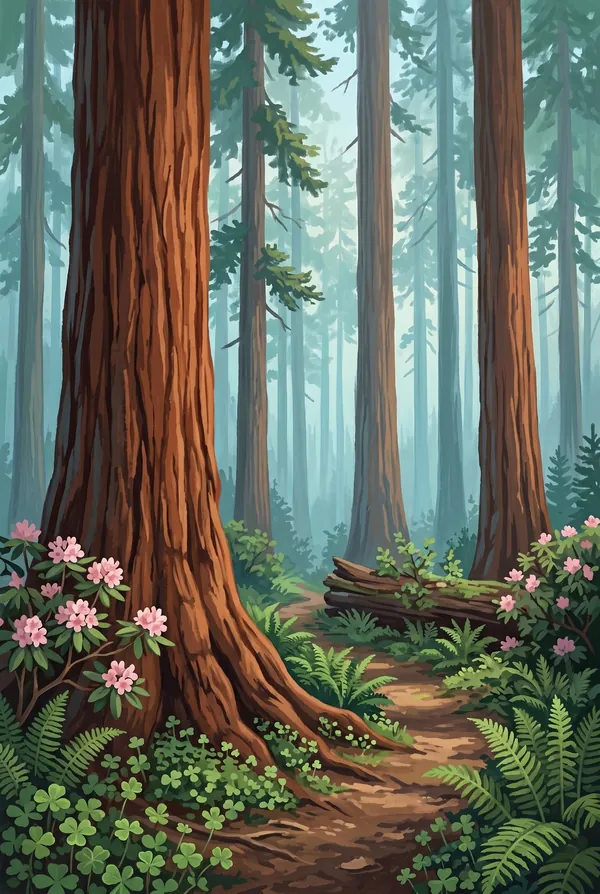
Lady Bird Johnson Grove
A ridgetop old-growth grove around 1,200 feet up, often standing in the fog that keeps these trees alive. Richard Nixon dedicated it in 1969 to honor the former First Lady whose husband had signed the park into law, and the easy loop through it is where most visitors meet their first monarch redwoods.
How to record your Redwood visit
Free, and it works whether you are standing there now or remembering a trip from years ago.
1
Check In at the park
Open ParkStamp inside the park boundary and check in. The app confirms you are actually there and logs the date.
2
Or Stamp It later
Already been? Pick the date yourself. Trips from decades ago count the same as last weekend.
3
Or scan your photos
Let ParkStamp read the dates and locations off photos already on your phone. Most people find parks they had forgotten.
Redwood, asked and answered
Quick answers, for people planning a trip and people remembering one.
When is the best time to visit Redwood?
There is no bad season, only different fog. Summer brings the thickest marine layer, which is atmospheric in the groves and cold on the beaches. May and June add rhododendron blooms under the big trees. September and October are the clearest and calmest, with elk bugling at Prairie Creek. Winter is storm season: dramatic surf, swollen creeks, few people, and the forest at its greenest.
How many days do you need at Redwood?
Two days covers the sweep: one in the south for Lady Bird Johnson Grove, the Redwood Creek country and the coast at Gold Bluffs Beach and Fern Canyon, and one in the north for Jedediah Smith's Howland Hill Road, the densest old growth of all. A third day is for walking to Tall Trees Grove and lingering in the quiet.
How busy is Redwood?
Redwood National and State Parks logged 1.20 million visits in 2025, the 25th busiest of the 63 national parks. That puts it in the middle of the pack: busy at the famous spots, quiet a mile past them.
What does the Redwood stamp show?
The lead Redwood design is Tall Trees Grove. An alluvial flat on a bend of Redwood Creek where the National Geographic survey of the 1960s measured the tallest tree then known on Earth, the discovery that finally produced the park. A long gravel road and a steep walk down keep it one of the quietest old-growth groves anywhere, which is the reason to make it your stamp. The other two designs are Fern Canyon and Lady Bird Johnson Grove.
Is the Redwood stamp free?
Recording your Redwood visit is always free: check in at the park, add an old trip, or let the photo scan find it. The full-color art is the paid part, $3.99 one-time with three Redwood designs to choose from, and the first stamp you collect in ParkStamp is free.
Can I add a Redwood trip from years ago?
Yes. Open Redwood in ParkStamp, tap Stamp It, and set the date yourself; a visit from decades ago counts the same as last weekend. If you still have photos from the trip, the photo scan can find and date it from their location tags, without your photos ever leaving your phone.
Do I have to be at Redwood to get the stamp?
No. Check In is for when you are standing inside Redwood, and it confirms you are actually there. Stamp It records any past visit on your honor, with your dates. Both are free and put the same stamp in your StampBook.
Start your StampBook with Redwood
Free on iOS and Android. Your first stamp is on us.