Rainier is an active volcano carrying more glacier ice than any other peak in the contiguous United States, which is precisely the combination that keeps geologists watching it. It became America's fifth national park in 1899, and it is named for a British admiral who fought against the American side in the Revolution and never saw the mountain.
Mount Rainier is one of 63 national parks in ParkStamp, and each park comes with original stamp designs drawn in the WPA poster tradition, every one an illustration of a specific real place inside the park.
The visit log is free. Check in at the mountain, enter a trip from years ago, or let the app pull dates and locations from the photos already on your phone.
The real NPS boundary, with the roads and towns you would actually use to get there.
Mount Rainier, for people who count parks
A borrowed name, a fifth park, and a mountain the lowland towns keep one eye on.
The name was a favor between officers. George Vancouver sighted the peak from Puget Sound in 1792 and named it for his friend Rear Admiral Peter Rainier, who had fought against the Americans in the Revolution and never set foot near the mountain. The peoples who lived under it already had names, Tahoma and Tacoma among them, and the city of Tacoma waged a decades-long campaign to make one of them official; the federal naming board sided with Rainier, more than once. The older names never left: the Salish word survives on the mountain's glaciers, trails, and half the businesses in the state.
It became the fifth national park on March 2, 1899, signed by William McKinley (after Yellowstone, Sequoia, Yosemite and General Grant) and the first carved out of an existing federal forest reserve. The push came notably from scientists: geologists and geographers wanted the glaciers protected as a natural laboratory, and John Muir lent his weight after climbing the peak in 1888, writing that he had not meant to climb it, but got excited and soon was on top.
The mountain is asleep, not finished. About 5,600 years ago its summit collapsed and slid toward Puget Sound as the Osceola Mudflow, a wall of volcanic mud that buried well over a hundred square miles of lowland, ground that towns and farms now sit on. Smaller lahars have run since, some only centuries ago, which is why valley schools below the mountain hold evacuation drills and sirens stand along the rivers. Rainier is one of the volcanoes international geologists flagged as most worth watching on Earth, less for the odds of eruption than for what sits downstream.
Paradise earned the name honestly. The Longmire family homesteaded mineral springs on the mountain's south side in the 1880s, and the story goes that it was Martha Longmire, coming up into the flower meadows, who said oh, what a paradise. The same meadows hold one of the great weather statistics anywhere: in the winter of 1971-72, Paradise recorded 1,122 inches of snow, over 93 feet: a world record for measured snowfall in a single season that stood for a quarter century. An ordinary winter still drops roughly fifty feet.
Twenty-five glaciers in retreat, a six-week flower season, and a fox built for snow.
The ice is the headline. Some 25 named glaciers wrap the peak. The Emmons, on the northeast side, is the largest glacier by area in the contiguous United States, and the Carbon reaches the lowest elevation. The Nisqually Glacier has been measured since 1918, one of the longest continuous glacier records in the hemisphere, and the record says what glacier records now say everywhere: retreat, thinning, and meltwater rivers running grey with rock flour.
The meadows live on a six-week clock. Subalpine flower fields at Paradise and Sunrise spend most of the year under snow, then bloom in a compressed rush from late July into August: avalanche lilies pushing up at the edge of the melting drifts, then lupine, paintbrush and bistort in waves. Plants here may take years to recover from a single bootprint, which is why the park is insistent about staying on trail.
The Cascade red fox is the rarity. A small, high-country subspecies found only in Washington's mountains, it hunts the parklands and snowfields alongside the more visible alpine crowd: hoary marmots whistling from the talus, pikas haying all summer, white-tailed ptarmigan going white for winter, and mountain goats on the crags.
The low valleys are the counterweight. Around Ohanapecosh and the rainy Carbon River corner, the park protects old-growth Douglas-fir, hemlock and western redcedar, with the oldest trees near a thousand years, forest that was ancient before Vancouver sailed past. A day here can run from glacier ice to rainforest moss inside twenty miles.
The Mount Rainier designs
Pick the one that matches the park you actually saw.
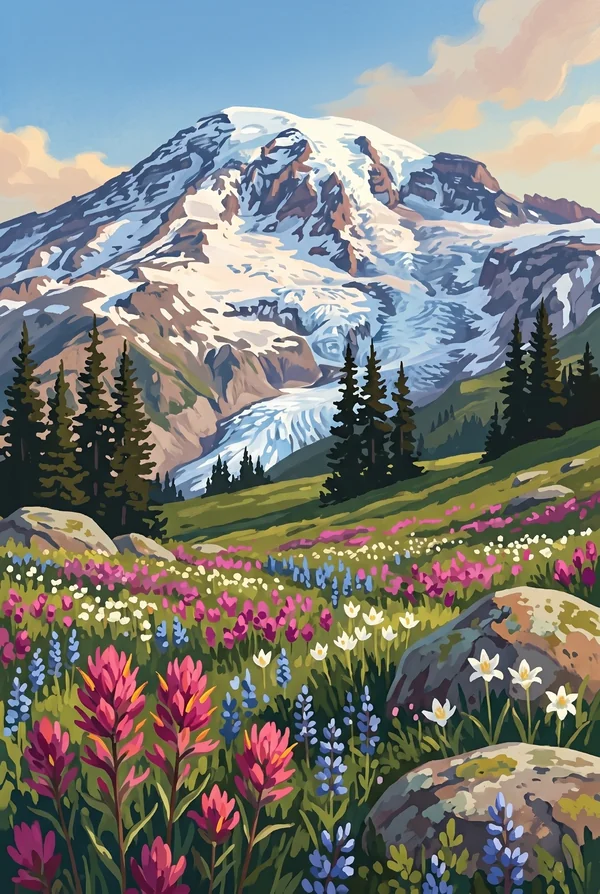
Paradise Wildflower Meadow
The subalpine fields on the mountain's south shoulder, which Muir called the most luxuriant and most extravagantly beautiful of the alpine gardens he had seen. For about six weeks from late July the meadows run solid with lupine, paintbrush and avalanche lilies below the summit ice. The rest of the year this scene is buried under one of the deepest snowpacks on Earth.
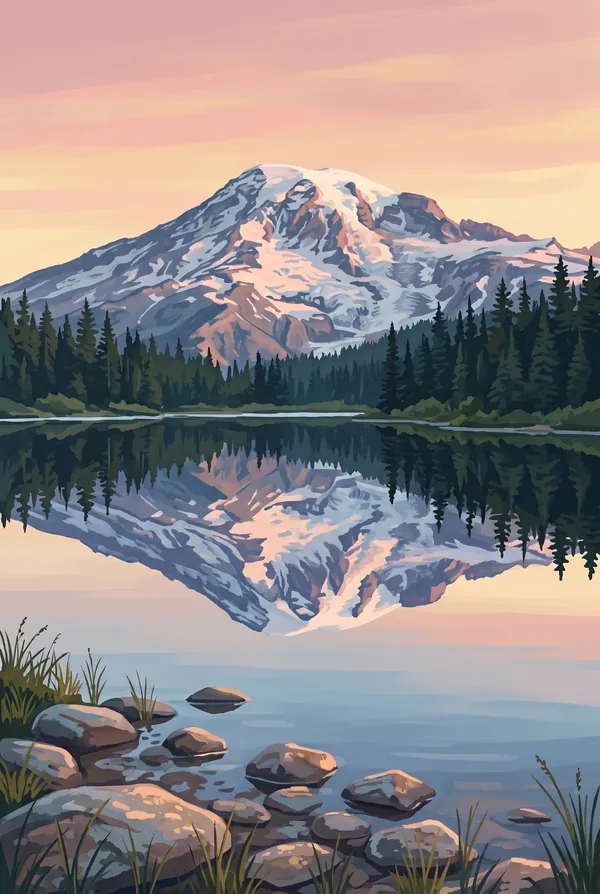
Reflection Lakes
Small tarns on the road between Paradise and Stevens Canyon where, on a still morning before the wind rises, the entire 14,410-foot mountain stands doubled in the water. It is probably the most photographed view in the park and it is earned honestly: arrive at dawn and the lake is a mirror. The stamp for photographers.
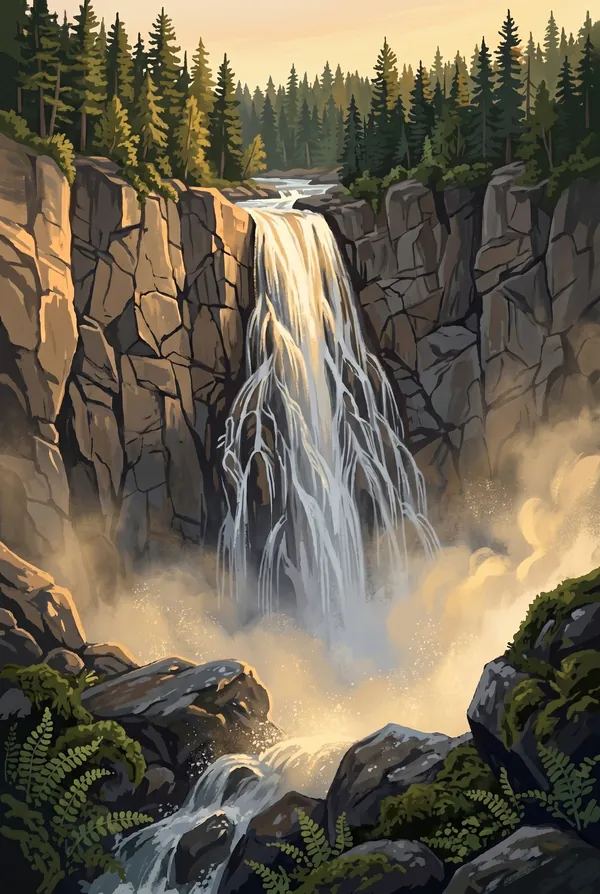
Narada Falls
The Paradise River dropping 188 feet in two tiers over the lip of an ancient lava flow, named in 1893 by a Tacoma climbing party for a branch of the Theosophical Society that took its name from a Hindu sage, chosen to mean pure. A short, steep path leads to a spray-soaked viewpoint below, where afternoon light hangs rainbows in the mist.
How to record your Mount Rainier visit
Free, and it works whether you are standing there now or remembering a trip from years ago.
1
Check In at the park
Open ParkStamp inside the park boundary and check in. The app confirms you are actually there and logs the date.
2
Or Stamp It later
Already been? Pick the date yourself. Trips from decades ago count the same as last weekend.
3
Or scan your photos
Let ParkStamp read the dates and locations off photos already on your phone. Most people find parks they had forgotten.
Mount Rainier, asked and answered
Quick answers, for people planning a trip and people remembering one.
When is the best time to visit Mount Rainier?
Late July to mid-August, when the snow finally leaves Paradise and Sunrise and the wildflower meadows compress a whole growing season into six weeks. September trades flowers for huckleberry color, fewer people, and steadier views of a mountain that makes its own clouds and hides for days at a time. Winter buries Paradise under one of the deepest snowpacks anywhere and hands the park to skiers and snowshoers.
How many days do you need at Mount Rainier?
Two days covers the two classic fronts: Paradise and the Skyline country on one, Sunrise (the highest point you can drive to in the park) on the other, with Reflection Lakes and Narada Falls on the road between. A third day earns the quiet corners: old growth at Ohanapecosh or the rainforest valley of the Carbon River.
How busy is Mount Rainier?
Mount Rainier National Park logged 1.64 million visits in 2025, the 20th busiest of the 63 national parks. That puts it in the middle of the pack: busy at the famous spots, quiet a mile past them.
What does the Mount Rainier stamp show?
The lead Mount Rainier design is Paradise Wildflower Meadow. The subalpine fields on the mountain's south shoulder, which Muir called the most luxuriant and most extravagantly beautiful of the alpine gardens he had seen. For about six weeks from late July the meadows run solid with lupine, paintbrush and avalanche lilies below the summit ice. The rest of the year this scene is buried under one of the deepest snowpacks on Earth. The other two designs are Reflection Lakes and Narada Falls.
Is the Mount Rainier stamp free?
Recording your Mount Rainier visit is always free: check in at the park, add an old trip, or let the photo scan find it. The full-color art is the paid part, $3.99 one-time with three Mount Rainier designs to choose from, and the first stamp you collect in ParkStamp is free.
Can I add a Mount Rainier trip from years ago?
Yes. Open Mount Rainier in ParkStamp, tap Stamp It, and set the date yourself; a visit from decades ago counts the same as last weekend. If you still have photos from the trip, the photo scan can find and date it from their location tags, without your photos ever leaving your phone.
Do I have to be at Mount Rainier to get the stamp?
No. Check In is for when you are standing inside Mount Rainier, and it confirms you are actually there. Stamp It records any past visit on your honor, with your dates. Both are free and put the same stamp in your StampBook.
Start your StampBook with Mount Rainier
Free on iOS and Android. Your first stamp is on us.