Five islands off the Southern California coast that were never connected to the mainland; everything living on them swam, flew, floated or was carried. The result is a park routinely called the Galapagos of North America, home to the oldest securely dated human remains on the continent and a fox the size of a housecat.
Channel Islands is one of 63 national parks in ParkStamp, each with original stamp designs drawn in the WPA poster tradition. Every design illustrates a specific real place (or, in one case here, a specific real animal).
Recording the visit is free. Check in from the islands, log a crossing you made years ago, or let the app read the dates and locations from photos already on your phone.
The real NPS boundary, with the roads and towns you would actually use to get there.
Channel Islands, for people who count parks
No land bridge, ever, and thirteen thousand years of people anyway.
The isolation is total and always was. Even at the bottom of the last ice age, when sea level dropped enough to fuse the four northern islands into one big island geologists call Santarosae, a deep channel still separated it from the mainland. Nothing ever walked here. Every plant and animal arrived by sea or air, and the castaways evolved in isolation into what the park counts as about 145 species found nowhere else on Earth.
People crossed that channel astonishingly early. Human leg bones eroding out of Arlington Canyon on Santa Rosa Island, known as Arlington Springs Man, date to roughly 13,000 years ago, among the oldest securely dated human remains in the Americas. Since the island was never walkable from shore, whoever it was arrived by boat, which makes these bones a standing argument for a coastal, seafaring route into the New World.
The Chumash built a maritime economy on them. Island villages ran on the tomol, a plank canoe sewn together and sealed with tar, used to trade across the channel. The islands were also the mint: shell beads manufactured there by the million circulated as currency across a wide swath of southern California. Chumash communities on the mainland still build tomols and make the crossing.
The park came in two installments. Franklin Roosevelt made tiny Anacapa and Santa Barbara islands a national monument in 1938; the national park of March 5, 1980 added San Miguel, Santa Rosa and big Santa Cruz, plus a mile of ocean around each island. The larger islands spent more than a century as sheep and cattle ranches first, and most of Santa Cruz is owned and managed by The Nature Conservancy in partnership with the park. Despite sitting within sight of several million people, the islands remain among the least visited national parks. The moat still works.
Dwarf foxes, dwarf mammoths, and one very lonely jay.
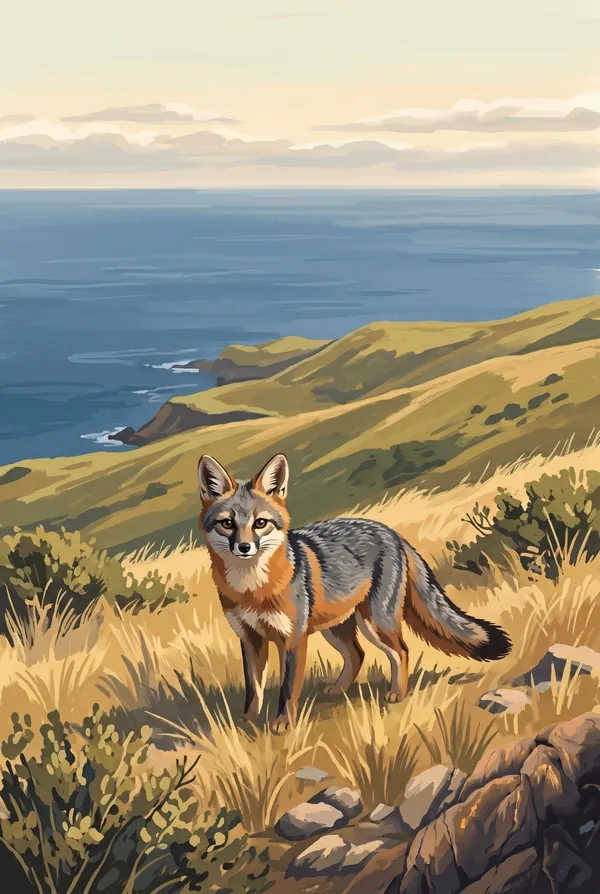
The island fox nearly vanished in a decade, then set a record coming back. Each of six islands has its own subspecies of this housecat-sized descendant of the mainland gray fox. In the 1990s the northern-island populations collapsed: DDT had wiped out the fish-eating bald eagles, golden eagles moved into the vacancy, and golden eagles eat foxes. Some islands were down to a few dozen animals. Captive breeding, eagle relocation and bald eagle reintroduction reversed it, and in 2016 three subspecies came off the endangered list in what was announced as the fastest recovery of any listed mammal in US history.
The islands once dwarfed mammoths too. Columbian mammoths swam out during low-sea-level periods (elephants are strong swimmers), and their marooned descendants shrank over generations into pygmy mammoths standing only five or six feet at the shoulder. In 1994 researchers on Santa Rosa excavated a nearly complete skeleton, one of the best pygmy mammoth finds anywhere.
One bird, one island. The island scrub-jay lives on Santa Cruz Island and nowhere else: bigger, bluer and heavier-billed than its mainland cousin, with one of the smallest ranges of any bird in North America. For a birder it is the rare species you cannot see without buying a boat ticket.
The richest habitat is below the waterline. The park boundary extends a nautical mile out, taking in giant kelp forests that shelter garibaldi, sheephead, sea lions and harbor seals. The surrounding channel sits on a cold-water upwelling that loads it with krill, and in summer it is one of the most reliable places on Earth to encounter blue whales.
The Channel Islands designs
Pick the one that matches the park you actually saw.
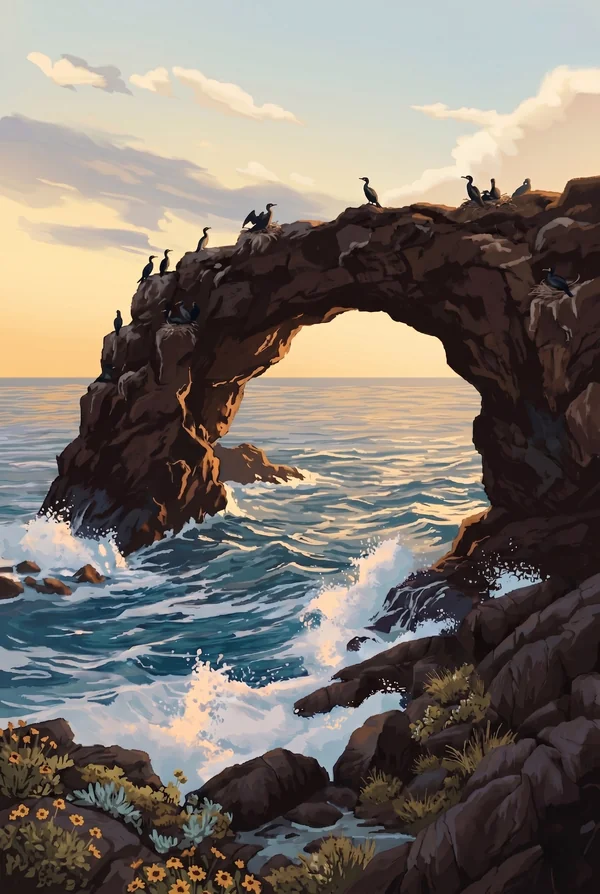
Arch Rock
A forty-foot arch of volcanic rock standing in the sea off the east end of Anacapa, near the 1932 light station, the last permanent lighthouse built on the West Coast. It is the first thing the boat shows you and the image on half the park's literature. The obvious pick if the crossing itself is what you remember.
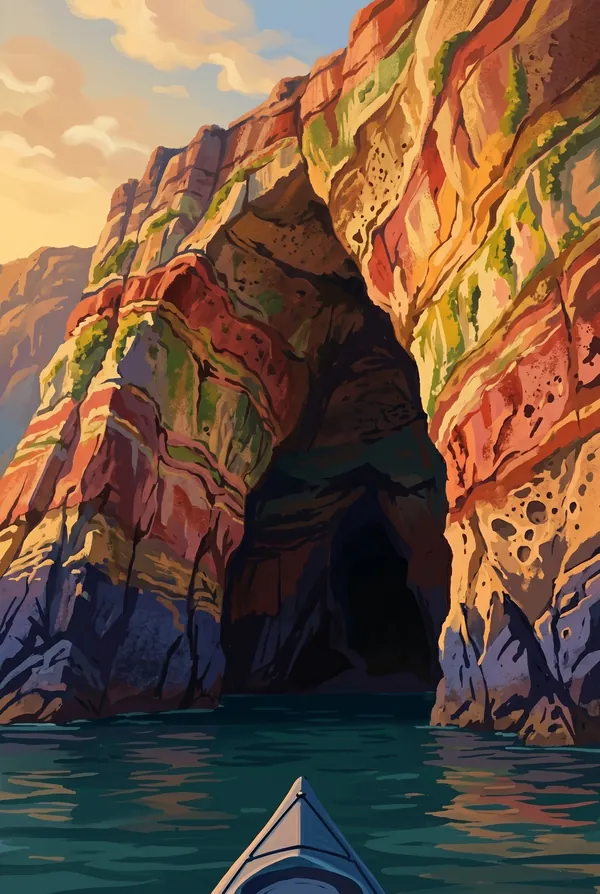
Painted Cave
One of the largest sea caves on Earth, cut into the volcanic cliffs of Santa Cruz Island: roughly a quarter mile deep, with an entrance around 160 feet high, named for the lichens and mineral stains coloring its walls. It is enterable only by boat or kayak, and sea lions haul out in the dark interior. A stamp for people who went in.
Island Fox
The park's animal, not a place: a fox the size of a housecat, six islands with six subspecies, descended from mainland gray foxes that reached the islands thousands of years ago. Nearly lost in the 1990s, recovered by 2016 in record time. Pick it if one trotted through your campground like it owned the place; on Santa Cruz, one probably did.
How to record your Channel Islands visit
Free, and it works whether you are standing there now or remembering a trip from years ago.
1
Check In at the park
Open ParkStamp inside the park boundary and check in. The app confirms you are actually there and logs the date.
2
Or Stamp It later
Already been? Pick the date yourself. Trips from decades ago count the same as last weekend.
3
Or scan your photos
Let ParkStamp read the dates and locations off photos already on your phone. Most people find parks they had forgotten.
Channel Islands, asked and answered
Quick answers, for people planning a trip and people remembering one.
When is the best time to visit Channel Islands?
There is no closed season, only different ones. Late winter and spring turn the islands green and bloom the giant coreopsis, with gray whales passing on migration. Summer is prime for kayaking, diving in the kelp, and blue whales feeding in the channel. Fall often brings the calmest seas and clearest water of the year. Winter crossings can be rough and wet, but the islands are at their emptiest.
How many days do you need at Channel Islands?
It runs on boat schedules, so think in whole days. A day trip to Anacapa or the Scorpion Anchorage end of Santa Cruz covers sea cliffs, kelp coves and probably a fox. Camping overnight is the real unlock: the islands after the last boat leaves are a different park. Santa Rosa and San Miguel are longer crossings that reward two or three days.
How busy is Channel Islands?
Channel Islands National Park logged 227,186 visits in 2025, the 51st busiest of the 63 national parks. That makes it one of the quieter national parks, and crowds are rarely the problem.
What does the Channel Islands stamp show?
The lead Channel Islands design is Arch Rock. A forty-foot arch of volcanic rock standing in the sea off the east end of Anacapa, near the 1932 light station, the last permanent lighthouse built on the West Coast. It is the first thing the boat shows you and the image on half the park's literature. The obvious pick if the crossing itself is what you remember. The other two designs are Painted Cave and Island Fox.
Is the Channel Islands stamp free?
Recording your Channel Islands visit is always free: check in at the park, add an old trip, or let the photo scan find it. The full-color art is the paid part, $3.99 one-time with three Channel Islands designs to choose from, and the first stamp you collect in ParkStamp is free.
Can I add a Channel Islands trip from years ago?
Yes. Open Channel Islands in ParkStamp, tap Stamp It, and set the date yourself; a visit from decades ago counts the same as last weekend. If you still have photos from the trip, the photo scan can find and date it from their location tags, without your photos ever leaving your phone.
Do I have to be at Channel Islands to get the stamp?
No. Check In is for when you are standing inside Channel Islands, and it confirms you are actually there. Stamp It records any past visit on your honor, with your dates. Both are free and put the same stamp in your StampBook.
Start your StampBook with Channel Islands
Free on iOS and Android. Your first stamp is on us.