America's second national park was created in 1890 to stop loggers from felling trees so large that the wood shattered on impact and was mostly good for fence posts. It holds the largest living tree on Earth, and its eastern boundary crosses the highest summit in the contiguous United States.
Sequoia is one of 63 national parks in ParkStamp, each with its own original stamp designs drawn in the WPA poster tradition. Every design depicts a specific real place inside the park, rendered the way the 1930s poster artists would have.
The record of your visit is free. Check in on the spot, add a trip from a decade ago, or let the app work out dates and places from the photos your phone already holds.
The real NPS boundary, with the roads and towns you would actually use to get there.
Sequoia, for people who count parks
Socialists named the biggest tree Karl Marx, and the Army sent Black cavalry to guard it.
September 25, 1890 made it the second national park, after Yellowstone. Six days later a second act tripled its size and created General Grant and Yosemite National Parks in the same stroke, the closest thing the 19th century had to a park system arriving at once. The urgency was real: sawmills were already working the sequoia belt, even though the brittle wood of the biggest trees splintered when they fell, and much of the harvest ended up as shingles, stakes and fence posts.
The Giant Forest was claimed by a socialist utopia first. The Kaweah Colony filed on the land in 1885, spent four years hand-building a road up from the foothills, and named the largest tree on Earth the Karl Marx Tree. The park's creation extinguished their claims without compensation, and historians still argue about how much quiet help the park bill got from railroad interests. The tree kept its other name: General Sherman.
In 1903 the park was run by Captain Charles Young, the only Black commissioned officer then serving in the U.S. Army, who led Buffalo Soldiers of the 9th Cavalry as acting superintendent, the first Black superintendent of any national park. In one summer his troops finished the wagon road into the Giant Forest that previous crews had crept along for years.
The park runs from foothill chaparral to the roof of the Lower 48. Its floor sits near 1,300 feet; its eastern edge crosses the 14,505-foot summit of Mount Whitney, the highest point in the contiguous United States. No road crosses that interior; the High Sierra section is reachable only on foot. Since the Second World War, Sequoia has been administered jointly with Kings Canyon next door as a single two-park unit.
A tree that needs fire, and a century that tried to protect it from exactly that.
Giant sequoias are not the tallest trees or the widest; they are the heaviest. By trunk volume nothing alive matches them. They grow naturally in only about 70-odd groves on the western slope of the Sierra Nevada, in a band of mid-elevation forest with the precise snowpack they require, and nowhere else on Earth.
They depend on fire. Sequoia cones can hang closed on the branch for decades until heat opens them, and seedlings establish best on the bare, ashy soil a fire leaves behind. A century of diligent fire suppression therefore nearly stopped their reproduction while stacking the forest with fuel. Sequoia was where the Park Service began deliberately reintroducing fire in the 1960s, among the first places in the country to burn on purpose.
The reckoning arrived anyway. After decades of accumulated fuel and a deep drought, the fires of 2020 and 2021 burned hot enough to kill monarchs that had survived thousands of years of ordinary flame: park estimates put the loss at 13 to 19 percent of all large sequoias in existence, in two years. The groves around the main visitor areas came through, partly because they had been treated with prescribed fire for decades.
Off the big trees, the park runs on black bears, mule deer and marmots, with two quieter recovery stories in progress: the Pacific fisher, a tree-hunting relative of the wolverine that dens in big old trunks, and the mountain yellow-legged frog, being restored lake by lake in the high country after fungus and introduced trout nearly finished it.
The Sequoia designs
Pick the one that matches the park you actually saw.
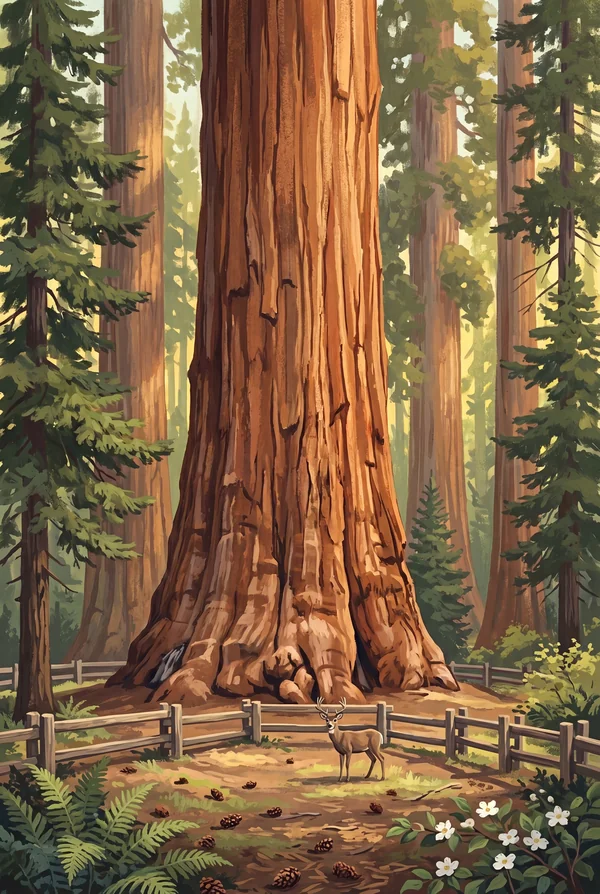
General Sherman Tree
The largest living tree on Earth by volume: about 52,500 cubic feet of trunk, 275 feet tall, roughly 36 feet across at the base, and around 2,200 years old. The Kaweah colonists called it the Karl Marx Tree. Choosing it as your stamp is choosing the single most superlative organism the park system contains.
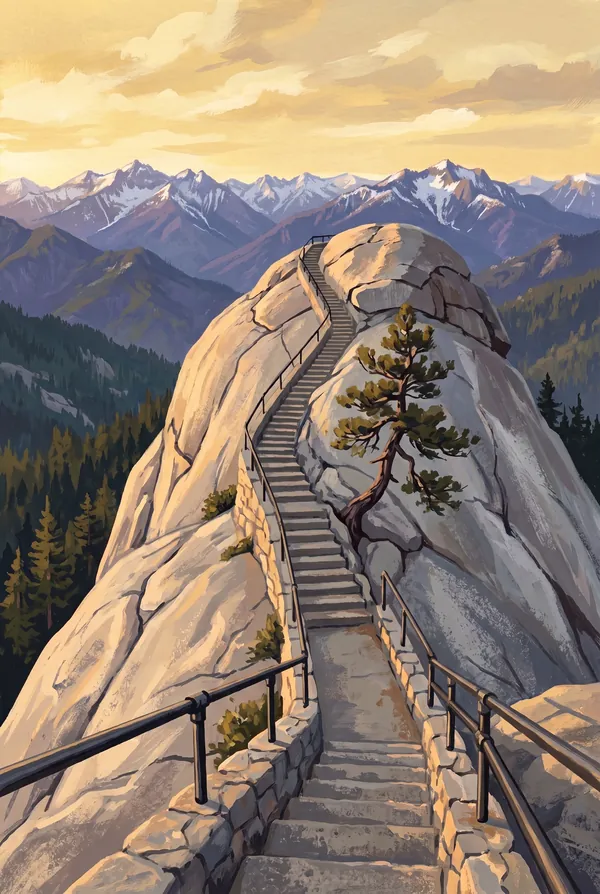
Moro Rock Summit View
A bare granite dome standing off the edge of the Giant Forest plateau at 6,725 feet, climbed by a stairway blasted into the rock in 1931 (nearly 400 steps, now on the National Register of Historic Places). From the railed summit the Great Western Divide saws across the sky and the foothills drop away a mile below.
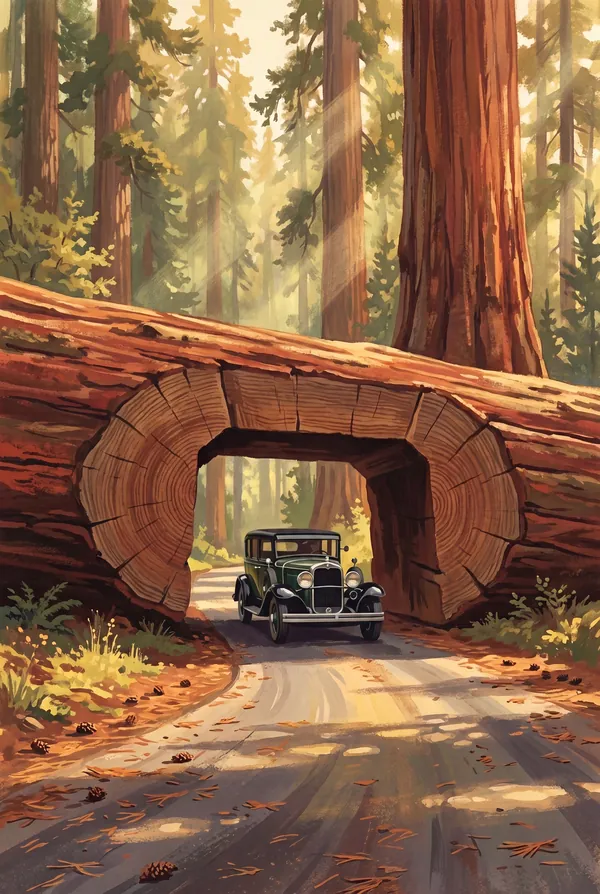
Tunnel Log
A sequoia 275 feet tall and 21 feet through that fell across the Crescent Meadow road in December 1937; a tunnel was cut through it the following summer rather than moving it. Unlike the tunnels once carved through living giants, this one cost the tree nothing; it was already down. Cars have been driving through it ever since.
How to record your Sequoia visit
Free, and it works whether you are standing there now or remembering a trip from years ago.
1
Check In at the park
Open ParkStamp inside the park boundary and check in. The app confirms you are actually there and logs the date.
2
Or Stamp It later
Already been? Pick the date yourself. Trips from decades ago count the same as last weekend.
3
Or scan your photos
Let ParkStamp read the dates and locations off photos already on your phone. Most people find parks they had forgotten.
Sequoia, asked and answered
Quick answers, for people planning a trip and people remembering one.
When is the best time to visit Sequoia?
June through September gives full access to the high country and Mineral King. But the Giant Forest sits near 6,500 feet, and many regulars argue for it in snow, when the cinnamon trunks stand out of white silence and crowds vanish; bring chains and check nps.gov on winter road conditions. Spring belongs to the foothills, with wildflowers and rushing rivers along the Kaweah while the sequoia belt is still melting out.
How many days do you need at Sequoia?
Two days is right. Spend the first entirely in the Giant Forest: General Sherman, the Congress Trail, Moro Rock and Crescent Meadow through Tunnel Log. Use the second for Crystal Cave, the foothills, or, in summer, if you can face the long switchbacked drive, Mineral King's subalpine valley. Add days freely if the backcountry is calling; most of the park has no road at all.
How busy is Sequoia?
Sequoia National Park logged 1.38 million visits in 2025, the 23rd busiest of the 63 national parks. That puts it in the middle of the pack: busy at the famous spots, quiet a mile past them.
What does the Sequoia stamp show?
The lead Sequoia design is General Sherman Tree. The largest living tree on Earth by volume: about 52,500 cubic feet of trunk, 275 feet tall, roughly 36 feet across at the base, and around 2,200 years old. The Kaweah colonists called it the Karl Marx Tree. Choosing it as your stamp is choosing the single most superlative organism the park system contains. The other two designs are Moro Rock Summit View and Tunnel Log.
Is the Sequoia stamp free?
Recording your Sequoia visit is always free: check in at the park, add an old trip, or let the photo scan find it. The full-color art is the paid part, $3.99 one-time with three Sequoia designs to choose from, and the first stamp you collect in ParkStamp is free.
Can I add a Sequoia trip from years ago?
Yes. Open Sequoia in ParkStamp, tap Stamp It, and set the date yourself; a visit from decades ago counts the same as last weekend. If you still have photos from the trip, the photo scan can find and date it from their location tags, without your photos ever leaving your phone.
Do I have to be at Sequoia to get the stamp?
No. Check In is for when you are standing inside Sequoia, and it confirms you are actually there. Stamp It records any past visit on your honor, with your dates. Both are free and put the same stamp in your StampBook.
Start your StampBook with Sequoia
Free on iOS and Android. Your first stamp is on us.