A third of this park is above the treeline. The road across the top stays open about five months a year, and the crews who open it dig through drifts twenty feet deep to do it.
Rocky Mountain is one of 63 national parks in ParkStamp, and like every park it has original stamp designs drawn in the WPA poster tradition. Each one is an illustration of a specific place you can go stand.
Recording the visit is free. Check in at the park, add a trip from years ago, or let the app read the dates off photos already on your phone.
The real NPS boundary, with the roads and towns you would actually use to get there.
Rocky Mountain, for people who count parks
The man who won the park lost the argument about how big it should be.
Signed January 26, 1915, by Woodrow Wilson. Depending on how you count General Grant National Park, which was absorbed into Kings Canyon in 1940, this was either the ninth or the tenth national park. Collectors argue about it. Both answers are defensible.
Enos Mills got it done and did not get what he wanted. He moved to Colorado at 14 for his health, homesteaded below Longs Peak, and ran an inn. A chance meeting with John Muir on a San Francisco beach in 1889 turned him into an activist. He was a publicist, not a legislator: lecture tours, fifteen books, photographs, and a coalition that reached from the Sierra Club to the Daughters of the American Revolution. He campaigned for a park of about 1,000 square miles. Mining, grazing and timber interests cut it down again and again, and the park that passed was about 358 square miles, roughly a third of what he asked for. He was called the father of the park afterward, though Mary Belle King Sherman and others were just as central. He then fell out bitterly with the new Park Service over transportation concessions and died at 52.
Trail Ridge Road is the highest continuous paved road in the country, topping out at 12,183 feet. Keep the word continuous: two Colorado roads go higher, but both are dead-end spurs to a summit. Eleven miles of Trail Ridge sit above the treeline, and it runs 20 to 30 degrees colder up there than in Estes Park.
Opening it every spring is the real story. Plowing starts in mid-April with crews working toward each other from both sides until they meet at the Alpine Visitor Center, which at 11,796 feet is the highest visitor center in the entire park system. In 2013 they were cutting through drifts averaging 18 to 22 feet. The road usually opens the last week of May and closes in mid-October. Earliest opening on record was May 7. Latest was June 26.
The Colorado River starts here, at La Poudre Pass in the northwest corner, as something you can step across. Downstream it supplies water to roughly 40 million people.
Including an animal with about five degrees of margin for error.
Pikas, and why they are the ones to watch. Six inches long, related to rabbits rather than rodents, and they do not hibernate. They spend all summer cutting and curing vegetation into haypiles that have to feed them through nine months of alpine winter. Their normal body temperature is 104 degrees and fatal heat stress starts around 109. That is the entire margin. The same dense fur that makes them cold-hardy makes them heat-intolerant, and they also need deep snowpack as insulation to survive the winter under the talus. Warming threatens them from both ends. They have vanished from 44% of Great Basin sites they held 110 years ago. Rocky Mountain's are still doing comparatively well.
Elk, and a problem the park created itself. Elk were hunted out of the Estes Valley by the 1880s. The park's founders brought them back from Yellowstone in 1913, before the park legally existed. Wolves and grizzlies were already gone, so nothing checked them. The herd exploded and stripped the willow and aspen. The Park Service culled directly from 1944 to 1968, then stopped as public attitudes turned, and by the 1990s had an overabundant, concentrated, barely migratory herd doing documented damage. A management plan started in 2008 using fencing, culling and restoration. It worked: willow height up 29%, aspen sapling recruitment doubled.
Bighorn sheep, the park symbol, and the Sheep Lakes crossing. Scabies and pneumonia caught from domestic sheep collapsed the herds by the early 1900s, down to about 150 animals by the 1950s. There are now 300 to 400. In late spring they come down from the Mummy Range to eat mineral-rich soil at Sheep Lakes, which means crossing a road to get there, which is why the park runs a volunteer brigade to stop traffic for them. Ram horns can weigh 30 pounds, about as much as the rest of the animal's skeleton.
Moose, and an argument about whether they belong. The official account is that Colorado released 24 moose in 1978 and 1979 and the first was documented in the park in 1980, making them introduced rather than reintroduced. Researchers publishing in 2025 dispute that, pointing to sightings from the 1860s, an 1863 diary describing cows and calves, the place name Moose Park, Indigenous oral traditions, and archaeological remains. Not settled. What is not disputed: willow is 91% of a moose's summer diet, versus about 15% for elk.
The Rocky Mountain designs
Pick the one that matches the park you actually saw.
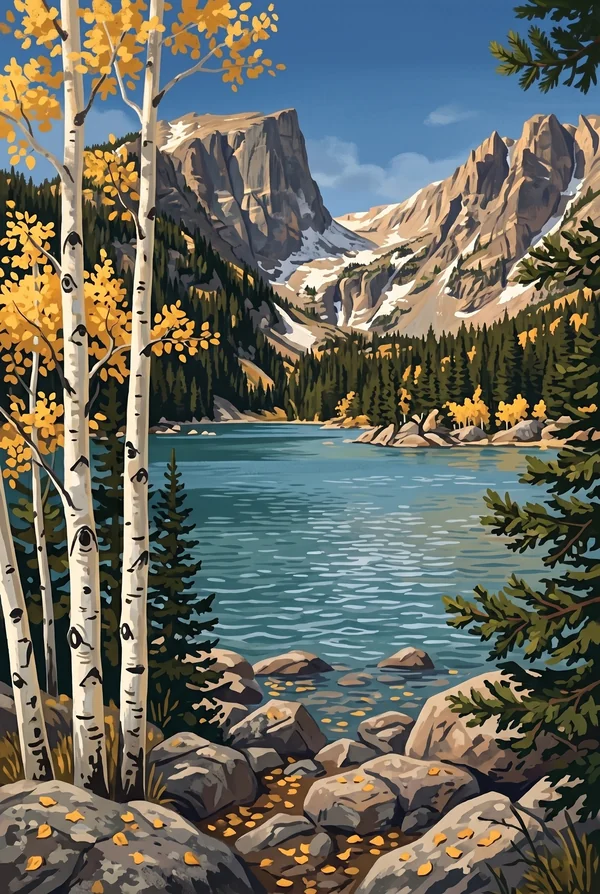
Bear Lake and Hallett Peak
A subalpine lake at 9,475 feet in a glacier-carved basin, and the most visited spot in the park for a simple reason: it is a 0.7-mile loop with 20 feet of elevation gain and it hands you a postcard for almost no effort. Hallett Peak rises straight behind it at about 12,720 feet, its blunt north face one of the most recognizable profiles in Colorado. The classic shot is the reflection in still morning water, which the wind usually destroys by mid-morning.
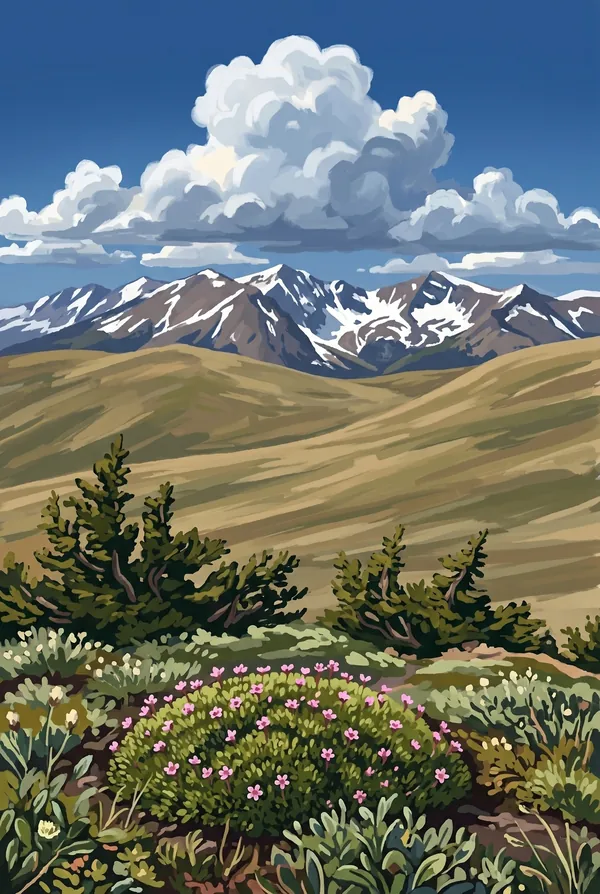
Trail Ridge Road Alpine Tundra
Eleven miles above the treeline, where there are no trees at all, just ground-hugging cushion plants on wind-scoured rock. The growing season is about six weeks. Winter gusts of 98 to 122 miles per hour have been recorded. The road is as much the subject as the tundra: a thin ribbon of asphalt with no shoulders and almost no guardrails, running across the top of a mountain range with nothing above it.
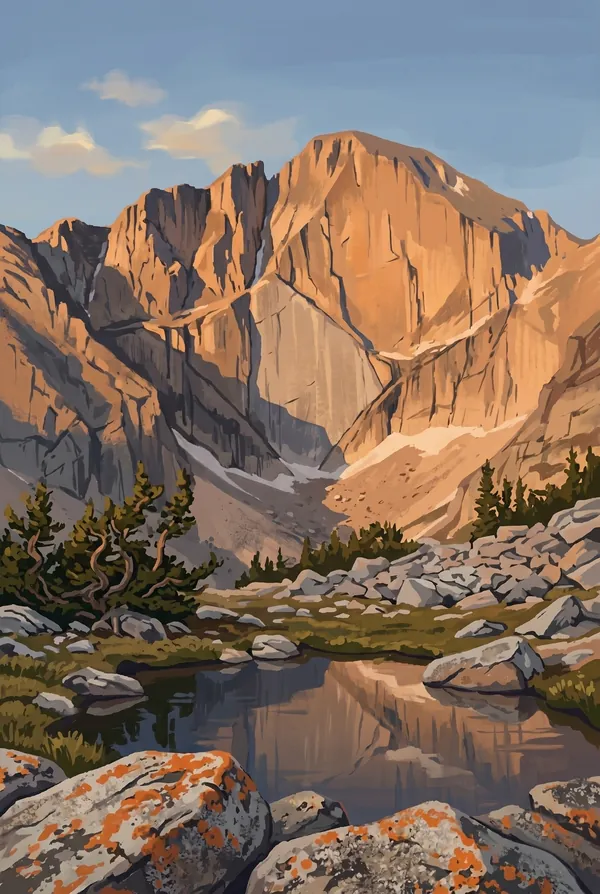
Longs Peak Diamond Face
The Diamond is a sheer 900-foot wall on the upper east face of the park's only fourteener, and the entire thing sits above 13,000 feet. The Park Service refused permission to climb it until 1960. Dave Rearick and Bob Kamps made the first ascent that August. The non-technical Keyhole Route up the mountain is 14.5 miles round trip with nearly 5,000 feet of gain, and it has killed around 60 people. The standard start time is 2 a.m., to be off the summit before the afternoon lightning.
How to record your Rocky Mountain visit
Free, and it works whether you are standing there now or remembering a trip from years ago.
1
Check In at the park
Open ParkStamp inside the park boundary and check in. The app confirms you are actually there and logs the date.
2
Or Stamp It later
Already been? Pick the date yourself. Trips from decades ago count the same as last weekend.
3
Or scan your photos
Let ParkStamp read the dates and locations off photos already on your phone. Most people find parks they had forgotten.
Rocky Mountain, asked and answered
Quick answers, for people planning a trip and people remembering one.
When is the best time to visit Rocky Mountain?
Summer is the classic, with Trail Ridge Road fully open and tundra wildflowers in July, and every trailhead busy by eight in the morning. September may be better: elk bugling in the meadows, aspen gold on the slopes, and the summer crowds back at work. Winter closes the high road and opens the quiet version of the park, snowshoe country under Longs Peak.
How many days do you need at Rocky Mountain?
Two days covers both personalities: one up on Trail Ridge Road among the tundra and marmots, one down in the lake basins, Bear Lake to Emerald Lake, or on to Sky Pond if your legs agree. A third day is for Wild Basin or a real summit attempt.
How busy is Rocky Mountain?
Rocky Mountain National Park logged 4.17 million visits in 2025, the 6th busiest of the 63 national parks. That makes it one of the busiest parks in the system, and early mornings are the quiet hours.
What does the Rocky Mountain stamp show?
The lead Rocky Mountain design is Bear Lake and Hallett Peak. A subalpine lake at 9,475 feet in a glacier-carved basin, and the most visited spot in the park for a simple reason: it is a 0.7-mile loop with 20 feet of elevation gain and it hands you a postcard for almost no effort. Hallett Peak rises straight behind it at about 12,720 feet, its blunt north face one of the most recognizable profiles in Colorado. The classic shot is the reflection in still morning water, which the wind usually destroys by mid-morning. The other two designs are Trail Ridge Road Alpine Tundra and Longs Peak Diamond Face.
Is the Rocky Mountain stamp free?
Recording your Rocky Mountain visit is always free: check in at the park, add an old trip, or let the photo scan find it. The full-color art is the paid part, $3.99 one-time with three Rocky Mountain designs to choose from, and the first stamp you collect in ParkStamp is free.
Can I add a Rocky Mountain trip from years ago?
Yes. Open Rocky Mountain in ParkStamp, tap Stamp It, and set the date yourself; a visit from decades ago counts the same as last weekend. If you still have photos from the trip, the photo scan can find and date it from their location tags, without your photos ever leaving your phone.
Do I have to be at Rocky Mountain to get the stamp?
No. Check In is for when you are standing inside Rocky Mountain, and it confirms you are actually there. Stamp It records any past visit on your honor, with your dates. Both are free and put the same stamp in your StampBook.
Start your StampBook with Rocky Mountain
Free on iOS and Android. Your first stamp is on us.