Rockefeller bought the valley in secret through a front company. When the locals found out, it started a fight that ran for twenty years and ended with Wyoming being permanently exempt from the law that created half the park system.
Grand Teton is one of 63 national parks in ParkStamp, and like every park it has original stamp designs drawn in the WPA poster tradition. Each one is an illustration of a specific place you can go stand.
Recording the visit is free. Check in at the park, add a trip from years ago, or let the app read the dates off photos already on your phone.
The real NPS boundary, with the roads and towns you would actually use to get there.
Grand Teton, for people who count parks
The most contested park creation in American history.
The 1929 park was the mountains only. Signed February 26, 1929, at 96,000 acres, covering the peaks and six lakes at their base, all carved from land the government already owned. The valley floor of Jackson Hole was left out. That was about half the park you can visit today.
Rockefeller bought the valley under a false name. He visited in 1926 with Yellowstone's superintendent, who lobbied him hard, and in 1927 formed the Snake River Land Company specifically so that sellers would not raise their prices on a Rockefeller. The local banker hired to negotiate did not know who he was working for. When it went public in 1930 the valley was furious. Congressional hearings in Jackson in 1933 found most accusations of coercion untrue, though the Park Service had been aggressive with homesteaders lacking clear title.
Congress refused the gift for over a decade. By 1942 Rockefeller issued an ultimatum: take the land or he would sell it off. On March 15, 1943, Roosevelt used the Antiquities Act to create Jackson Hole National Monument by proclamation, no vote required. Four days later a Wyoming congressman introduced a bill to abolish it. Ranchers, including a future governor and the actor Wallace Beery, drove cattle across monument land without permits in protest. The Park Service ignored them. Roosevelt pocket-vetoed the abolition bill in December 1944, and Congress retaliated by refusing to fund the monument at all for years.
The 1950 compromise is why Wyoming is different. Truman signed the merger on September 14, 1950, producing today's roughly 310,000-acre park. The deal compensated Teton County for lost taxes and grandfathered grazing rights. It also barred any future national park or monument in Wyoming without express congressional authorization. Wyoming remains the only state exempt from the Antiquities Act.
Why there are no foothills. The Tetons are the youngest range in the Rockies, and the mechanism is unusual: the valley is dropping faster than the range is rising. Each major earthquake on the Teton fault moves about ten feet total, two to three feet up on the west side and four to six feet down on the east. Nothing transitional accumulates, so the peaks come straight off flat sagebrush. The rock itself is ancient even though the range is not, with gneiss more than 2.7 billion years old.
The most famous individual wild animal in America lived here.
Grizzly 399. Born in 1996, collared in 2001 as the 399th bear in a long-running study, which is where the number came from. She produced at least 22 cubs and grandcubs, usually triplets. In May 2020 she came out of hibernation with four, which is what made her famous well beyond Wyoming. At her death she was the oldest known reproducing female grizzly in the Greater Yellowstone Ecosystem. She was killed by a vehicle on October 22, 2024, on the highway south of Jackson, outside the park. A yearling cub was with her and survived. Between 2009 and 2023, 49 grizzlies died in vehicle collisions in this ecosystem.
Pronghorn, on a migration older than agriculture. They travel about 150 miles each way between Jackson Hole and the Upper Green River Valley, with some animals of the herd covering more than 200. Archaeology at Trapper's Point shows roughly 6,000 years of continuous use of the same route. In 2008 the Forest Service designated 45 miles of it the first federally recognized wildlife migration corridor in the country. Without it, pronghorn would disappear from Grand Teton entirely, because they cannot survive the valley's winters.
The elk refuge next door. The National Elk Refuge was established in 1912, sits immediately south of the park, and holds around 7,500 elk each winter plus more than a thousand bison, the largest single bison herd under federal management. A century-old supplemental feeding program is being phased down because concentrating that many animals spreads brucellosis and chronic wasting disease.
Wolves let themselves in. They were not reintroduced here. They walked down from Yellowstone after the 1995 releases and recolonized on their own.
The Grand Teton designs
Pick the one that matches the park you actually saw.
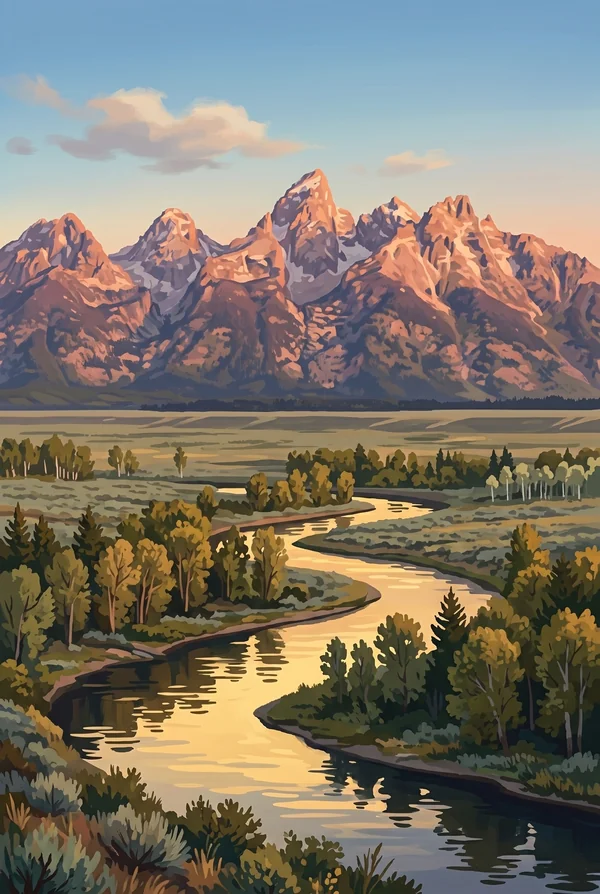
Snake River Overlook
Where Ansel Adams made "The Tetons and the Snake River" in 1942, the river bending through the foreground and the peaks behind. You cannot take that photograph anymore. The Park Service says so on its own page: the trees have grown and the exact spot is not known. The image was encoded onto the Voyager Golden Record and is currently in interstellar space on two spacecraft. A print sold for $988,000 in 2020.
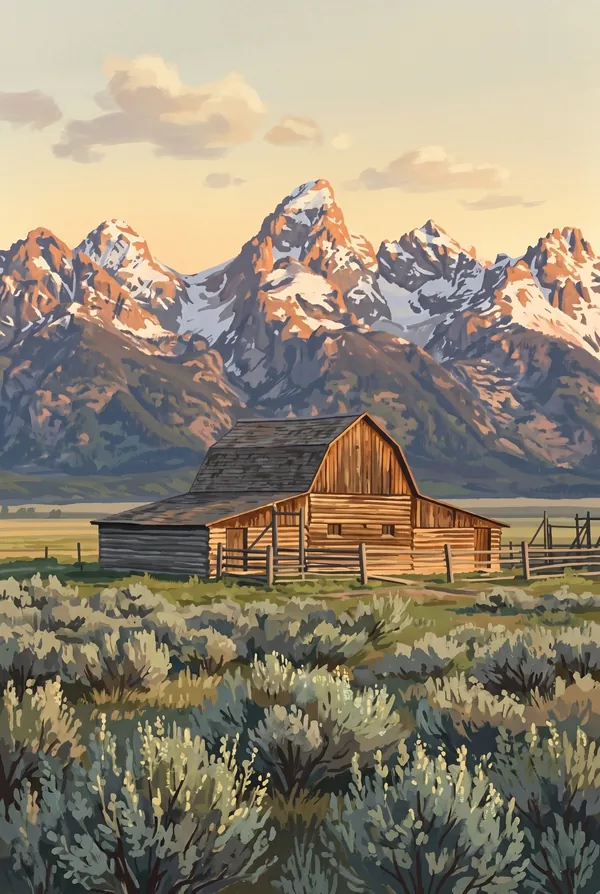
Mormon Row
Two weathered barns on open sagebrush flats with the Teton wall rising directly behind them, unobstructed. LDS families arrived from Idaho in the 1890s and, following settlement doctrine, clustered their homesteads in a row rather than scattering them the way everyone else in Jackson Hole did. Hence the name. Of about 27 original homesteads, six clusters survive.
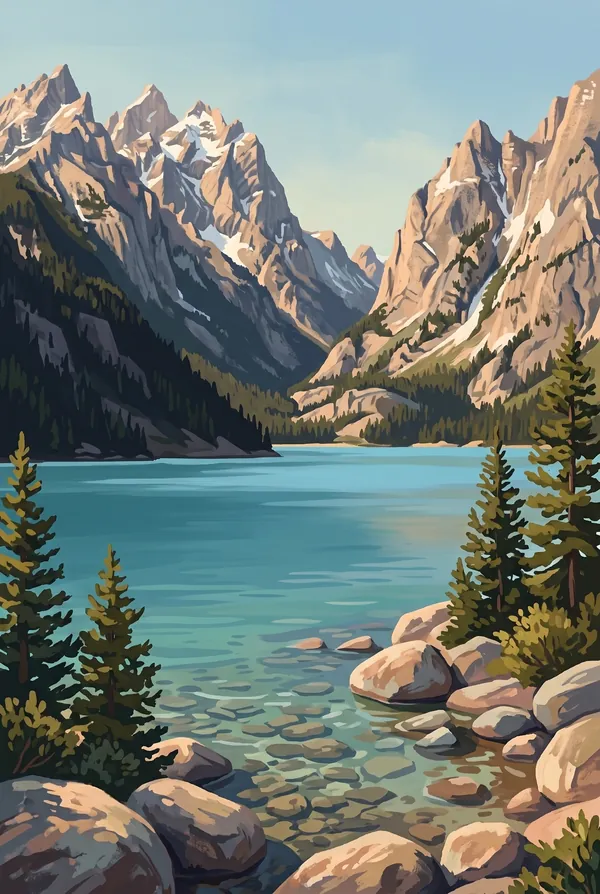
Jenny Lake
Formed about 12,000 years ago when a glacier coming out of Cascade Canyon pushed a pile of rock ahead of itself and then melted, leaving the debris as a dam. Roughly 1,191 acres and 256 feet deep. It was named by the 1872 Hayden Expedition for Jenny, a Shoshone woman married to the trapper who guided the survey. She and their six children died of smallpox four years later.
How to record your Grand Teton visit
Free, and it works whether you are standing there now or remembering a trip from years ago.
1
Check In at the park
Open ParkStamp inside the park boundary and check in. The app confirms you are actually there and logs the date.
2
Or Stamp It later
Already been? Pick the date yourself. Trips from decades ago count the same as last weekend.
3
Or scan your photos
Let ParkStamp read the dates and locations off photos already on your phone. Most people find parks they had forgotten.
Grand Teton, asked and answered
Quick answers, for people planning a trip and people remembering one.
When is the best time to visit Grand Teton?
September, and it is not close: aspens go gold under the peaks, elk bugle across the valley, bull moose stand in the willow flats, and the summer crowds go home. June trades gold for green, wildflowers below peaks still holding snow. Winter is severe and beautiful, the range at its sharpest above a frozen valley floor.
How many days do you need at Grand Teton?
Two days: one for the valley floor, the lakes and the Snake River overlooks, and one to get up into a canyon, Cascade or Paintbrush, where the Tetons stop being scenery and become terrain. Pairing a trip with Yellowstone works, since they touch, but give the Tetons their own days.
How busy is Grand Teton?
Grand Teton National Park logged 3.80 million visits in 2025, the 8th busiest of the 63 national parks. That makes it one of the busiest parks in the system, and early mornings are the quiet hours.
What does the Grand Teton stamp show?
The lead Grand Teton design is Snake River Overlook. Where Ansel Adams made "The Tetons and the Snake River" in 1942, the river bending through the foreground and the peaks behind. You cannot take that photograph anymore. The Park Service says so on its own page: the trees have grown and the exact spot is not known. The image was encoded onto the Voyager Golden Record and is currently in interstellar space on two spacecraft. A print sold for $988,000 in 2020. The other two designs are Mormon Row and Jenny Lake.
Is the Grand Teton stamp free?
Recording your Grand Teton visit is always free: check in at the park, add an old trip, or let the photo scan find it. The full-color art is the paid part, $3.99 one-time with three Grand Teton designs to choose from, and the first stamp you collect in ParkStamp is free.
Can I add a Grand Teton trip from years ago?
Yes. Open Grand Teton in ParkStamp, tap Stamp It, and set the date yourself; a visit from decades ago counts the same as last weekend. If you still have photos from the trip, the photo scan can find and date it from their location tags, without your photos ever leaving your phone.
Do I have to be at Grand Teton to get the stamp?
No. Check In is for when you are standing inside Grand Teton, and it confirms you are actually there. Stamp It records any past visit on your honor, with your dates. Both are free and put the same stamp in your StampBook.
Start your StampBook with Grand Teton
Free on iOS and Android. Your first stamp is on us.