This park had signs telling visitors the glaciers would be gone by 2020. They took the signs down in 2020. The ice is still retreating; the timetable was just wrong, and the two federal agencies that study it still cannot agree on a new one.
Glacier is one of 63 national parks in ParkStamp, and like every park it has original stamp designs drawn in the WPA poster tradition. Each one is an illustration of a specific place you can go stand.
Recording the visit is free. Check in at the park, add a trip from years ago, or let the app read the dates off photos already on your phone.
The real NPS boundary, with the roads and towns you would actually use to get there.
Glacier, for people who count parks
Built by a railroad, and the first international peace park in the world.
Established May 11, 1910, signed by Taft. George Bird Grinnell, a naturalist and magazine editor, first came out on an 1885 hunting trip and spent two decades lobbying for it. He also coined the phrase "Crown of the Continent" in an article in 1901, which is now the name of the whole transboundary ecosystem.
The Great Northern Railway built the lodges as a loss leader. Between roughly 1910 and 1915 the railway put up hotels and backcountry chalets all over the park, in Swiss alpine style, and marketed the place as America's Switzerland. The company president picked the sites himself for their backdrops. The hotels never made money. They were not supposed to. They existed to sell train tickets, and the railway's main line still forms the park's southern boundary. Three of the chalets survive.
The world's first international peace park, 1932. Rotary clubs from Cardston, Alberta and Montana met at the Prince of Wales Hotel over July 4th and 5th, 1931 and passed a resolution proposing it. Both national legislatures agreed within a year, and Waterton Lakes and Glacier were formally joined on June 18, 1932. UNESCO states plainly that it was the first.
About the glaciers, carefully. USGS counts something as a glacier if it covers at least 25 acres, because below that an ice body generally cannot move, and movement is what makes a glacier. There were roughly 150 by that standard about a century ago and there are 26 today. A 2017 USGS study measured 39 named glaciers between 1966 and 2015 and found an average area loss of 39%, with some individual glaciers losing 85%.
The signs, and why this matters. Park signage based on early-2000s modeling told visitors the glaciers would be melted by 2020. They were removed and replaced that year. The park's explanation was that the ice is shrinking in ways more complex than the models predicted, because local thickness, shading and terrain make some glaciers far more persistent than a park-wide average suggests. As of now USGS projects the glaciers gone by the end of the century while the Park Service's own page still says 2030. That is a seventy-year gap between two federal agencies. The retreat is thoroughly documented. The end date is not.
And the night in 1967 that changed how every national park handles bears.
The Night of the Grizzlies, August 13, 1967. Two nineteen-year-old women were killed by grizzly bears in two separate attacks, by two different bears, about ten miles apart, on the same night. The cause was not wilderness. It was garbage. Despite an incinerator installed the year before, the caretaker at Granite Park Chalet had gone back to dumping refuse in the gully behind it deliberately, to draw bears in for tourists to watch. The other bear had been feeding at a camp described afterward as looking like a battlefield strewn with rations. What followed reshaped the entire Park Service: bear-proof containers, cooking areas separated from sleeping areas, food-hanging cables, and a backcountry permit system to cap and track campers. It is the single most consequential wildlife-management night in the agency's history.
Wolverines, and this is the real density record. Researchers have documented more than 50 in the park, which the Park Service states is the densest wolverine population in the lower 48.
Grizzlies, roughly 300 of them, alongside about 600 black bears, counted by analyzing 34,000 hair samples snagged on barbed wire. Glacier anchors one of the largest remaining grizzly populations in the lower 48; they survive in only five recovery areas at all.
Mountain goats, and the uncomfortable reason they follow you. The goats at Logan Pass are habituated, and researchers have found two likely explanations: human presence deters predators, and humans are a salt source. The salt is urine. Goats at natural mineral licks get in, get the salt, and leave, staying near cliffs they can escape to. The Logan Pass goats lick, sleep, feed, lick more, wander far from escape terrain and show measurably less vigilance. The mountain goat was also the Great Northern Railway's logo, which is why it is so bound up with this park's identity.
The Glacier designs
Pick the one that matches the park you actually saw.
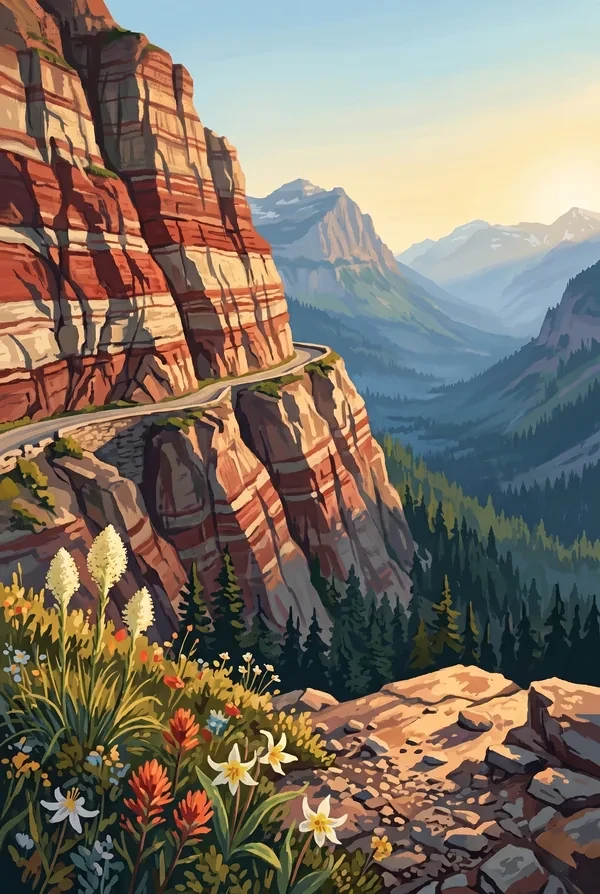
Going-to-the-Sun Road
About 50 miles across the Continental Divide at Logan Pass, 6,646 feet. Built between 1921 and 1932 using almost 500,000 pounds of explosives. The landscape architect who redesigned it cut the switchbacks and held the grade to 6% at higher cost, specifically so the road would disappear into the mountain rather than scar it. Snow at Logan Pass piles up to 80 feet; plowing takes about ten weeks every spring, and the last obstacle is a drift so reliable it has a name.
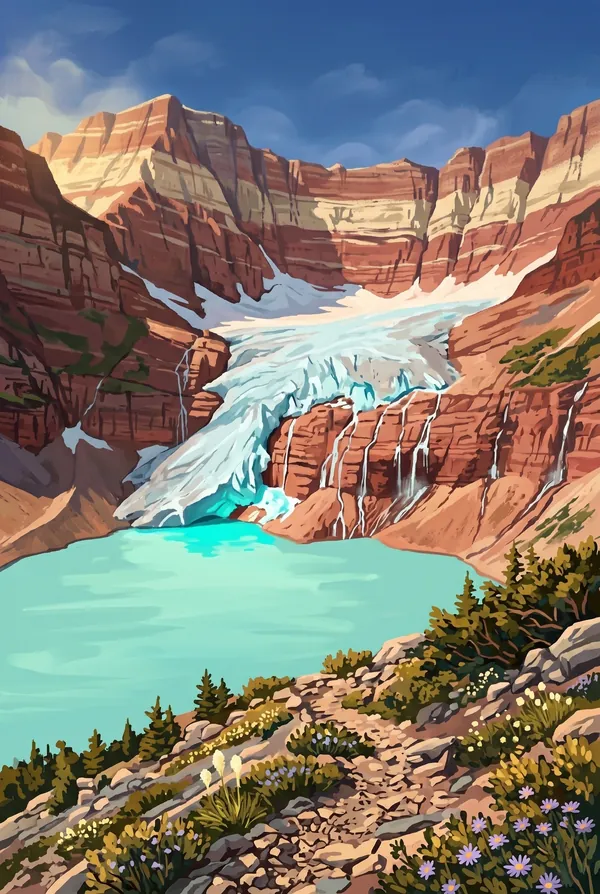
Grinnell Glacier
Named for the man who campaigned the park into existence. It covered 710 acres in 1850 and 220 by 1993, losing almost 40% between 1966 and 2005. It is the most photographed glacier in the USGS repeat-photography project, with 23 matched pairs shot from the same camera stations decades apart. Two things show up in those pairs: the lake below it did not exist in the old photos, and the retreat split the ice, stranding a separate apron above the main glacier.
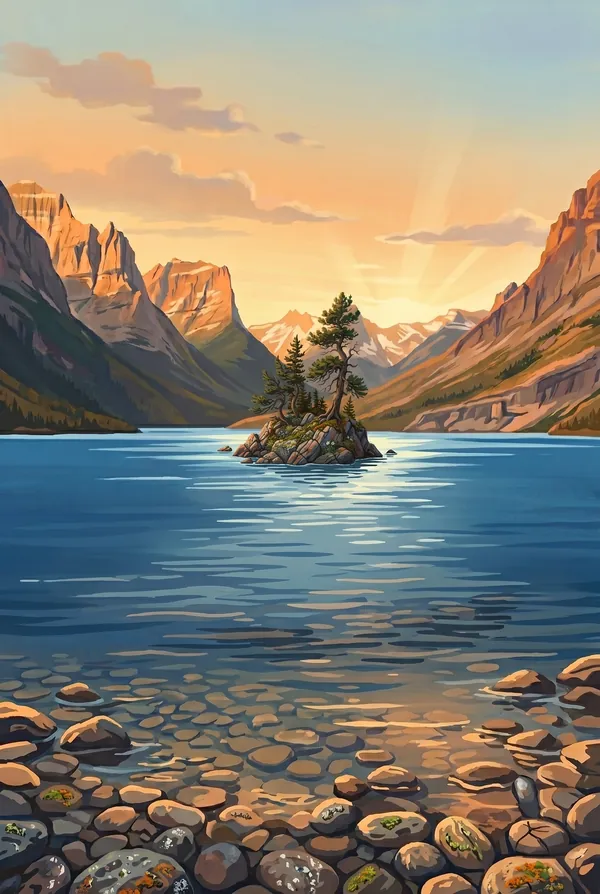
Wild Goose Island
A speck of an island with a few wind-bent conifers on it, sitting in St. Mary Lake with the peaks behind. Its fame is scale. It is also in the first shot of Kubrick's The Shining, where the helicopter tracks the yellow Volkswagen along the lake and up Going-to-the-Sun Road. Unused footage from the same Montana shoot sat in the vault and later supplied the closing aerials of Blade Runner.
How to record your Glacier visit
Free, and it works whether you are standing there now or remembering a trip from years ago.
1
Check In at the park
Open ParkStamp inside the park boundary and check in. The app confirms you are actually there and logs the date.
2
Or Stamp It later
Already been? Pick the date yourself. Trips from decades ago count the same as last weekend.
3
Or scan your photos
Let ParkStamp read the dates and locations off photos already on your phone. Most people find parks they had forgotten.
Glacier, asked and answered
Quick answers, for people planning a trip and people remembering one.
When is the best time to visit Glacier?
High summer, and it is not really a choice: the alpine heart of the park is only reliably snow-free in July and August, once the plows finish with Going-to-the-Sun Road. September is the connoisseur's month, larches turning and grizzlies fattening in the berry patches. Winter hands the high country over to the skiers.
How many days do you need at Glacier?
Three days. Going-to-the-Sun Road deserves a full one with stops, Many Glacier deserves one for the hiking, Grinnell Glacier if you only do one hike, and Two Medicine or the North Fork rewards the third. This is the park people most regret giving a single night.
How busy is Glacier?
Glacier National Park logged 3.14 million visits in 2025, the 10th busiest of the 63 national parks. That makes it one of the busiest parks in the system, and early mornings are the quiet hours.
What does the Glacier stamp show?
The lead Glacier design is Going-to-the-Sun Road. About 50 miles across the Continental Divide at Logan Pass, 6,646 feet. Built between 1921 and 1932 using almost 500,000 pounds of explosives. The landscape architect who redesigned it cut the switchbacks and held the grade to 6% at higher cost, specifically so the road would disappear into the mountain rather than scar it. Snow at Logan Pass piles up to 80 feet; plowing takes about ten weeks every spring, and the last obstacle is a drift so reliable it has a name. The other two designs are Grinnell Glacier and Wild Goose Island.
Is the Glacier stamp free?
Recording your Glacier visit is always free: check in at the park, add an old trip, or let the photo scan find it. The full-color art is the paid part, $3.99 one-time with three Glacier designs to choose from, and the first stamp you collect in ParkStamp is free.
Can I add a Glacier trip from years ago?
Yes. Open Glacier in ParkStamp, tap Stamp It, and set the date yourself; a visit from decades ago counts the same as last weekend. If you still have photos from the trip, the photo scan can find and date it from their location tags, without your photos ever leaving your phone.
Do I have to be at Glacier to get the stamp?
No. Check In is for when you are standing inside Glacier, and it confirms you are actually there. Stamp It records any past visit on your honor, with your dates. Both are free and put the same stamp in your StampBook.
Start your StampBook with Glacier
Free on iOS and Android. Your first stamp is on us.