This is a park in two halves with a metropolitan area of a million people sitting between them. Both halves exist to protect a single species of cactus that can take half a century to grow its first arm and can outlive everyone who ever photographed it.
Saguaro is one of the 63 national parks in ParkStamp, and like all of them it gets original stamp designs in the WPA poster tradition, each one an illustration of an actual place in the park you can stand in front of.
Logging the visit is free. Check in from the park itself, backfill a trip from years back, or let the app read the dates and locations off the photos already on your phone.
The real NPS boundary, with the roads and towns you would actually use to get there.
Saguaro, for people who count parks
A monument created to save a forest that then appeared to start dying.
Herbert Hoover protected it on March 1, 1933, in his final days in office, using the Antiquities Act to make Saguaro National Monument out of the Cactus Forest at the foot of the Rincon Mountains east of Tucson. The push came largely from University of Arizona scientists, who considered that stand of giant saguaros the finest anywhere.
Then the finest stand anywhere started to collapse. Beginning in the 1940s the monument's huge old cacti died faster than young ones replaced them, and for a while researchers treated it as an epidemic; a bacterial disease was blamed. The eventual explanation was less dramatic and more instructive: a hard freeze, an aging cohort, and decades of cattle grazing and woodcutting that had stripped away the nurse trees and trampled the seedlings, so an old forest simply was not being followed by a young one. With grazing ended, the forest has been filling back in for decades.
John F. Kennedy added the second half in 1961, attaching the Tucson Mountain District west of the city, lower and hotter ground carrying some of the densest saguaro stands in the country. That gave the park its permanent geometry: two districts facing each other across Tucson, about thirty miles apart, with no park land between.
Congress made it a national park on October 14, 1994. The upgrade changed the name more than the ground, but the ground is stranger than it looks: the eastern district climbs from desert floor to over 8,600 feet on Mica Mountain, high enough for pine and fir forest with black bears in it. It is a sky island, a cool, wet mountain range marooned in desert, so one park runs from cactus to conifers in a single afternoon's climb.
A cactus that is less an individual plant than a piece of infrastructure.
A saguaro's first years are spent hiding. Seedlings survive almost only in the shade of a nurse tree, usually a palo verde or mesquite, and growth is nearly invisible: a plant a decade old can be small enough to cover with a coffee cup. Arms commonly wait fifty to a hundred years. The giants pushing forty feet, ribs swollen with stored water after a rain, have generally been standing since before Arizona was a state.
The bloom is a night shift. Saguaro flowers open after dark in late spring and close by the following afternoon, each one lasting less than a day. Overnight they are worked by nectar-feeding bats, principally the lesser long-nosed bat migrating up from Mexico; by morning the doves and bees take over. The waxy white blossom is Arizona's state flower, and the fruit that follows has been harvested by the Tohono O'odham for centuries.
A standing saguaro is an apartment block. Gila woodpeckers and gilded flickers chisel nest cavities into the flesh, which the cactus seals into a hard-walled hollow called a boot. Abandoned holes pass down to elf owls, cactus wrens, kestrels and honeybees. Even a dead saguaro keeps working: its woody ribs stand for years and shelter another shift of tenants.
The rest of the cast is classic Sonoran Desert: javelina moving in family groups at dusk, desert tortoises, Gila monsters, coyotes, and roadrunners. The eastern district adds white-tailed deer and black bears in its high country, which is not a sentence most people expect from a cactus park.
The Saguaro designs
Pick the one that matches the park you actually saw.
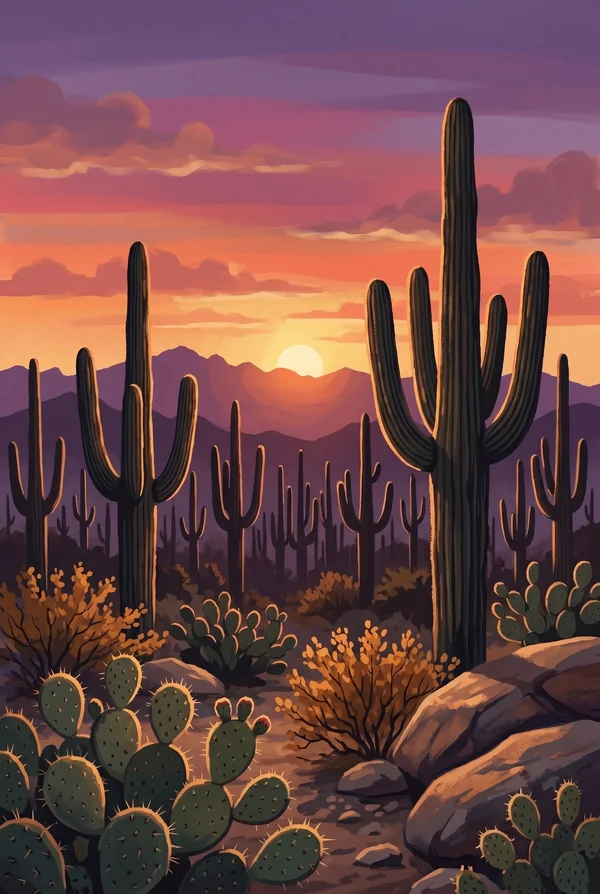
Saguaro Forest
The stand that started it all: the Cactus Forest of the Rincon foothills, protected since 1933 and slowly refilling with young saguaros after its mid-century decline. A loop drive and flat trails put you inside thousands of giants at once. As the image on a stamp, it is the park reduced to one word.
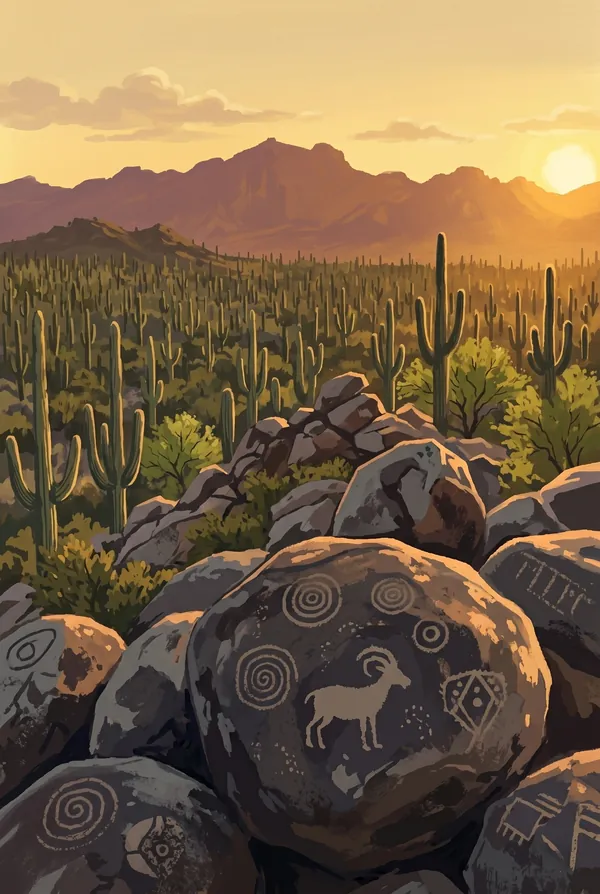
Signal Hill Petroglyphs
A low rock knoll in the western district where Hohokam people pecked dozens of figures into the desert varnish centuries before Europeans reached the continent: spirals, animals, human forms. A short trail climbs past them with saguaro country spread out behind. The famous spiral, its meaning still argued over, makes a stamp with a built-in mystery.
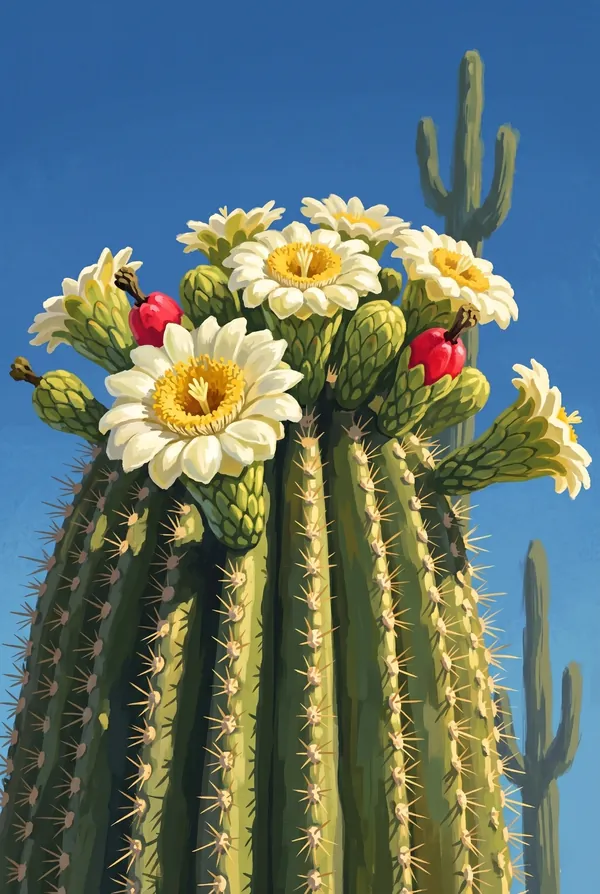
Saguaro in Bloom
For a few weeks in late spring the tips of the arms crown with white flowers that open at night and die by the next afternoon, pollinated in the dark by migrating bats. A single large saguaro can put out a hundred blooms in a season. It is the state flower of Arizona, caught at the one moment the giant is delicate.
How to record your Saguaro visit
Free, and it works whether you are standing there now or remembering a trip from years ago.
1
Check In at the park
Open ParkStamp inside the park boundary and check in. The app confirms you are actually there and logs the date.
2
Or Stamp It later
Already been? Pick the date yourself. Trips from decades ago count the same as last weekend.
3
Or scan your photos
Let ParkStamp read the dates and locations off photos already on your phone. Most people find parks they had forgotten.
Saguaro, asked and answered
Quick answers, for people planning a trip and people remembering one.
When is the best time to visit Saguaro?
October through April, when the desert is walkable all day and the light is low and long. March can add wildflowers under the cacti in a good rain year. The saguaros themselves bloom in late May and June, worth the rising heat if the white crowns of flowers are what you came for. High summer is genuinely dangerous for midday hiking, though the July and August monsoon storms build skies the poster artists would have loved.
How many days do you need at Saguaro?
One day works: the eastern Cactus Forest loop in the morning, the denser western stands and Signal Hill toward sunset, with Tucson conveniently in between for lunch. A second day lets you actually hike, up into the Rincon high country from the east side or among the giants on the west side's Hugh Norris ridge, instead of admiring everything from the loop drives.
How busy is Saguaro?
Saguaro National Park logged 847,749 visits in 2025, the 28th busiest of the 63 national parks. That puts it in the middle of the pack: busy at the famous spots, quiet a mile past them.
What does the Saguaro stamp show?
The lead Saguaro design is Saguaro Forest. The stand that started it all: the Cactus Forest of the Rincon foothills, protected since 1933 and slowly refilling with young saguaros after its mid-century decline. A loop drive and flat trails put you inside thousands of giants at once. As the image on a stamp, it is the park reduced to one word. The other two designs are Signal Hill Petroglyphs and Saguaro in Bloom.
Is the Saguaro stamp free?
Recording your Saguaro visit is always free: check in at the park, add an old trip, or let the photo scan find it. The full-color art is the paid part, $3.99 one-time with three Saguaro designs to choose from, and the first stamp you collect in ParkStamp is free.
Can I add a Saguaro trip from years ago?
Yes. Open Saguaro in ParkStamp, tap Stamp It, and set the date yourself; a visit from decades ago counts the same as last weekend. If you still have photos from the trip, the photo scan can find and date it from their location tags, without your photos ever leaving your phone.
Do I have to be at Saguaro to get the stamp?
No. Check In is for when you are standing inside Saguaro, and it confirms you are actually there. Stamp It records any past visit on your honor, with your dates. Both are free and put the same stamp in your StampBook.
Start your StampBook with Saguaro
Free on iOS and Android. Your first stamp is on us.