The Rio Grande runs 118 miles along this park's southern edge, making the turn that names it. Big Bend has recorded more kinds of birds, bats and cacti than any other US national park, and in 1971 a graduate student walking its badlands found the bones of the largest flying animal ever discovered.
Big Bend is one of 63 national parks in ParkStamp, each with original stamp art drawn in the WPA poster tradition. Every design is a picture of a specific place in the park: somewhere you can actually go stand.
Recording the visit is free. Check in on the spot, add the trip you took a decade ago, or let the app pull the dates and locations from the photos on your phone.
The real NPS boundary, with the roads and towns you would actually use to get there.
Big Bend, for people who count parks
Texas's first national park, delivered in the middle of a world war.
Established June 12, 1944, six days after D-Day. Texas bought the land, hundreds of thousands of acres of desert and mountain, and deeded it to the federal government, and the paperwork went through while the war did; with gasoline rationed, almost nobody could drive out to see the new park. The groundwork was older: Civilian Conservation Corps crews had spent the 1930s building the road up into the Chisos Basin and the stone cottages that still stand there, much of it with hand tools.
The Chisos are the only mountain range entirely inside one national park. They work as a sky island: a cool, wooded range surrounded on all sides by Chihuahuan Desert, topping out at Emory Peak, 7,825 feet. Forest stranded on the high slopes since the ice age (Douglas-fir, Arizona cypress, even a few stands of quaking aspen) survives up there like a museum collection, with the nearest anything similar across the river in Mexico's Sierra del Carmen.
The largest flying animal ever found came out of this ground. In 1971 Douglas Lawson, a University of Texas graduate student doing field work in the park, found the wing bones of a pterosaur later named Quetzalcoatlus northropi, after the Aztec feathered serpent. Wingspan estimates run to 36 feet and beyond, the proportions of a small aircraft, and half a century later it still sits at or near the top of every list of the largest creatures ever to fly.
The river is the border, and the ecosystem ignores it. The Rio Grande forms 118 miles of the park's edge, running through three great limestone canyons: Santa Elena, Mariscal and Boquillas. Across the water sit Mexican protected lands, so the desert functions as one binational system whatever the maps say. Big Bend is also among the most remote parks in the lower 48, with some of the darkest measured night skies of any of them; on a moonless night the sky is the main event.
More birds than any other park, and a bear that walked back.
More than 450 bird species, the longest list of any US national park. The park stacks river, desert and mountain habitats along a major migration corridor, which is how one place logs that many. The prize is the Colima warbler, a small gray-and-yellow bird that nests in the oak canyons of the Chisos and, in the United States, essentially nowhere else. Birders fly across the country and then climb for hours to add it to a life list.
The black bears came back on their own. Shot and trapped out by the middle of the 20th century, they were absent for decades until, in the late 1980s, bears from the Sierra del Carmen crossed the desert and the river and recolonized the Chisos. Nobody moved them; they walked. The park now holds a small breeding population, one of the few large-mammal recoveries in the country that required no reintroduction program at all.
It leads the park system in bats and cacti too. Roughly twenty bat species work the night shift, including the endangered Mexican long-nosed bat, which follows the agave bloom north each year and drinks from the flower stalks like an oversized hummingbird. On the ground, more cactus species grow here than in any other national park, and in a wet spring the desert floor blooms in relays for weeks.
The Big Bend designs
Pick the one that matches the park you actually saw.
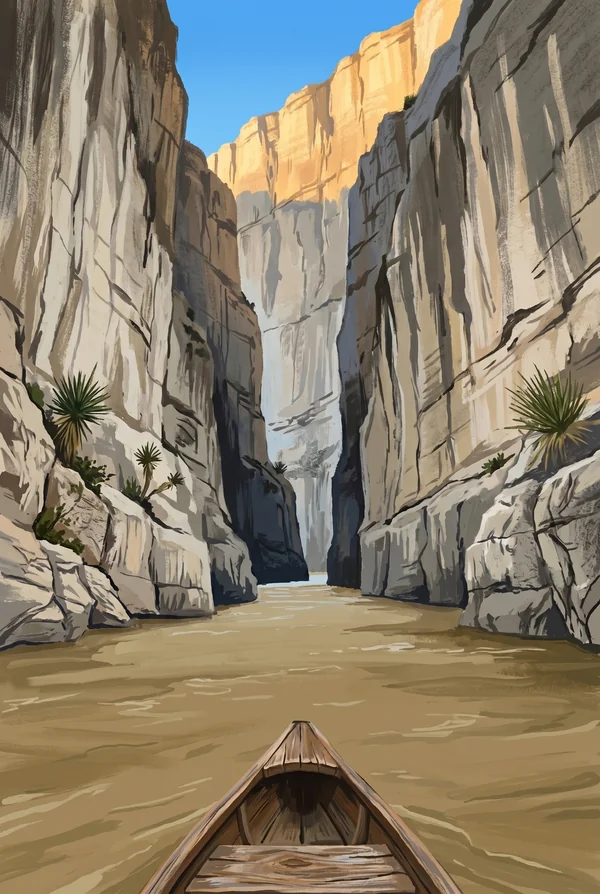
Santa Elena Canyon
The Rio Grande exits a limestone slot with walls up to 1,500 feet: Mexico on the left wall, Texas on the right. A short trail crosses Terlingua Creek and climbs into the canyon mouth until the walls close in and the river fills the floor. Late afternoon, when the cliff face catches the sun, is when the famous photograph gets taken.
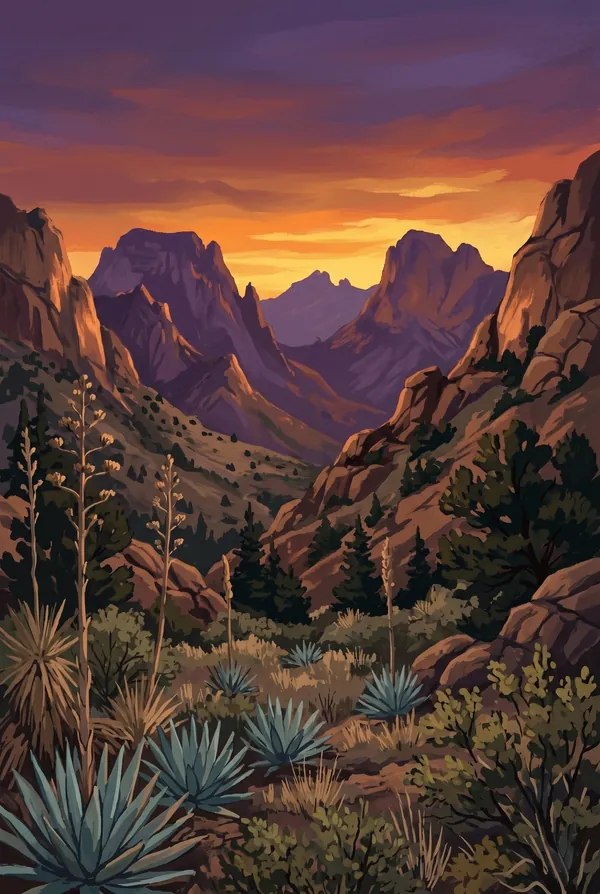
Chisos Basin
A high bowl walled in by the only mountain range contained entirely within one national park, with Casa Grande's square summit standing over it. The Basin runs reliably cooler than the desert floor, which is why the CCC put the road in during the 1930s and why summer visitors retreat here. Trails to Emory Peak and the South Rim start at its edge.
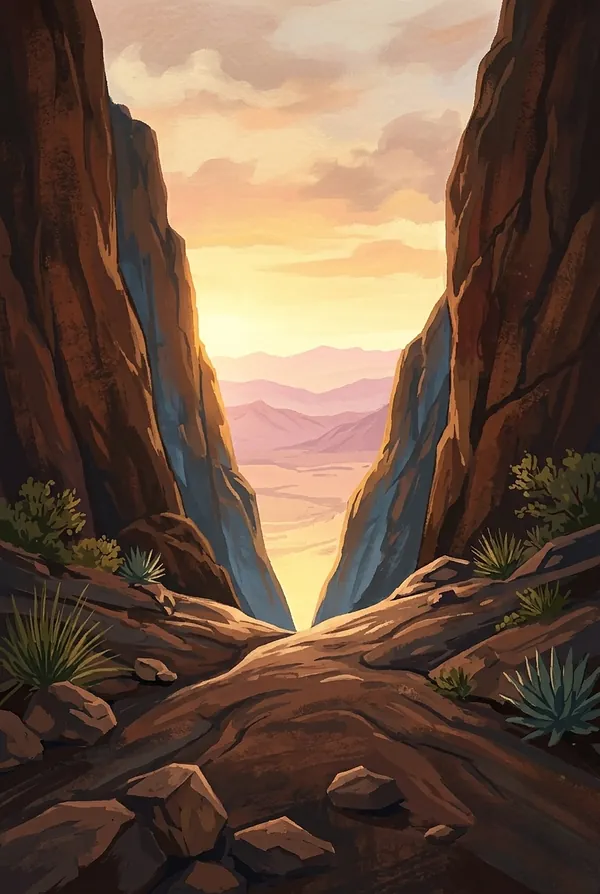
The Window
The V-shaped notch that drains the entire Chisos Basin, its pour-off polished smooth by every storm the mountains have ever shed. It frames a single wedge of desert far below, and at the right times of year the sun sets dead center in the notch. The walk out is easy; the polished lip at the end is not a place to hurry.
How to record your Big Bend visit
Free, and it works whether you are standing there now or remembering a trip from years ago.
1
Check In at the park
Open ParkStamp inside the park boundary and check in. The app confirms you are actually there and logs the date.
2
Or Stamp It later
Already been? Pick the date yourself. Trips from decades ago count the same as last weekend.
3
Or scan your photos
Let ParkStamp read the dates and locations off photos already on your phone. Most people find parks they had forgotten.
Big Bend, asked and answered
Quick answers, for people planning a trip and people remembering one.
When is the best time to visit Big Bend?
October through April. Winter is the season here: mild desert days, cold nights, and the river canyons at their best. Late winter into early spring brings the bloom, bluebonnets first and cactus after. Summer pushes the desert floor past 110°F, though the Chisos Basin, thousands of feet higher, stays livable; late-summer storms turn the desert briefly, violently green.
How many days do you need at Big Bend?
Three days, one per landscape: a river day for Santa Elena Canyon and the Ross Maxwell drive, a mountain day in the Chisos for the Window or the South Rim, and a desert day for the hot springs and Boquillas Canyon on the east side. Distances are serious (the park is bigger than Rhode Island), so plan around drive times, not mileage.
How busy is Big Bend?
Big Bend National Park logged 568,104 visits in 2025, the 38th busiest of the 63 national parks. That makes it one of the quieter national parks, and crowds are rarely the problem.
What does the Big Bend stamp show?
The lead Big Bend design is Santa Elena Canyon. The Rio Grande exits a limestone slot with walls up to 1,500 feet: Mexico on the left wall, Texas on the right. A short trail crosses Terlingua Creek and climbs into the canyon mouth until the walls close in and the river fills the floor. Late afternoon, when the cliff face catches the sun, is when the famous photograph gets taken. The other two designs are Chisos Basin and The Window.
Is the Big Bend stamp free?
Recording your Big Bend visit is always free: check in at the park, add an old trip, or let the photo scan find it. The full-color art is the paid part, $3.99 one-time with three Big Bend designs to choose from, and the first stamp you collect in ParkStamp is free.
Can I add a Big Bend trip from years ago?
Yes. Open Big Bend in ParkStamp, tap Stamp It, and set the date yourself; a visit from decades ago counts the same as last weekend. If you still have photos from the trip, the photo scan can find and date it from their location tags, without your photos ever leaving your phone.
Do I have to be at Big Bend to get the stamp?
No. Check In is for when you are standing inside Big Bend, and it confirms you are actually there. Stamp It records any past visit on your honor, with your dates. Both are free and put the same stamp in your StampBook.
Start your StampBook with Big Bend
Free on iOS and Android. Your first stamp is on us.