A teenage cowboy saw what he took for smoke rising out of the desert and rode toward it. It was bats, hundreds of thousands of them, spiraling out of a hole in the ground. The hole turned out to be one of the great cave systems on Earth, and the first tourists went down it in a guano bucket.
Carlsbad Caverns is one of 63 national parks in ParkStamp. Every park in the app has original stamp designs drawn in the WPA poster tradition, and each design is an illustration of a real place, which in this case means places several hundred feet underground.
Recording your visit is free. Check in at the park, add a trip from any year past, or let the app work out dates and locations from the photos already on your phone.
The real NPS boundary, with the roads and towns you would actually use to get there.
Carlsbad Caverns, for people who count parks
Found by following bats, mined for their droppings, and dissolved by acid from below.
Jim White spent years being disbelieved. Around 1898, a cowhand of about sixteen followed the bat flight to the cave mouth and started exploring it with a kerosene lantern and a wire ladder he built himself. He talked about limestone chambers of impossible size to anyone who would listen, which was nearly no one, until a photographer's flash-powder pictures of the interior finally made the case in the early 1920s. White ended his career as a park ranger in the cave he had mapped by lantern light.
The first industry here was droppings. Decades of bat colonies had left guano deposits tens of feet deep, and around the turn of the century companies mined it as fertilizer for California citrus groves, hauling it up a shaft in an iron bucket. When curious visitors started showing up, the bucket doubled as the elevator. A federal inspector sent to assess the claims went down it in 1923 and reported back, in effect, that the place beggared description; Coolidge proclaimed the national monument that October, and Congress made it a national park on May 14, 1930.
The cave was made by acid rising, not water sinking. Most limestone caves are dissolved slowly by mildly acidic rainwater percolating down. Here, hydrogen sulfide migrating up from the oil-and-gas basin below mixed with groundwater to form sulfuric acid, which ate out chambers of enormous volume. The limestone itself is the Capitan Reef, a fossil reef laid down at the edge of an inland sea in the Permian, roughly 265 million years ago, so the rooms are dissolved out of an ancient seabed standing in a desert.
The park's greatest cave has almost no visitors at all. In 1986 cavers dug through a rubble plug at the bottom of a pit called Lechuguilla and broke into a system that has since been mapped past 150 miles, among the deepest in the country, lined with gypsum chandeliers and crystal pools. Entry is restricted to research and survey teams, and its isolated microbes have drawn serious attention from scientists hunting new antibiotics. It is one of more than a hundred known caves inside the park boundary.
A city of bats with a nightly rush hour, and a desert upstairs that most visitors skip.
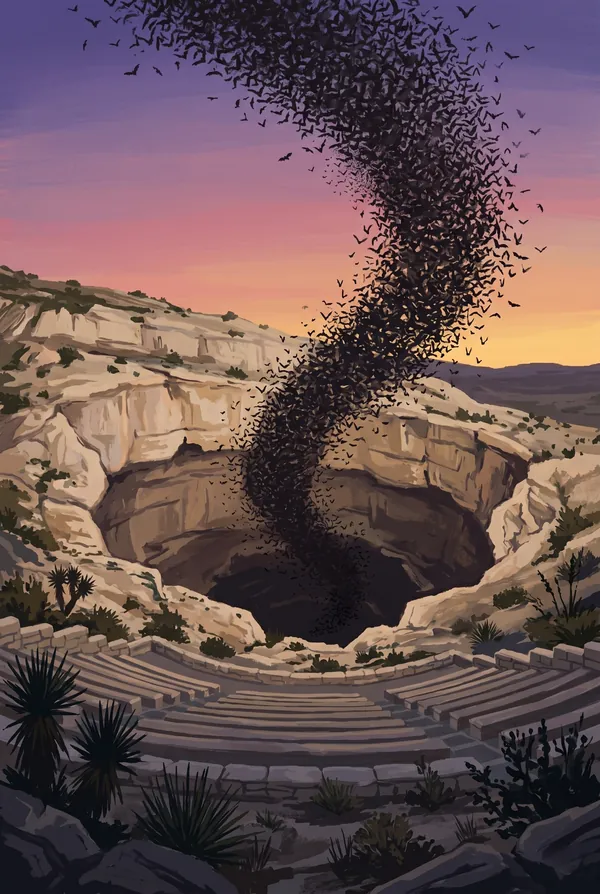
The bats are Brazilian free-tailed, and they commute. The summer colony of hundreds of thousands roosts in a section of the cave and pours out of the Natural Entrance at dusk in a counterclockwise spiral, off to hunt moths over the Pecos and Black river valleys. They winter in Mexico. Guano mining and DDT-era pesticides knocked the colony far below its historic size, but the evening flight remains one of the reliable wildlife spectacles in the park system.
The entrance has a day shift too. Cave swallows nest on the twilight ledges just inside the Natural Entrance, for decades one of the northernmost colonies of the species anywhere. So the same hole in the ground runs swallows by day and bats by night, trading places at dusk like a shift change.
Above ground is a national park in its own right. Most of the surface is Chihuahuan Desert wilderness: lechuguilla agave, sotol, mule deer, ringtails and javelinas on ridges of the same fossil reef that holds the caves. And a detached spring-fed oasis at Rattlesnake Springs, shaded by cottonwoods, is one of the best birding spots in New Mexico, with a species list out of all proportion to its size.
The Carlsbad Caverns designs
Pick the one that matches the park you actually saw.
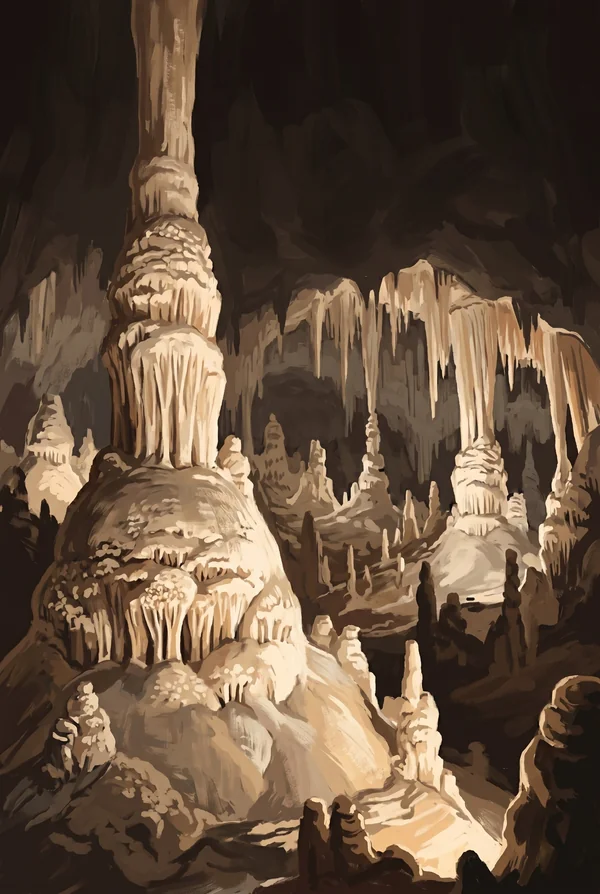
The Big Room
The largest single cave chamber in North America: about eight acres of floor, with the ceiling arching 255 feet overhead at its highest. A paved trail of about a mile and a quarter loops past the Bottomless Pit, the Giant Dome and the Hall of Giants. This is the image most people carry out of Carlsbad, and the obvious first stamp.
Bat Flight
The spectacle that revealed the cave: on summer evenings, hundreds of thousands of Brazilian free-tailed bats spiral out of the Natural Entrance at dusk, watched from a stone amphitheater built at the rim. It reads as smoke from a distance, which is exactly what a teenage cowboy thought it was in 1898. Pick it if the animals were the point.
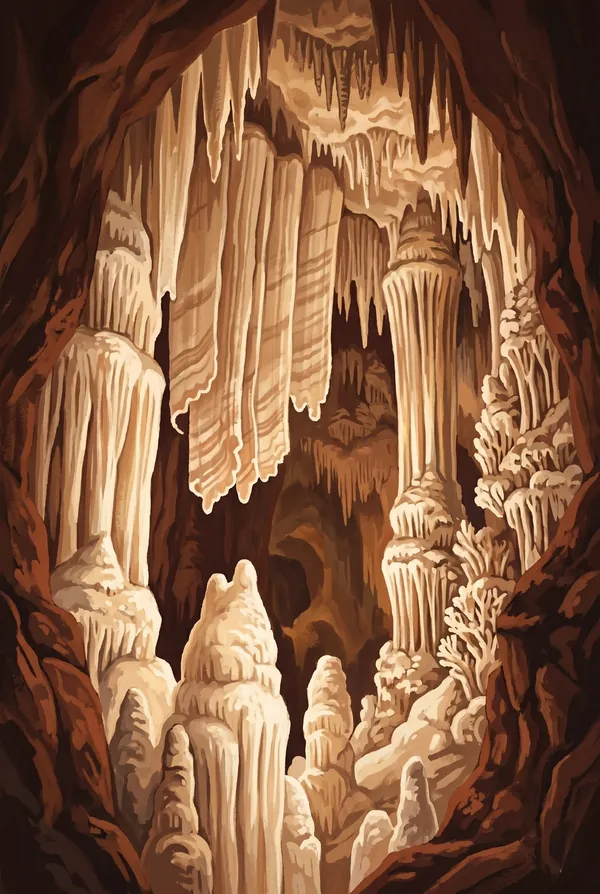
King's Palace
The deepest developed chamber open to visitors, 830 feet below the desert surface and seen with a ranger, part of a run of four rooms hung with draperies, columns, soda straws and helictites that grow in defiance of gravity. Rangers traditionally kill the lights partway through to demonstrate absolute darkness. Choose it if that blackout stayed with you.
How to record your Carlsbad Caverns visit
Free, and it works whether you are standing there now or remembering a trip from years ago.
1
Check In at the park
Open ParkStamp inside the park boundary and check in. The app confirms you are actually there and logs the date.
2
Or Stamp It later
Already been? Pick the date yourself. Trips from decades ago count the same as last weekend.
3
Or scan your photos
Let ParkStamp read the dates and locations off photos already on your phone. Most people find parks they had forgotten.
Carlsbad Caverns, asked and answered
Quick answers, for people planning a trip and people remembering one.
When is the best time to visit Carlsbad Caverns?
The cave itself does not care: it holds around 56°F all year, so the caverns are a genuine any-season visit. The calendar matters for the bats: the colony is in residence roughly from spring through October, and late summer is the richest flight, when the season's pups join the adults. Surface hiking is best in the mild months; summer afternoons on the desert ridges are brutal, and late-summer storms bring dramatic skies.
How many days do you need at Carlsbad Caverns?
One full day does it properly: walk down the switchbacks of the Natural Entrance trail, loop the Big Room, ride the elevator out, and stay for the evening bat flight in season. Add a second day if you want ranger-led rooms like King's Palace, the birds at Rattlesnake Springs, or the Guadalupe Mountains rising just across the state line.
How busy is Carlsbad Caverns?
Carlsbad Caverns National Park logged 410,778 visits in 2025, the 46th busiest of the 63 national parks. That makes it one of the quieter national parks, and crowds are rarely the problem.
What does the Carlsbad Caverns stamp show?
The lead Carlsbad Caverns design is The Big Room. The largest single cave chamber in North America: about eight acres of floor, with the ceiling arching 255 feet overhead at its highest. A paved trail of about a mile and a quarter loops past the Bottomless Pit, the Giant Dome and the Hall of Giants. This is the image most people carry out of Carlsbad, and the obvious first stamp. The other two designs are Bat Flight and King's Palace.
Is the Carlsbad Caverns stamp free?
Recording your Carlsbad Caverns visit is always free: check in at the park, add an old trip, or let the photo scan find it. The full-color art is the paid part, $3.99 one-time with three Carlsbad Caverns designs to choose from, and the first stamp you collect in ParkStamp is free.
Can I add a Carlsbad Caverns trip from years ago?
Yes. Open Carlsbad Caverns in ParkStamp, tap Stamp It, and set the date yourself; a visit from decades ago counts the same as last weekend. If you still have photos from the trip, the photo scan can find and date it from their location tags, without your photos ever leaving your phone.
Do I have to be at Carlsbad Caverns to get the stamp?
No. Check In is for when you are standing inside Carlsbad Caverns, and it confirms you are actually there. Stamp It records any past visit on your honor, with your dates. Both are free and put the same stamp in your StampBook.
Start your StampBook with Carlsbad Caverns
Free on iOS and Android. Your first stamp is on us.