The trees here fell more than 200 million years ago and came back as solid quartz, crystal by crystal, cell by cell. People have been unable to stop putting pieces in their pockets ever since, and the park keeps the apology letters to prove it.
Petrified Forest is one of the 63 national parks in ParkStamp, and like the rest it carries original stamp designs in the WPA poster tradition: each one a picture of an actual named place in the park, not an idealized desert.
Recording your visit is free. Check in from the park road, add the family trip from twenty years back, or let the app find the dates and places in photos already on your phone.
The real NPS boundary, with the roads and towns you would actually use to get there.
Petrified Forest, for people who count parks
Triassic logs, a highway ghost, and the letters people write when they give the wood back.
Start 225-odd million years ago, when this was a river floodplain near the equator on the supercontinent Pangaea. Conifers approaching 200 feet tall fell, washed downstream, and were buried in sediment loaded with volcanic ash. Silica-rich groundwater worked into the wood and precipitated quartz within the cells, sometimes tinted purple and yellow by trace minerals, preserving growth rings and bark in stone. The signature species, Araucarioxylon arizonicum, is Arizona's state fossil. The logs lie in neat segments that look chainsawed because quartz is brittle: as the land rose and flexed, the trunks snapped cleanly, like glass rods.
The park exists because people would not stop hauling the wood away. By the 1890s, souvenir hunters were carting off logs and dynamiting them for the amethyst inside, and a mill was proposed to crush petrified wood into industrial abrasives. That prospect pushed Arizona's territorial leaders to petition Washington, and in 1906, months after the Antiquities Act became law, Theodore Roosevelt made Petrified Forest one of the very first national monuments. It became a national park on December 9, 1962.
The theft never stopped; it just shrank to pocket size. The park has spent decades trying to deter visitors from palming a chip of the stuff, and it maintains a remarkable archive: letters from people mailing pieces back, often blaming years of bad luck on the stolen rock. Returned wood cannot go back where it came from (a fossil without its location is scientifically orphaned), so it accumulates in a conscience pile.
People kept living here the whole time. The park holds a 13,000-year human record: Puerco Pueblo, a village of more than a hundred rooms occupied into the 1300s; Newspaper Rock, with hundreds of petroglyphs pecked into varnished sandstone; and Agate House, a small pueblo built entirely of petrified wood. The most recent layer is Route 66: this is the only unit of the park system containing a stretch of the old highway's alignment, marked by a rusted 1932 Studebaker where the pavement used to run. On the rim above it stands the Painted Desert Inn, rebuilt by the CCC in the 1930s and painted inside with murals by the Hopi artist Fred Kabotie.
The dawn of the dinosaurs underfoot, and pronghorn doing 50 on the grassland.
This is one of the best windows anywhere on the Late Triassic, the awkward age when dinosaurs were new, small and far from in charge. The fossil beds have produced crocodile-shaped phytosaurs, armored aetosaurs, giant flat-headed amphibians, and early dinosaurs, including one excavated at Chinde Point in the 1980s and nicknamed Gertie. Erosion is the park's unpaid field crew: the badland clays shed and slump with every storm, and new bone keeps surfacing.
Above ground it is shortgrass prairie, and the star is the pronghorn. America's fastest land animal cruises the grassland here, built to outrun a predator, the American cheetah, that went extinct more than ten thousand years ago. It still runs as if the cheetah might come back. Coyotes, bobcats and burrowing owls fill out the cast, and brilliant turquoise-and-yellow collared lizards do push-ups on the logs in summer.
The badlands are bare on purpose. The banded hills are bentonite, a clay weathered from Triassic volcanic ash that swells when wet and shrinks as it dries, constantly shrugging off seedlings. Almost nothing can root in it, which is exactly why the colors stay exposed and the fossils keep coming. The nearly treeless horizon has a side benefit: some of the darkest night skies of any park along an interstate.
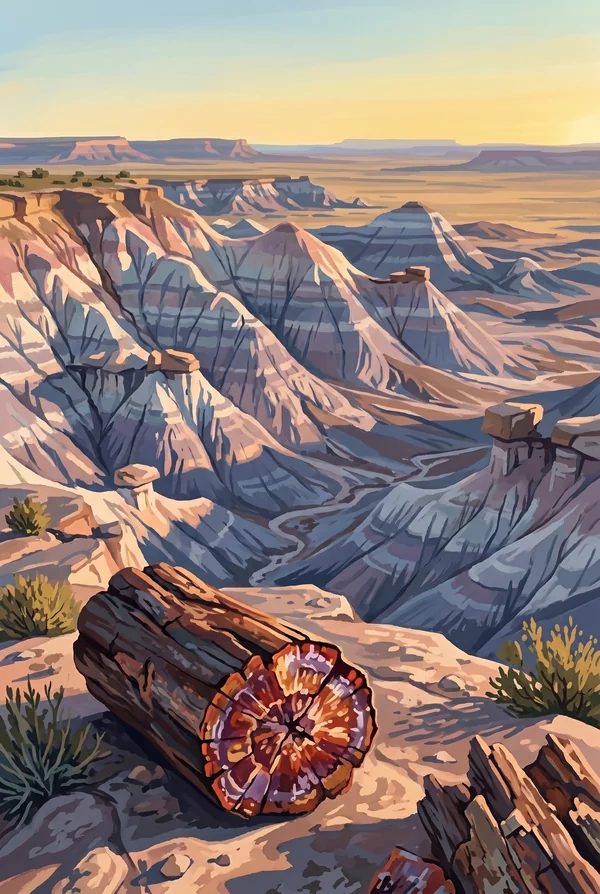
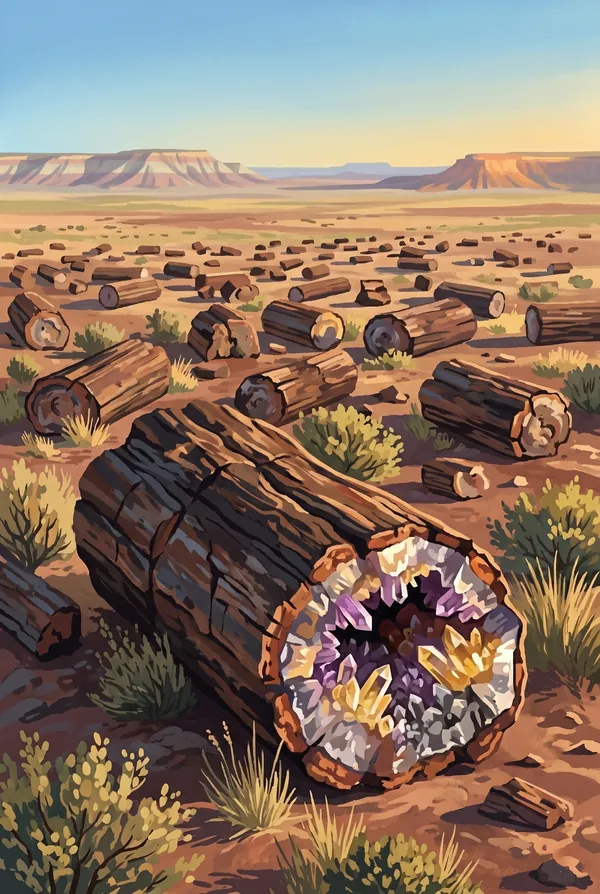
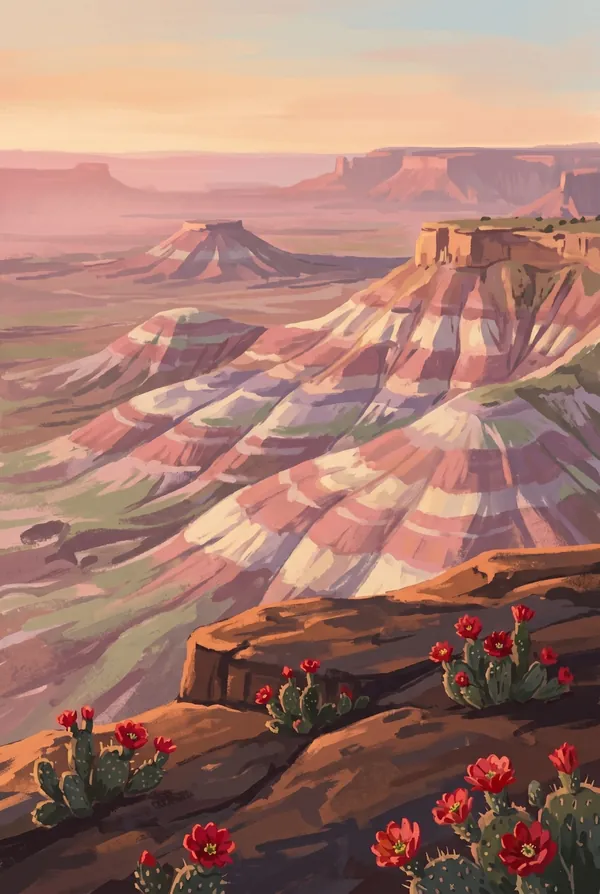
The Petrified Forest designs
Pick the one that matches the park you actually saw.
Blue Mesa Badlands
Banded hills of blue, gray and purple bentonite, striped like a tide chart of the Triassic, with petrified logs perched on pedestals of clay as erosion lowers the ground beneath them. The short, steep loop trail off the mesa rim drops you inside the banding. This is the strangest-looking place in the park, and the strong choice if you want a stamp no one can place at a glance.
Crystal Forest Log Scatter
A hillside strewn with logs so dense with quartz and amethyst that 19th-century collectors dynamited them for crystals, the vandalism that helped get the place protected in 1906. An easy paved loop winds among trunks more than 200 million years old, their broken faces flashing red, yellow and violet in low sun.
Painted Desert Panorama
The long view north from the rim overlooks near the historic Painted Desert Inn: banded red and rose badlands running to the horizon, changing color hour by hour as the light moves. This is the park's opening act for travelers coming off I-40, painted on a landscape that has been accumulating color since the Triassic.
How to record your Petrified Forest visit
Free, and it works whether you are standing there now or remembering a trip from years ago.
1
Check In at the park
Open ParkStamp inside the park boundary and check in. The app confirms you are actually there and logs the date.
2
Or Stamp It later
Already been? Pick the date yourself. Trips from decades ago count the same as last weekend.
3
Or scan your photos
Let ParkStamp read the dates and locations off photos already on your phone. Most people find parks they had forgotten.
Petrified Forest, asked and answered
Quick answers, for people planning a trip and people remembering one.
When is the best time to visit Petrified Forest?
Spring and fall bring the mild, stable weather this high grassland does best; the park sits above 5,000 feet, so summer means hot middays and afternoon monsoon storms that light the badlands dramatically, and winter can dust the logs with snow. In any month, the real variable is sun angle: the Painted Desert and Blue Mesa go flat at noon and catch fire in the first and last hours of light.
How many days do you need at Petrified Forest?
Half a day does the essentials: the 28-mile park road from the Painted Desert rim to the Rainbow Forest, with stops at Newspaper Rock, Blue Mesa and Crystal Forest. A full day adds the Blue Mesa loop trail, Agate House and time at the Painted Desert Inn murals. It sits right on I-40, which makes it the easiest park in the Southwest to actually stop for.
How busy is Petrified Forest?
Petrified Forest National Park logged 315,951 visits in 2025, the 48th busiest of the 63 national parks. That makes it one of the quieter national parks, and crowds are rarely the problem.
What does the Petrified Forest stamp show?
The lead Petrified Forest design is Blue Mesa Badlands. Banded hills of blue, gray and purple bentonite, striped like a tide chart of the Triassic, with petrified logs perched on pedestals of clay as erosion lowers the ground beneath them. The short, steep loop trail off the mesa rim drops you inside the banding. This is the strangest-looking place in the park, and the strong choice if you want a stamp no one can place at a glance. The other two designs are Crystal Forest Log Scatter and Painted Desert Panorama.
Is the Petrified Forest stamp free?
Recording your Petrified Forest visit is always free: check in at the park, add an old trip, or let the photo scan find it. The full-color art is the paid part, $3.99 one-time with three Petrified Forest designs to choose from, and the first stamp you collect in ParkStamp is free.
Can I add a Petrified Forest trip from years ago?
Yes. Open Petrified Forest in ParkStamp, tap Stamp It, and set the date yourself; a visit from decades ago counts the same as last weekend. If you still have photos from the trip, the photo scan can find and date it from their location tags, without your photos ever leaving your phone.
Do I have to be at Petrified Forest to get the stamp?
No. Check In is for when you are standing inside Petrified Forest, and it confirms you are actually there. Stamp It records any past visit on your honor, with your dates. Both are free and put the same stamp in your StampBook.
Start your StampBook with Petrified Forest
Free on iOS and Android. Your first stamp is on us.