The Joshua tree is not a tree, it cannot reproduce without one specific moth, and current modeling suggests almost none of them will still be growing in this park by the end of the century.
Joshua Tree is one of 63 national parks in ParkStamp, and like every park it has original stamp designs drawn in the WPA poster tradition. Each one is an illustration of a specific place you can go stand.
Recording the visit is free. Check in at the park, add a trip from years ago, or let the app read the dates off photos already on your phone.
The real NPS boundary, with the roads and towns you would actually use to get there.
Joshua Tree, for people who count parks
A society gardener, seven freight cars of sand, and three parks born on one signature.
Minerva Hoyt made this park happen, and her method was theater. Her husband died in 1918 and she redirected her wealth and social standing into desert conservation, alarmed at Angelenos driving out to dig up cacti and Joshua trees by the truckload for suburban gardens. She staged elaborate desert-plant exhibitions that traveled nationally. Her 1928 show for the Garden Club of America in New York required seven freight cars of rocks, plants and sand to mount. She took displays to Boston and London, founded a desert conservation league in 1930, and in early 1933 met with Roosevelt, the Interior Secretary and the director of the Park Service, which is remarkable access for a private citizen holding no office. She asked for about a million acres.
Roosevelt proclaimed the national monument on August 10, 1936, at roughly 825,000 acres. Congress then cut about 290,000 acres out of it in 1950 to allow mining.
It became a national park on October 31, 1994, when Clinton signed the California Desert Protection Act. That single act also upgraded Death Valley and created the Mojave National Preserve. Three units, one signature, one day. It is the cleanest "class of" in the park system.
Two deserts meet inside the boundary, and the line is about 3,000 feet. Above it is the Mojave: higher, cooler, wetter, with winter frost. Below it is the Colorado Desert, the western lobe of the Sonoran, all creosote and ocotillo and cholla. Joshua trees only grow on the Mojave side. Drive south toward Cottonwood through the Pinto Basin and they simply stop.
It is a Dark Sky Park, which should be impossible. Designated in August 2017 with roughly 22 million people living within a few hours' drive, wedged between the light domes of Palm Springs and the Morongo Basin. The head of the Dark-Sky Association called the nomination singular in the program's sixteen-year history, because the hard part was not retrofitting park lighting. It was negotiating with every surrounding community.
The Joshua tree and its moth, which cannot live without each other. Yucca brevifolia is not a tree; it is a yucca, a monocot with no growth rings, which is why nobody can agree on how long they live. The Park Service says about 150 years and others claim several hundred. Its only pollinator is the yucca moth. Bees do not work, because the flower requires something deliberate: the female moth gathers pollen into a ball with specialized mouthparts, flies to another flower, packs it onto the stigma on purpose, and then lays her eggs in the ovary. Her larvae eat some of the developing seeds. Enough survive for the tree to reproduce. Neither species can reproduce without the other, and the flower shapes have coevolved to match the moths' body dimensions.
And the modeling is grim. A study out of UC Riverside found that with aggressive emissions reductions about 19% of the park's Joshua tree habitat survives past 2070. Without them, about 0.02%. Adults are surviving while seedlings fail, trees are migrating upslope, and invasive grasses are carrying fire into the cool high-elevation refuges. Joshua trees do not resprout well after fire.
Desert tortoises, and why you must never pick one up. They live 50 to 100 years and spend 95% of it underground in burrows up to 30 feet long. They store water in the bladder, gaining noticeable weight after a good rain. If frightened, a tortoise voids its bladder as a reflex. In a drought year that can be fatal before the next rain arrives. Handling one is also illegal under the Endangered Species Act.
Kangaroo rats never drink. Not rarely: never. Their kidneys pull nearly all the water back out of their urine, and they manufacture the rest metabolically by digesting dry seeds. Combined with staying underground through the day, that is enough to complete an entire life cycle without free water.
Come at dawn or dusk. The Park Service says the desert is most alive at night, especially in summer. A visitor arriving at one in the afternoon in July sees lizards and ground squirrels and concludes the place is empty. It is not empty, it is asleep.
The Joshua Tree designs
Pick the one that matches the park you actually saw.
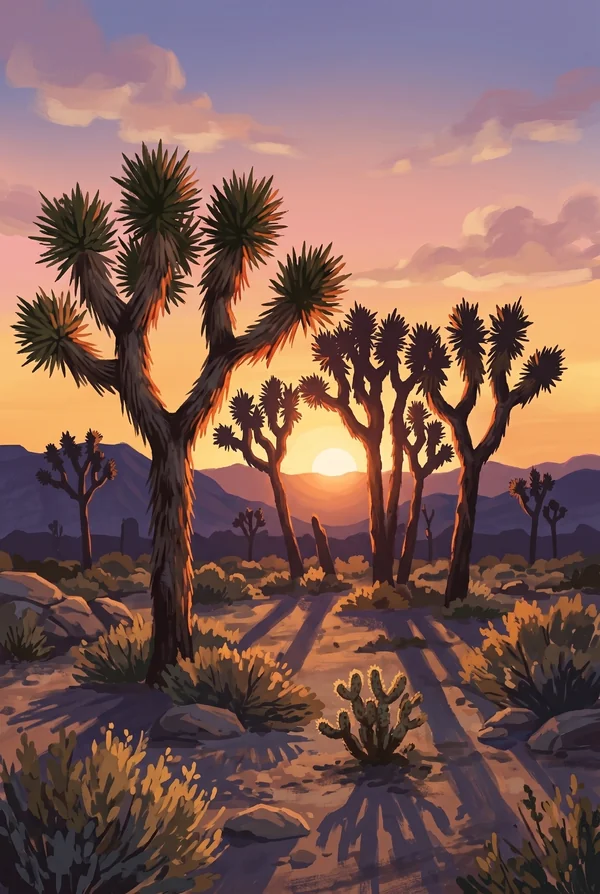
Joshua Tree Forest
Only on the Mojave side, above about 3,000 feet, thickest along Park Boulevard and through Queen Valley. It does not look like a forest. The trees stand well apart because they are competing for water, so the spacing is a signature of scarcity rather than a design. A useful thing to know while looking at one: branching only happens after a Joshua tree flowers or its growing tip is damaged, so an unbranched tree has never bloomed.
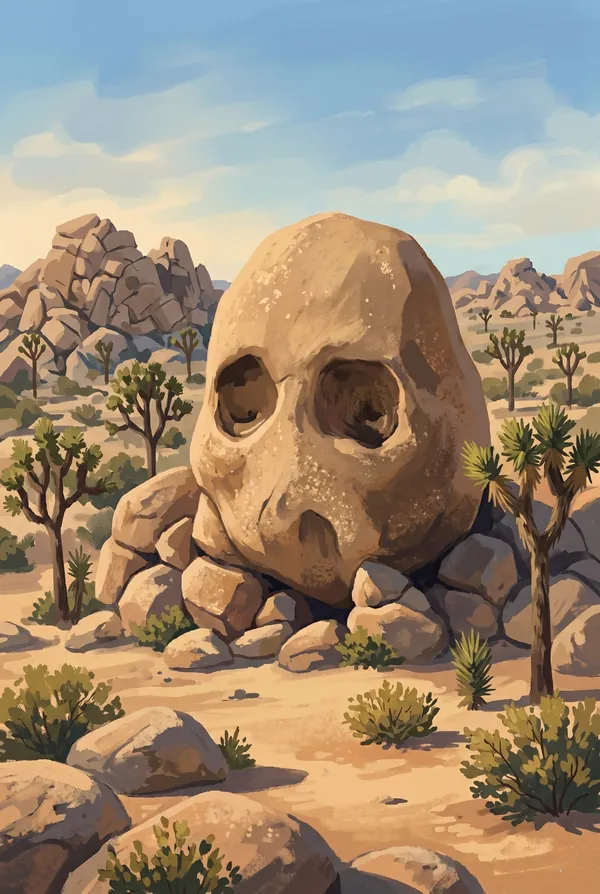
Skull Rock
Nobody carved it. Rainwater collected in two depressions on the boulder and, over a very long time, chemically ate them into sockets. The boulder itself is the older accident: molten rock cooled underground into monzogranite, cracked into a grid of blocks, and groundwater seeping along the cracks rotted the corners first and rounded them, the way an ice cube rounds under a tap. Then the climate dried and flash floods washed the softened material away, leaving the rounded blocks stacked in the open.
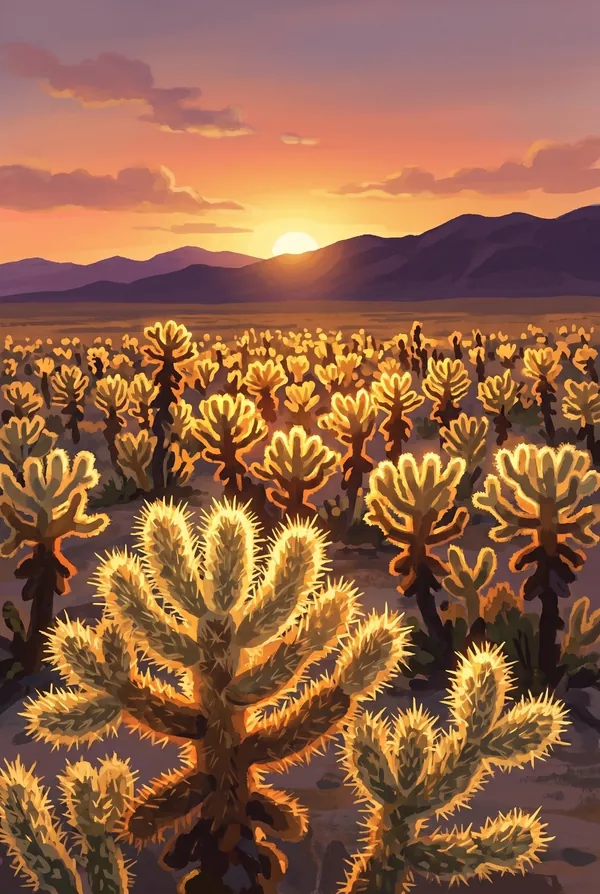
Cholla Cactus Garden
A quarter-mile loop through thousands of teddybear cholla in the transition zone between the two deserts, best photographed backlit at either end of the day when the spines glow. The friendly name is a trap. The segments are attached so loosely that the slightest brush detaches a whole joint onto you, which is why it is called jumping cholla, and the spines are barbed so they tear on the way out. That hazard is the plant's reproductive strategy: dropped segments root where they land, and being too heavy to blow anywhere is exactly why there is a dense garden here instead of scattered plants.
How to record your Joshua Tree visit
Free, and it works whether you are standing there now or remembering a trip from years ago.
1
Check In at the park
Open ParkStamp inside the park boundary and check in. The app confirms you are actually there and logs the date.
2
Or Stamp It later
Already been? Pick the date yourself. Trips from decades ago count the same as last weekend.
3
Or scan your photos
Let ParkStamp read the dates and locations off photos already on your phone. Most people find parks they had forgotten.
Joshua Tree, asked and answered
Quick answers, for people planning a trip and people remembering one.
When is the best time to visit Joshua Tree?
October through April. Joshua Tree is the rare park that closes for summer in everything but name, with days routinely past 100°F. Spring can bring a wildflower bloom if the winter rains cooperated. Winter days are hiking weather, the nights drop below freezing, and the skies are the darkest within reach of twenty million people.
How many days do you need at Joshua Tree?
One long day covers the icons: Hidden Valley, Keys View, and the Cholla Garden at golden hour. Two days lets the desert slow you down to its own speed, a scramble in the Wonderland of Rocks, both deserts crossed, and a night kept for the stars, which are half the reason to come.
How busy is Joshua Tree?
Joshua Tree National Park logged 2.93 million visits in 2025, the 12th busiest of the 63 national parks. That puts it in the middle of the pack: busy at the famous spots, quiet a mile past them.
What does the Joshua Tree stamp show?
The lead Joshua Tree design is Joshua Tree Forest. Only on the Mojave side, above about 3,000 feet, thickest along Park Boulevard and through Queen Valley. It does not look like a forest. The trees stand well apart because they are competing for water, so the spacing is a signature of scarcity rather than a design. A useful thing to know while looking at one: branching only happens after a Joshua tree flowers or its growing tip is damaged, so an unbranched tree has never bloomed. The other two designs are Skull Rock and Cholla Cactus Garden.
Is the Joshua Tree stamp free?
Recording your Joshua Tree visit is always free: check in at the park, add an old trip, or let the photo scan find it. The full-color art is the paid part, $3.99 one-time with three Joshua Tree designs to choose from, and the first stamp you collect in ParkStamp is free.
Can I add a Joshua Tree trip from years ago?
Yes. Open Joshua Tree in ParkStamp, tap Stamp It, and set the date yourself; a visit from decades ago counts the same as last weekend. If you still have photos from the trip, the photo scan can find and date it from their location tags, without your photos ever leaving your phone.
Do I have to be at Joshua Tree to get the stamp?
No. Check In is for when you are standing inside Joshua Tree, and it confirms you are actually there. Stamp It records any past visit on your honor, with your dates. Both are free and put the same stamp in your StampBook.
Start your StampBook with Joshua Tree
Free on iOS and Android. Your first stamp is on us.