The mountain is the tallest in North America and big enough to make its own weather, which is why roughly two visitors out of three never see it. The park came first, though. It was created in 1917 not for the peak but to save the Dall sheep around it from market hunters.
Denali is one of 63 national parks in ParkStamp, and like every park in the app it has original stamp designs drawn in the WPA poster tradition: each one is an illustration of a specific real place, not a generic mountain.
Recording the visit is free. Check in from the park road, add the trip you took years ago, or let the app read the dates and locations from photos already on your phone.
The real NPS boundary, with the roads and towns you would actually use to get there.
Denali, for people who count parks
A park created for sheep, a summit reached by an Alaska Native, and a name fight that ran a century.
This was the first park created chiefly to protect wildlife. Charles Sheldon, a hunter-naturalist from Vermont, spent the winter of 1907–08 in a cabin near the mountain and watched market hunters slaughtering Dall sheep by the hundreds to feed railroad and mining camps. He spent the next decade lobbying Congress, and on February 26, 1917 Woodrow Wilson signed Mount McKinley National Park into law. Scenery was the afterthought; the sheep were the point.
Sheldon wanted it called Denali from the start. That is the Koyukon Athabascan name, usually translated as "the tall one" or "the high one." A prospector had attached McKinley in 1896, honoring a presidential candidate from Ohio who never set foot in Alaska, and Ohio's congressional delegation blocked every attempt to undo it for decades. In 1980 the park itself was renamed Denali; Washington has since changed the mountain's official name more than once, but the park's name has stayed put.
The first people on the summit got there in 1913. The Hudson Stuck expedition put Walter Harper, a Koyukon Athabascan, first onto the 20,310-foot top, a fitting piece of history, since his ancestors named it. Co-leader Harry Karstens went on to become the park's first superintendent. The mountain's real superlative is not its elevation but its rise: it stands roughly 18,000 feet above its own lowlands, a greater base-to-peak sweep than Everest's.
1980 also made the park three times bigger. The Alaska National Interest Lands Conservation Act grew it to six million acres (bigger than New Hampshire), with a single road, 92 miles long and mostly gravel, run mainly by transit buses so the wildlife keeps the right of way. The park has kept a working sled dog kennel since 1922, the only one in the national park system; rangers still patrol the wilderness by dog team in winter.
The big five from a bus seat, and a frog that freezes solid.
The big five, all from one road. Grizzly bear, wolf, moose, caribou, Dall sheep: Denali is the most reliable place in America to see all five wild, often in a single day, from a bus seat. The subarctic runs lean: this is a place with a short list of species in large, visible numbers, the opposite of a rainforest and easier to read.
The wood frog freezes solid every winter. It is the park's only amphibian, and it survives here by dying on schedule: heart stopped, no breathing, up to two-thirds of its body water turned to ice, with glucose flooding its cells as antifreeze. In spring it thaws out and starts calling. That one animal explains the interior Alaska winter better than any thermometer.
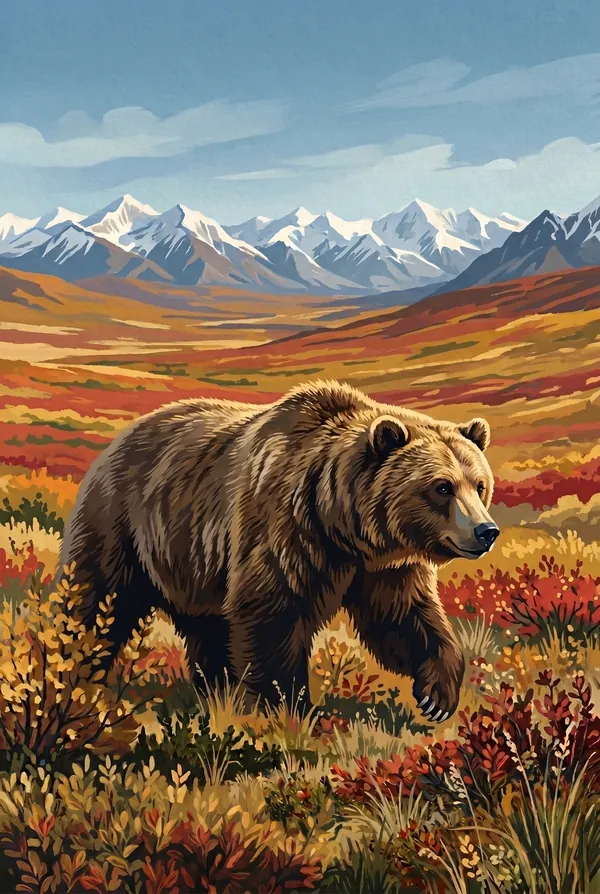
Denali's grizzlies are mostly vegetarian. The blond "Toklat" bears of the park interior live largely on roots, grasses and berries, with ground squirrels and the occasional moose calf as protein. Watching a several-hundred-pound predator graze a hillside like livestock for an hour is a very Denali experience.
Golden eagles run a commuter operation. The park's ridges hold one of the densest known nesting populations of golden eagles in North America, tracked in a research program running since the 1980s. Many of the birds winter as far south as the American West and Mexico and fly back to these same cliffs each spring.
The Denali designs
Pick the one that matches the park you actually saw.
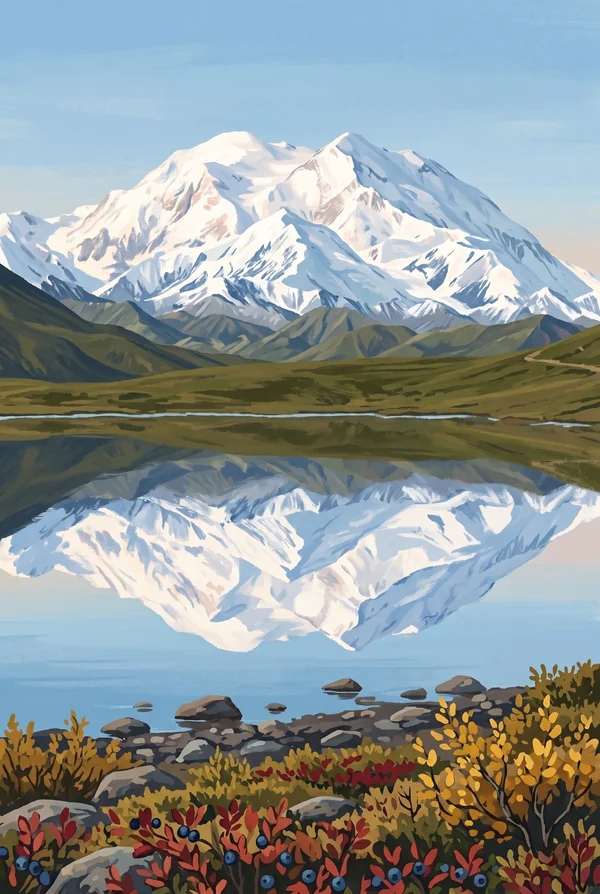
Wonder Lake
A glacier-carved kettle lake near the far end of the park road, and the closest road-accessible ground to the mountain: about 26 miles from the summit, close enough that Denali fills the sky and doubles in the water on a calm morning. This is the view Ansel Adams made famous in 1947. Pick it if you got the mountain; most people don't.
Autumn Tundra
Fall in Denali arrives in mid-August and is finished in about two weeks: dwarf birch, blueberry and bearberry turn the tundra scarlet and orange from horizon to horizon, grizzlies graze the berry slopes ahead of denning, and the first snow (termination dust, Alaskans call it) lands on the peaks above. The shortest, loudest season in the park.
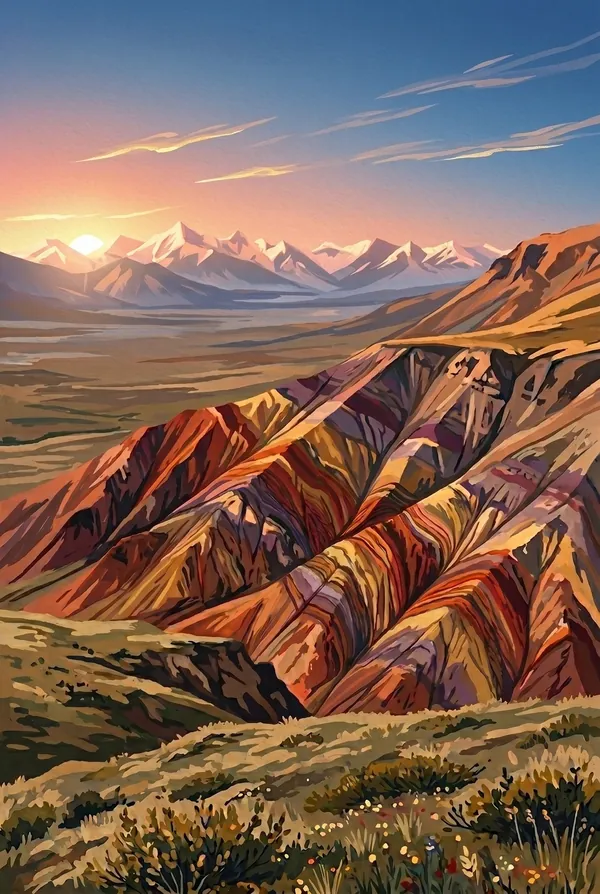
Polychrome Pass
A ledge of road high above the Plains of Murie, cut through volcanic rock weathered into bands of orange, red and lavender, the paint that named the pass, with braided rivers threading the valley floor below. The hillside here is ice-rich permafrost and it moves; check nps.gov for how far along the road you can currently get.
How to record your Denali visit
Free, and it works whether you are standing there now or remembering a trip from years ago.
1
Check In at the park
Open ParkStamp inside the park boundary and check in. The app confirms you are actually there and logs the date.
2
Or Stamp It later
Already been? Pick the date yourself. Trips from decades ago count the same as last weekend.
3
Or scan your photos
Let ParkStamp read the dates and locations off photos already on your phone. Most people find parks they had forgotten.
Denali, asked and answered
Quick answers, for people planning a trip and people remembering one.
When is the best time to visit Denali?
June through August is the practical season, with nearly endless daylight around the solstice. The strongest case is late August into early September: the tundra turns red, the mosquitoes die back, and the returning night brings the first aurora of the year. The mountain hides in its own weather in any month; roughly one visitor in three sees it, so extra days are your only real strategy.
How many days do you need at Denali?
Two days is the honest minimum: one full day riding a bus deep into the park (the distances are serious, and wildlife sets the schedule) and one day around the entrance for Savage River, Horseshoe Lake and the sled dog kennels. A third day is weather insurance for actually seeing Denali, and it pays off often enough to be worth it.
How busy is Denali?
Denali National Park & Preserve logged 543,300 visits in 2025, the 39th busiest of the 63 national parks. That makes it one of the quieter national parks, and crowds are rarely the problem.
What does the Denali stamp show?
The lead Denali design is Wonder Lake. A glacier-carved kettle lake near the far end of the park road, and the closest road-accessible ground to the mountain: about 26 miles from the summit, close enough that Denali fills the sky and doubles in the water on a calm morning. This is the view Ansel Adams made famous in 1947. Pick it if you got the mountain; most people don't. The other two designs are Autumn Tundra and Polychrome Pass.
Is the Denali stamp free?
Recording your Denali visit is always free: check in at the park, add an old trip, or let the photo scan find it. The full-color art is the paid part, $3.99 one-time with three Denali designs to choose from, and the first stamp you collect in ParkStamp is free.
Can I add a Denali trip from years ago?
Yes. Open Denali in ParkStamp, tap Stamp It, and set the date yourself; a visit from decades ago counts the same as last weekend. If you still have photos from the trip, the photo scan can find and date it from their location tags, without your photos ever leaving your phone.
Do I have to be at Denali to get the stamp?
No. Check In is for when you are standing inside Denali, and it confirms you are actually there. Stamp It records any past visit on your honor, with your dates. Both are free and put the same stamp in your StampBook.
Start your StampBook with Denali
Free on iOS and Android. Your first stamp is on us.