More than 400 miles of Mammoth Cave have been mapped, no one has found the end, and no other known cave on Earth comes within a hundred miles of it. The cave has been a gunpowder mine, a tuberculosis hospital, and the making of an enslaved seventeen-year-old who became the most famous cave explorer of his century.
Mammoth Cave is one of the 63 national parks in ParkStamp. Every park in the app has original stamp designs made in the WPA poster tradition, and every design is an illustration of a real, specific place, including places 200 feet underground.
Keeping the record is free. Check in at the park, log a visit from years ago, or let the app lift the dates and locations from photos already on your phone.
The real NPS boundary, with the roads and towns you would actually use to get there.
Mammoth Cave, for people who count parks
The longest cave on Earth, and the strange two centuries it took to become a park.
The first industry here was gunpowder. During the War of 1812, enslaved men worked leaching vats deep inside the cave, extracting the nitrates that went east to be made into powder. When the war ended the owners noticed that visitors would pay simply to walk in with a lamp, and tours have run more or less continuously since 1816, which makes this one of the oldest tourist attractions in North America. The wooden saltpeter works still sit in the entrance passages, preserved by the cave's unchanging air.
Stephen Bishop was brought here enslaved in 1838, at seventeen, to guide tourists. Within a year he had crossed the Bottomless Pit on a cedar-pole ladder, a void that had stopped all exploration before him, and the cave effectively doubled. He found the underground Echo River and the eyeless fish in it, named much of what tourists still see, and drew a map of the system from memory that stayed in use for decades. Visitors from Europe came asking for him by name. His description of the cave, grand, gloomy and peculiar, has never been improved on. He was freed in 1856 and died the following year.
In 1842 a doctor moved tuberculosis patients underground. John Croghan, who owned the cave and the people who worked it, believed the constant cool air would cure consumption, and built stone huts for patients deep inside. Within months some were dead and the rest were worse, and the experiment ended. Two of the huts still stand along the tour route. Croghan himself died of tuberculosis in 1849.
The park came out of a circus. By the 1920s the surrounding karst country was in the Kentucky Cave Wars, rival owners hustling tourists off the highway toward competing holes. In January 1925 a local caver named Floyd Collins, hunting a new show cave, was pinned by a fallen rock in a crawlway at Sand Cave; the two-week rescue attempt became one of the first national media spectacles of the radio age, and he died before rescuers reached him. The attention fed a campaign already underway: Congress authorized a park in 1926, Kentucky spent years buying out and condemning the farms of hundreds of families (a hard history the park now acknowledges), and Mammoth Cave National Park was finally established on July 1, 1941.
The superlative came later. In 1972, cavers from the Cave Research Foundation pushed a wet, tight passage from the Flint Ridge system toward Mammoth, with the smallest member of the team, Patricia Crowther, first through the squeeze, and surfaced the connection that made this officially the longest cave on Earth. Surveying has never stopped; the mapped length still grows by miles in a good year, and the total now stands above 400.
Fish without eyes, crickets that commute, and the geological accident that made it all possible.
The deep cave has permanent residents, and they are strange. Eyeless, unpigmented cavefish hang motionless in the underground rivers, sensing prey through vibration, and the Kentucky cave shrimp, a translucent, blind crustacean found in this groundwater and essentially nowhere else, is federally endangered. Life without light runs on a starvation budget: these animals grow slowly, breed rarely, and can live far longer than their surface relatives.
Cave crickets are the supply line. They roost in the cave by day and hop out on summer nights to feed on the surface, then return, carrying calories into a world that has none of its own. Their droppings and eggs support a whole community of beetles, springtails and mites. Break the cricket commute and much of the deep-cave food web goes with it.
The bats are the loss. Staining on the ceilings and centuries of guano show that millions of bats once wintered in these passages before mining and heavy visitation changed the entrances. White-nose syndrome, a cold-loving fungus, reached the park in the 2010s and cut the survivors hard. Researchers now count what remains and manage the cave to give the colonies their best chance.
Why is this cave so long? Look up at the ridge. A cap of tough sandstone sits over the limestone like a roof, keeping surface water from dissolving the passages away, while the Green River (one of the most biologically diverse rivers in North America, with dozens of species of freshwater mussels) has spent millions of years cutting slowly downward. Each pause in that descent left a level of dry, stable tunnels. Stack the levels, protect them with the caprock, and you get 400-plus miles that refuse to end.
The Mammoth Cave designs
Pick the one that matches the park you actually saw.
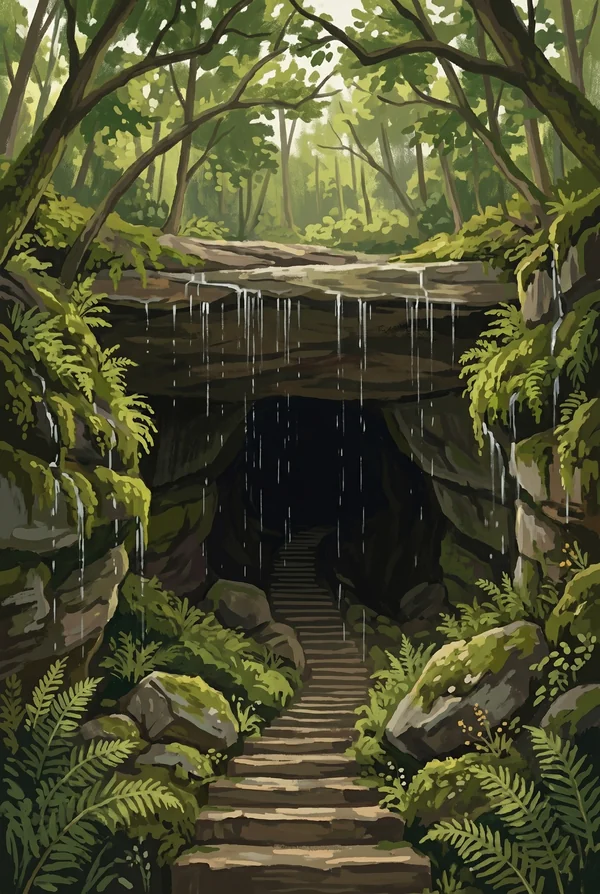
Historic Entrance
The natural mouth of the longest cave on Earth: a shadowed sinkhole entrance breathing cool air, with a waterfall thin as a thread dropping across it. People were exploring by cane torch thousands of years ago, saltpeter miners worked just inside during the War of 1812, and every tour since 1816 has started more or less here. The front-door stamp.
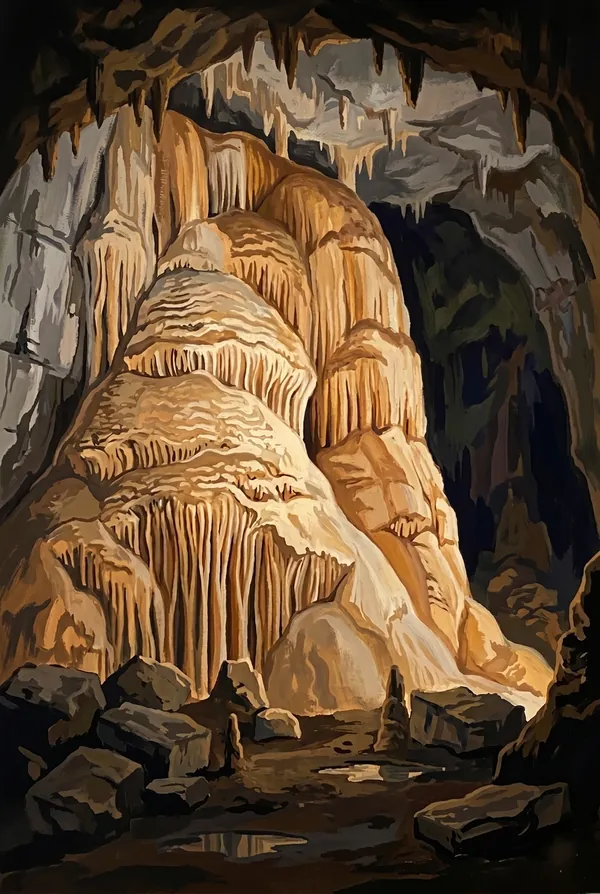
Frozen Niagara Flowstone
A cascade of orange-brown flowstone and draperies discovered in 1923, the most decorated chamber in the cave. Formations like this are actually rare at Mammoth, because the sandstone caprock keeps most passages dry (which is why the cave survived to be long), so this is the place where the water gets through and shows what it can build.
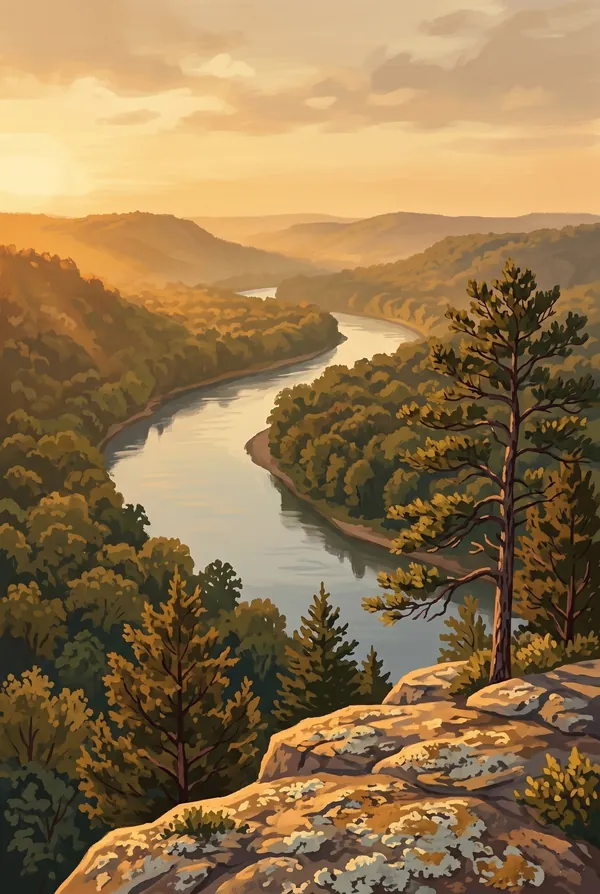
Green River Valley Overlook
The view from the wooded ridgetop down to the river that made the cave and is still making it, cutting the base level the deepest passages follow. The Green is among the most biologically rich rivers in North America, thick with mussel and fish species. Pick it for the rare reminder that this park has a surface.
How to record your Mammoth Cave visit
Free, and it works whether you are standing there now or remembering a trip from years ago.
1
Check In at the park
Open ParkStamp inside the park boundary and check in. The app confirms you are actually there and logs the date.
2
Or Stamp It later
Already been? Pick the date yourself. Trips from decades ago count the same as last weekend.
3
Or scan your photos
Let ParkStamp read the dates and locations off photos already on your phone. Most people find parks they had forgotten.
Mammoth Cave, asked and answered
Quick answers, for people planning a trip and people remembering one.
When is the best time to visit Mammoth Cave?
Any month, honestly: the cave holds its cool mid-50s temperature year-round, so the underground experience is identical in January and July. For the surface, April and May bring wildflowers and rushing spring water to the karst country, and October colors the ridgetops over the Green River. Summer is the busy season; winter is the quiet one, when a light crowd has the passages nearly to itself.
How many days do you need at Mammoth Cave?
One day fits two contrasting cave tours (say the Historic route through the saltpeter works and Bottomless Pit, and the Frozen Niagara end of the cave), with time left for the Green River overlooks. A second day is for the surface: paddling the Green through the park, or walking the sinkhole-and-spring country on the north side trails.
How busy is Mammoth Cave?
Mammoth Cave National Park logged 660,734 visits in 2025, the 34th busiest of the 63 national parks. That puts it in the middle of the pack: busy at the famous spots, quiet a mile past them.
What does the Mammoth Cave stamp show?
The lead Mammoth Cave design is Historic Entrance. The natural mouth of the longest cave on Earth: a shadowed sinkhole entrance breathing cool air, with a waterfall thin as a thread dropping across it. People were exploring by cane torch thousands of years ago, saltpeter miners worked just inside during the War of 1812, and every tour since 1816 has started more or less here. The front-door stamp. The other two designs are Frozen Niagara Flowstone and Green River Valley Overlook.
Is the Mammoth Cave stamp free?
Recording your Mammoth Cave visit is always free: check in at the park, add an old trip, or let the photo scan find it. The full-color art is the paid part, $3.99 one-time with three Mammoth Cave designs to choose from, and the first stamp you collect in ParkStamp is free.
Can I add a Mammoth Cave trip from years ago?
Yes. Open Mammoth Cave in ParkStamp, tap Stamp It, and set the date yourself; a visit from decades ago counts the same as last weekend. If you still have photos from the trip, the photo scan can find and date it from their location tags, without your photos ever leaving your phone.
Do I have to be at Mammoth Cave to get the stamp?
No. Check In is for when you are standing inside Mammoth Cave, and it confirms you are actually there. Stamp It records any past visit on your honor, with your dates. Both are free and put the same stamp in your StampBook.
Start your StampBook with Mammoth Cave
Free on iOS and Android. Your first stamp is on us.