ParkStamp/Parks/Indiana Dunes
Indiana · Northeast

The Indiana Dunes National Park Stamp

This park was first proposed in 1916 and did not become a national park until 2019. It is also, per acre, one of the most biodiverse places in the entire park system, and the ground it sits on is where the science of ecology was more or less invented.

Indiana Dunes is one of 63 national parks in ParkStamp, and like every park it has original stamp designs drawn in the WPA poster tradition. Each one is an illustration of a specific place you can go stand.

Recording the visit is free. Check in at the park, add a trip from years ago, or let the app read the dates off photos already on your phone.

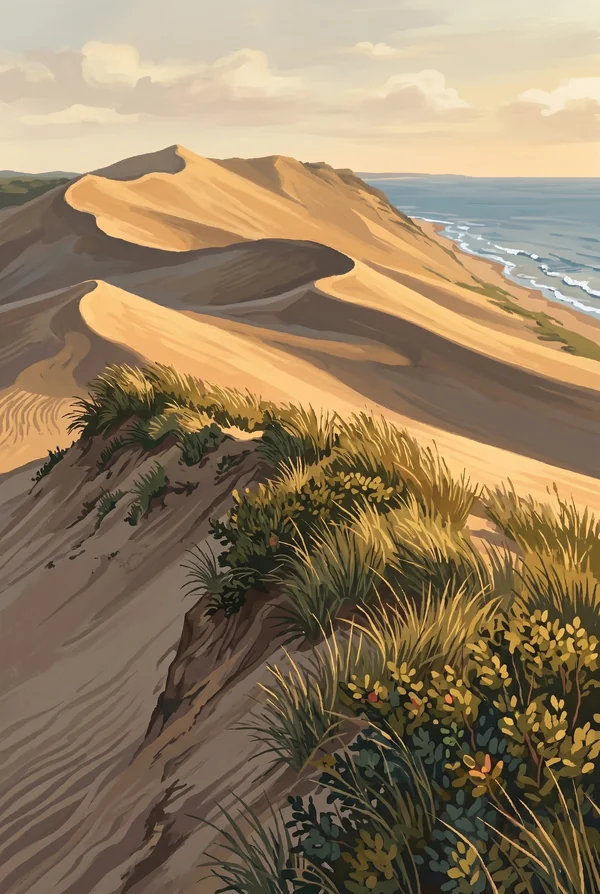
Indiana Dunes National Park stamp, WPA-style illustration of Lake Michigan Shoreline and Dunes
Lake Michigan Shoreline and Dunes
Indiana Dunes National Park
© 2026 Reciprocity Holdings LLC.
All rights reserved.
State
Indiana
Became a park
February 15, 2019
Visitors (2025)
2.63 million
Busiest park rank
13th of 63
Region
Northeast

Where Indiana Dunes is

The real NPS boundary, with the roads and towns you would actually use to get there.
Indiana Dunes National Park boundary map Chicago Gary ONTARIO MICHIGAN ILLINOIS INDIANA 25 km Indiana Dunes

Indiana Dunes, for people who count parks

103 years from proposal to park, and the best argument for it is scientific.

Stephen Mather proposed a Sand Dunes National Park in 1916, the same year the Park Service was created, and held public hearings in Chicago where hundreds of prominent people testified for it. World War I killed it. Later administrations judged the increasingly industrial shoreline unsuitable.

It took a woman from Ogden Dunes and an Illinois senator to revive it. Dorothy Buell founded the Save the Dunes Council in 1952 with 21 local women. Paul Douglas, an Illinois senator fighting for Indiana land, spent fourteen years introducing bills and was called a millstone around Indiana's neck for his trouble. Johnson signed the national lakeshore into law on November 5, 1966.

It was redesignated a national park on February 15, 2019, and the redesignation is worth being honest about. It rode through attached to an omnibus spending bill rather than passing on its own. Nothing on the ground changed: no new land, no new money, just the name. Visits jumped about 17% in the first year, which is the entire case for the critics who call it a tourism play. The counter-argument is that the site had been in the park system since 1966 and the only question was what to call it. A superintendent put it best: it is not Yellowstone and it is not Yosemite, but it is not supposed to be.

The real case is the science, and it is a good one. Henry Chandler Cowles did his doctoral work on these dunes and published in 1899, and that paper essentially founded the study of ecological succession, the process by which plants alter their own environment until they are replaced by different species. He got there by teaching himself Danish to read a Danish botanist in the original, and later wrote that reading it turned the current of his life.

Why here. Lake Michigan has dropped in stages since the glaciers left, and each stage stranded a beach ridge. The result is parallel dune ridges lined up inland, each older than the one in front of it. So you can walk perpendicular to the water and cross thousands of years of vegetation development in a couple of miles: bare beach, then marram grass building the foredune, then open dune, then jack pine, then oak woodland. Cowles substituted space for time. The dunes are a time machine you cross on foot, and that methodological trick is now standard across ecology.

The numbers back it up. The Park Service ranks it fourth or fifth in biodiversity among all national parks, with roughly 1,100 native vascular plants in about 16,000 acres. That is around ten species per hundred acres. Yellowstone, roughly 140 times larger, runs about a tenth of a species per hundred acres. There are 28 native orchid species here, more than the entire state of Hawaii.

And there are steel mills on the skyline. The park is fragmented across three counties and parts of fifteen towns, with a state park sitting in the middle of it and a working blast furnace, a port and a power plant immediately adjacent. That is not a flaw to apologize for. It is why a century of people had to fight for it.

What lives in the dunes

Arctic plants and cactus in the same park, and one loss that made national news.

Arctic bearberry and prickly pear cactus, growing in the same park. This is the biodiversity argument in a single image. North-facing dune slopes stay cool and shaded and hold glacial-era relict species. South-facing bare sand bakes and drains instantly and functions as desert. Two ecosystems separated by fifty vertical feet.

The Karner blue butterfly is gone, and that is a first. Federally endangered since 1992, its larvae ate wild blue lupine and nothing else. In 2012 an unseasonably warm spring caused the larvae to hatch before the lupine had leafed out, because plants track soil temperature and insects track air temperature. The larvae had nothing to eat. A park biologist of twenty years called it the beginning of the end. Reported in 2024 as the first known endangered species to disappear from an American national park because of climate change. Last sightings are given as 2012 or 2014 depending on the source.

More than 350 bird species, because of geography. The park sits at the southern tip of Lake Michigan. Migrants will not cross open water, so they funnel around the end of the lake and concentrate on this shoreline to rest and feed. It is a continental pinch point, which is how 16,000 acres logs a bird list rivalling parks a hundred times the size.

Pitcher's thistle, federally threatened, grows on Great Lakes dunes and nowhere else on Earth.
The Indiana Dunes designs

Pick the one that matches the park you actually saw.
Indiana Dunes National Park stamp design 1: Lake Michigan Shoreline and Dunes

Lake Michigan Shoreline and Dunes

About fifteen miles of shore backed by parallel dune ridges, with marram grass doing the structural work of trapping windblown sand and building the foredune. On a clear day the Chicago skyline is visible across the water, thirty-odd miles northwest, which tells you most of what you need to know about this park. So do the mills visible in the other direction.

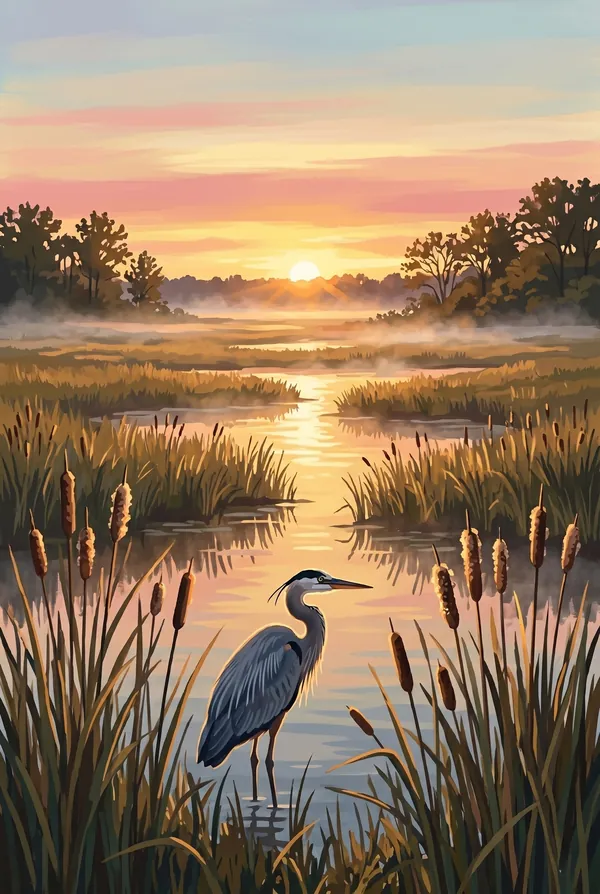
Indiana Dunes National Park stamp design 2: Great Marsh at Sunrise

Great Marsh at Sunrise

The largest interdunal wetland in the Lake Michigan watershed, originally around 4,000 acres, lying in the trough behind the dunes. It was ditched, drained, farmed for cranberries and partly turned into a golf course. Restoration started in 1998: over 25 years, roughly 1,100 acres brought back, more than 734,000 native plants installed, culverts plugged and ditches filled to restore the water. Sandhill cranes have returned.

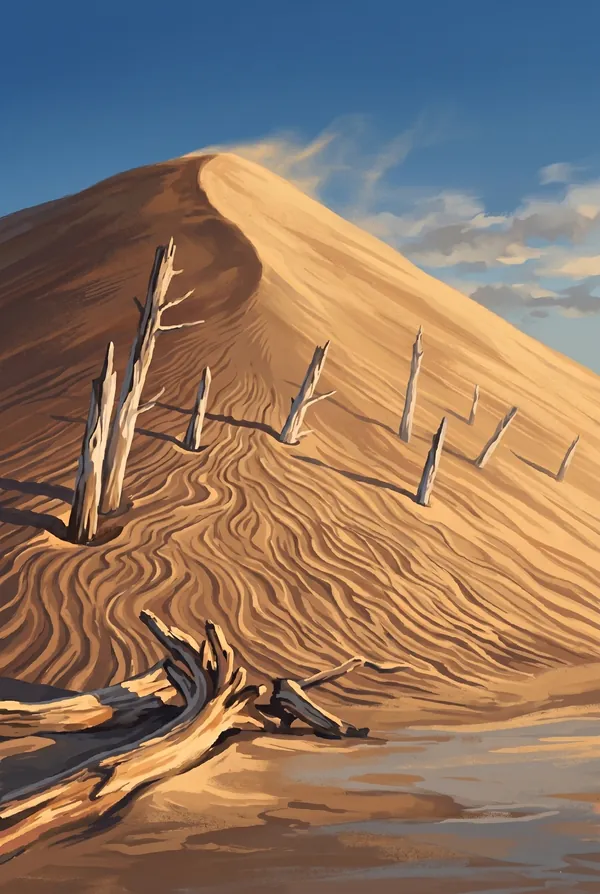
Indiana Dunes National Park stamp design 3: Mount Baldy Moving Dune

Mount Baldy Moving Dune

A dune that walks. It moved 443 feet inland between 1938 and 2008, averaging 6.23 feet a year, because harbor structures built since 1836 trap the sand that would otherwise resupply it. In July 2013 a six-year-old boy vanished into a hole that opened under him and was buried about eleven feet down for three and a half hours. He survived. The hole was a decomposition chimney, the shaft left behind when the advancing dune buries a tree and the trunk rots away. Researchers have since found more than 66 of them on this one dune. The phenomenon was essentially undocumented before that day. The summit is still closed.

How to record your Indiana Dunes visit

Free, and it works whether you are standing there now or remembering a trip from years ago.
1

Check In at the park

Open ParkStamp inside the park boundary and check in. The app confirms you are actually there and logs the date.

2

Or Stamp It later

Already been? Pick the date yourself. Trips from decades ago count the same as last weekend.

3

Or scan your photos

Let ParkStamp read the dates and locations off photos already on your phone. Most people find parks they had forgotten.

Indiana Dunes, asked and answered

Quick answers, for people planning a trip and people remembering one.
When is the best time to visit Indiana Dunes?
July and August for the beach, once Lake Michigan finally warms enough to swim. Spring and fall are the birding seasons, when migrations funnel along the lakeshore and the checklist passes 350 species. October puts fall color on the black oak savannas, and deep winter builds shelf ice along the shore, beautiful and strictly for looking at.
How many days do you need at Indiana Dunes?
One full day covers the essentials: a dune climb, a swim if the lake allows, and a walk through the bog country that made this shoreline famous in ecology. A second day, on the Cowles Bog trail or at the Heron Rookery, is for people who came because of the science.
How busy is Indiana Dunes?
Indiana Dunes National Park logged 2.63 million visits in 2025, the 13th busiest of the 63 national parks. That puts it in the middle of the pack: busy at the famous spots, quiet a mile past them.
What does the Indiana Dunes stamp show?
The lead Indiana Dunes design is Lake Michigan Shoreline and Dunes. About fifteen miles of shore backed by parallel dune ridges, with marram grass doing the structural work of trapping windblown sand and building the foredune. On a clear day the Chicago skyline is visible across the water, thirty-odd miles northwest, which tells you most of what you need to know about this park. So do the mills visible in the other direction. The other two designs are Great Marsh at Sunrise and Mount Baldy Moving Dune.
Is the Indiana Dunes stamp free?
Recording your Indiana Dunes visit is always free: check in at the park, add an old trip, or let the photo scan find it. The full-color art is the paid part, $3.99 one-time with three Indiana Dunes designs to choose from, and the first stamp you collect in ParkStamp is free.
Can I add a Indiana Dunes trip from years ago?
Yes. Open Indiana Dunes in ParkStamp, tap Stamp It, and set the date yourself; a visit from decades ago counts the same as last weekend. If you still have photos from the trip, the photo scan can find and date it from their location tags, without your photos ever leaving your phone.
Do I have to be at Indiana Dunes to get the stamp?
No. Check In is for when you are standing inside Indiana Dunes, and it confirms you are actually there. Stamp It records any past visit on your honor, with your dates. Both are free and put the same stamp in your StampBook.

Start your StampBook with Indiana Dunes

Free on iOS and Android. Your first stamp is on us.

More parks in the Northeast

Collect the region.