This was the first national park protected for the life in it rather than the scenery: a river 60 miles wide and a few inches deep, moving toward the sea at roughly a quarter mile a day. Truman dedicated it in December 1947, the same year Marjory Stoneman Douglas taught the country to stop calling it a swamp.
Everglades is one of 63 national parks in ParkStamp, each with original stamp designs drawn in the WPA poster tradition. Every design is an illustration of a specific real place in the park (a named trail, a tower, a coastline), not a generic wetland.
Logging the visit is free. Check in on the spot, add a trip from any year past, or let the app read the dates and locations off photos that are already on your phone.
The real NPS boundary, with the roads and towns you would actually use to get there.
Everglades, for people who count parks
The park that redefined what a park is for, dedicated the year "River of Grass" was published.
Every earlier park was about spectacle. Mountains, canyons, geysers: things you look up or down at. The Everglades is flat, wet and slow, and the case for it was biological: nowhere else on the continent did this ecosystem exist at all. When it was authorized in 1934 that was a genuinely radical argument, and it changed what a national park could be. Every park since that protects an ecosystem rather than a view is downstream of this one.
It took a salesman and a writer. Ernest Coe, a retired landscape architect, began campaigning in 1928 with the single-mindedness that earned him the title "father of the Everglades," and then endured 13 years of land assembly before there was a park to open; Truman dedicated it at Everglades City on December 6, 1947. Weeks earlier, Marjory Stoneman Douglas had published The Everglades: River of Grass, whose first line ("There are no other Everglades in the world") and central metaphor, a river rather than a swamp, permanently changed how the place was understood. She kept fighting for it until her death at 108.
The river's problem is that its headwaters were rerouted. The water arrives as a sheet flowing south from the Lake Okeechobee basin, and the twentieth century spent itself diking, ditching and draining that flow for farms and cities. The Tamiami Trail, built across the grain of the river in 1928, functioned as a dam you could drive on. The park protects the receiving end of a plumbing system it does not control, which is why the Everglades became the subject of one of the largest ecosystem restoration efforts ever attempted.
The world has noticed. The Everglades is the only place in the United States carrying all three major international designations at once: World Heritage Site, International Biosphere Reserve, and Wetland of International Importance, a triple crown shared by only a handful of sites on Earth.
Alligators and crocodiles in the same water, and a warden who died for the egrets.
This is the only place on Earth with both alligators and crocodiles. The freshwater sawgrass country belongs to the American alligator; the brackish mangrove fringe along Florida Bay belongs to the American crocodile; and in between, the two overlap. One park, two apex crocodilians, separated mostly by salt.
A century ago, egret plumes were worth more than gold by weight. The hat trade shot out the great wading bird rookeries of South Florida, and in 1905 Guy Bradley, an Audubon warden hired to guard the survivors near Flamingo, was shot dead confronting plume hunters. His death helped turn the country against the trade. The herons, egrets, wood storks and roseate spoonbills you see today are the recovering remnant, still a fraction of what the 1800s knew.
The Burmese python is rewriting the food web. Escaped and released pet pythons established themselves in the park around the turn of this century, and a 2012 study documented what followed: raccoon and opossum observations down by more than 90 percent in the python zone, marsh rabbits effectively gone. A ten-foot ambush predator with no local enemies is the park's hardest current problem.
The Florida panther is still out here. Down to a few dozen animals in the 1980s and hollowed out by inbreeding, the population was bolstered by Texas cougars in 1995 and has climbed back to a couple hundred statewide. The park's pinelands and cypress country are the southern end of its range; almost nobody sees one, which is roughly the point.
The Everglades designs
Pick the one that matches the park you actually saw.
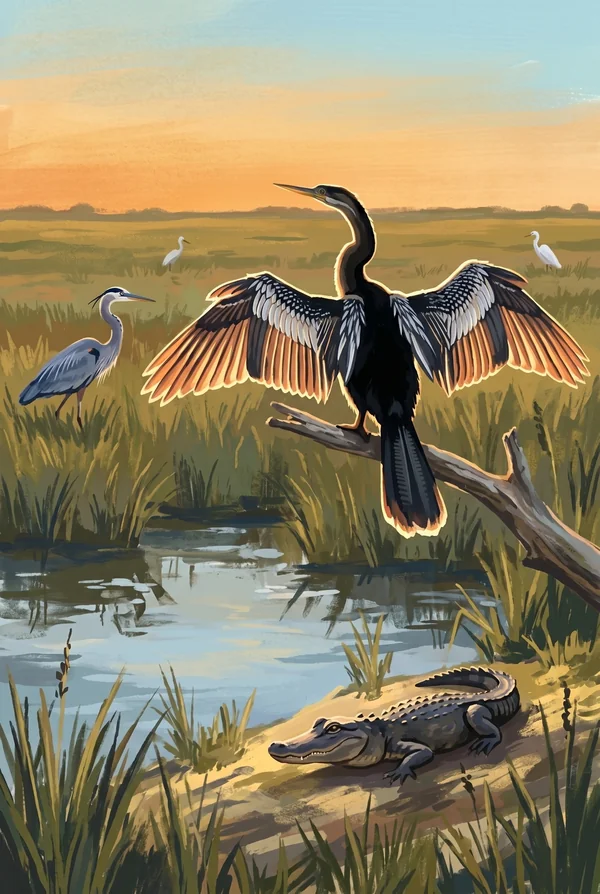
Anhinga Trail
A short boardwalk over Taylor Slough near Royal Palm, and possibly the most reliable wildlife walk in the entire park system: in the winter dry season the slough holds the water, so alligators, herons, egrets and the trail's namesake anhingas (spear-fishing birds that must spread their wings to dry) crowd within feet of the railing. No stalking, no luck required.
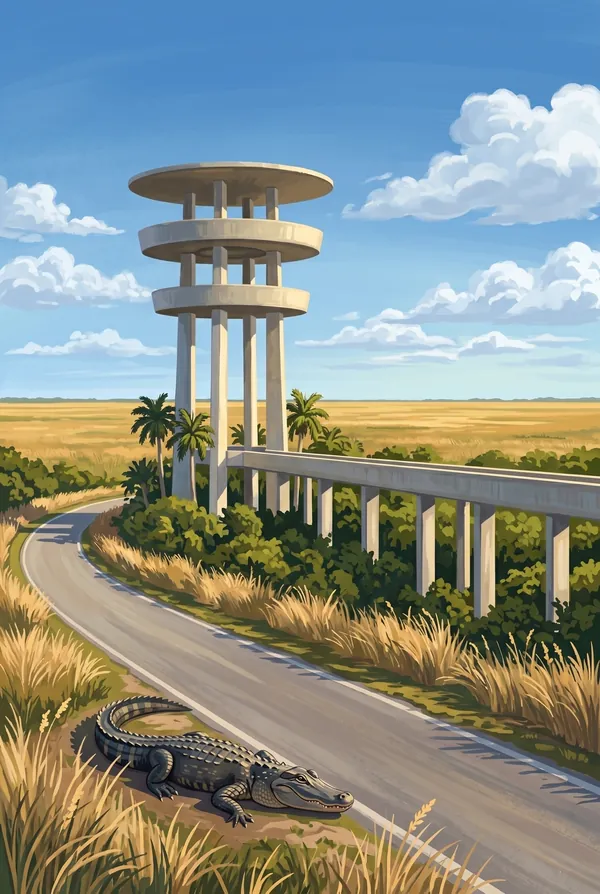
Shark Valley Tower
A 65-foot concrete observation tower at the far end of a 15-mile loop into the middle of Shark River Slough, the main channel of the river of grass. From the top ramp the sawgrass runs level to the horizon in every direction. It is the only place a person can stand above the Everglades and actually see the river shape of it, gators lounging on the banks below.
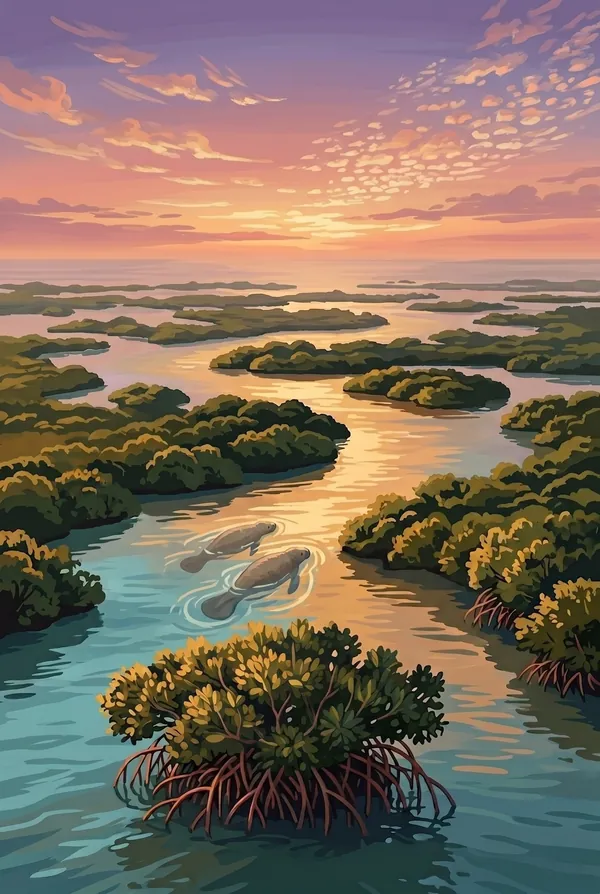
Ten Thousand Islands
The Gulf Coast side of the park: a labyrinth of mangrove islands, part of the largest protected mangrove forest in the Western Hemisphere, where nobody has ever settled on an exact count. Best seen at water level by kayak among dolphins and wheeling ospreys; this is the trailhead of the 99-mile Wilderness Waterway that winds to Flamingo.
How to record your Everglades visit
Free, and it works whether you are standing there now or remembering a trip from years ago.
1
Check In at the park
Open ParkStamp inside the park boundary and check in. The app confirms you are actually there and logs the date.
2
Or Stamp It later
Already been? Pick the date yourself. Trips from decades ago count the same as last weekend.
3
Or scan your photos
Let ParkStamp read the dates and locations off photos already on your phone. Most people find parks they had forgotten.
Everglades, asked and answered
Quick answers, for people planning a trip and people remembering one.
When is the best time to visit Everglades?
December through April, the dry season. As the sawgrass country dries, the wildlife concentrates around the remaining water; this is when the Anhinga Trail turns into a crowd of alligators and wading birds, and when the mosquitoes are merely present rather than in charge. Summer brings daily thunderheads, flooded sloughs and insect pressure that all but empties the park of people.
How many days do you need at Everglades?
Two days, split by coast: one for the main road from the entrance near Homestead down to Flamingo, with stops at the Anhinga Trail, Pa-hay-okee and the mangrove country at the end; one for either the Shark Valley loop and its tower or a paddle among the Ten Thousand Islands from the Gulf Coast side. The park is three distinct trips wearing one name.
How busy is Everglades?
Everglades National Park logged 778,198 visits in 2025, the 31st busiest of the 63 national parks. That puts it in the middle of the pack: busy at the famous spots, quiet a mile past them.
What does the Everglades stamp show?
The lead Everglades design is Anhinga Trail. A short boardwalk over Taylor Slough near Royal Palm, and possibly the most reliable wildlife walk in the entire park system: in the winter dry season the slough holds the water, so alligators, herons, egrets and the trail's namesake anhingas (spear-fishing birds that must spread their wings to dry) crowd within feet of the railing. No stalking, no luck required. The other two designs are Shark Valley Tower and Ten Thousand Islands.
Is the Everglades stamp free?
Recording your Everglades visit is always free: check in at the park, add an old trip, or let the photo scan find it. The full-color art is the paid part, $3.99 one-time with three Everglades designs to choose from, and the first stamp you collect in ParkStamp is free.
Can I add a Everglades trip from years ago?
Yes. Open Everglades in ParkStamp, tap Stamp It, and set the date yourself; a visit from decades ago counts the same as last weekend. If you still have photos from the trip, the photo scan can find and date it from their location tags, without your photos ever leaving your phone.
Do I have to be at Everglades to get the stamp?
No. Check In is for when you are standing inside Everglades, and it confirms you are actually there. Stamp It records any past visit on your honor, with your dates. Both are free and put the same stamp in your StampBook.
Start your StampBook with Everglades
Free on iOS and Android. Your first stamp is on us.