Seventy miles west of Key West, reachable only by boat or seaplane, stands the largest brick structure in the Western Hemisphere: sixteen million bricks on a sand island, begun in 1846 and never finished. The park around it is 99 percent open water.
Dry Tortugas is one of 63 national parks in ParkStamp, and like every park it gets original stamp designs drawn in the WPA poster tradition: each one is an illustration of a specific real place, in this case places you mostly reach by water.
Recording the visit is free. Check in from the island, add the trip you took years ago, or let the app read dates and locations from the photos already on your phone.
The real NPS boundary, with the roads and towns you would actually use to get there.
Dry Tortugas, for people who count parks
A 500-year-old name, an obsolete fortress, and the doctor who treated his jailers.
The name is older than almost any other on a US map. Ponce de León sailed through in 1513 and called the islands Las Tortugas for the sea turtles his crew caught here. "Dry" was added to the charts later as a warning: there is no fresh water on any of these islands. Five centuries on, both halves of the name are still accurate.
Fort Jefferson was obsolete before it was finished. Construction started in 1846 to command the shipping lane between the Gulf of Mexico and the Atlantic: whoever held the Tortugas anchorage could shelter a fleet astride the Mississippi trade. Work ran for three decades, consumed some sixteen million bricks, and stopped without ever completing the fort, partly because rifled artillery had made thick masonry walls pointless. It never saw battle.
Its most famous resident arrived in chains. During and after the Civil War the fort served as a military prison, and its best-known inmate was Dr. Samuel Mudd, convicted of conspiracy for setting John Wilkes Booth's broken leg after the Lincoln assassination. When yellow fever swept the garrison in 1867 and killed the post surgeon, Mudd took over the care of the men guarding him. President Johnson pardoned him in 1869.
Franklin Roosevelt put the park system in charge in 1935, proclaiming Fort Jefferson National Monument that January, and Congress redesignated it Dry Tortugas National Park on October 26, 1992. It remains one of the least visited parks in the country (under a hundred thousand people a year) for the same reason it stays worth visiting: seventy miles of open water between it and the nearest road.
A seabird city on a sandbar, and turtles still nesting under a 500-year-old name.
Sooty terns own Bush Key. Tens of thousands of them nest on the little island beside the fort, the only major sooty tern rookery in the continental United States. The birds themselves are stranger than the spectacle: young sooty terns leave the colony and stay out over the open ocean for years without touching land, sleeping on the wing, before returning here to breed.
Magnificent frigatebirds nest on Long Key, the species' only significant breeding colony in the continental United States. With a seven-foot wingspan on a body that weighs about as much as a chicken, frigatebirds barely ever flap, hanging over the anchorage like kites and robbing other seabirds of their catch mid-air.
The turtles are still here. Loggerhead and green sea turtles nest on the park's beaches every summer, five centuries after they fed Ponce de León's crew and named the place. The surrounding shallows, seagrass meadows and coral heads in famously clear water, work as a nursery for reef fish, nurse sharks and the occasional enormous goliath grouper.
The Dry Tortugas designs
Pick the one that matches the park you actually saw.
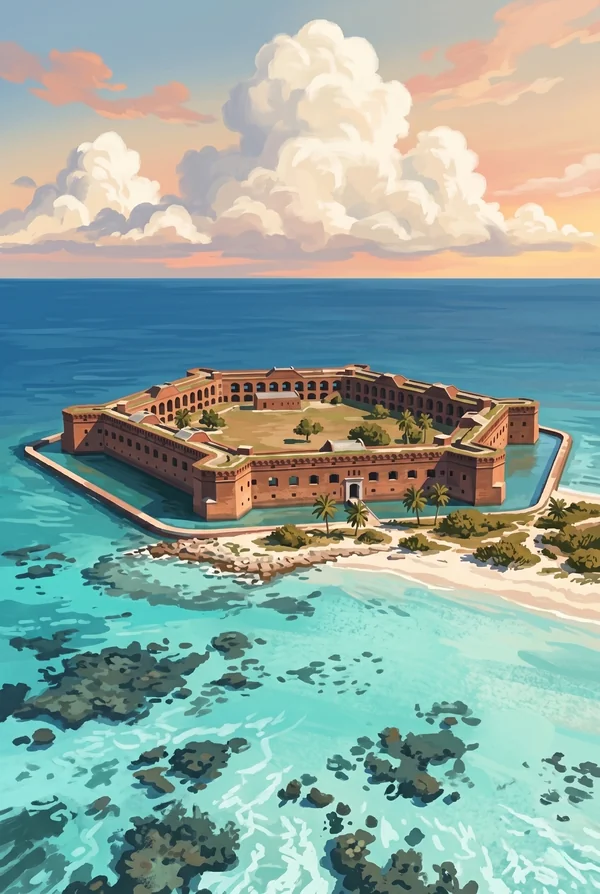
Fort Jefferson
The six-sided fortress that covers nearly all of Garden Key: sixteen million bricks, three gun tiers, and a seawater moat you can walk around on top of the moat wall. Started in 1846, never finished, never attacked. The arched brick casemates run in receding rows like a hall of mirrors, and the whole improbable mass sits on sand in the middle of the sea.
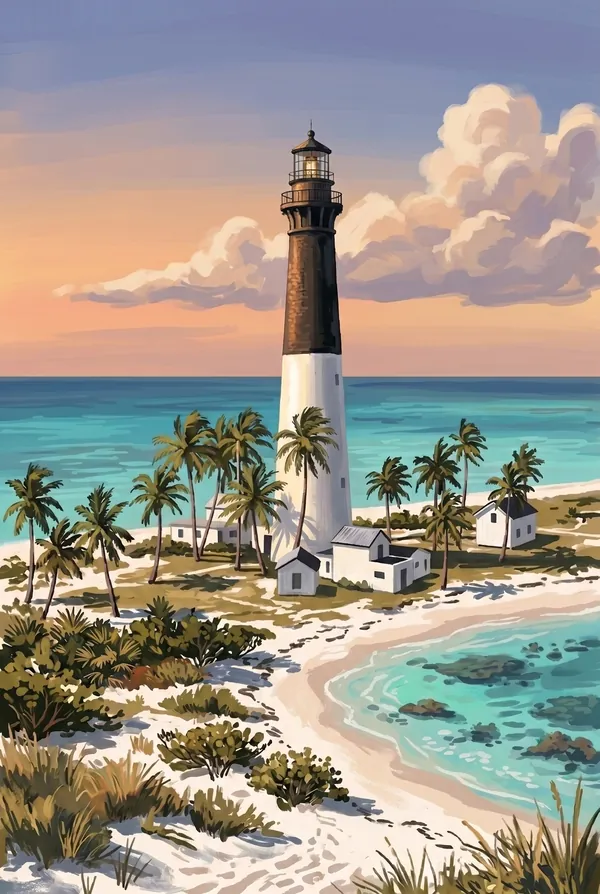
Loggerhead Key
The largest island in the group, three miles from the fort, with a brick lighthouse that has stood over it since 1858. From 1904 to 1939 the Carnegie Institution ran its Tortugas Laboratory here, doing some of the earliest serious coral reef science in the hemisphere. Pick it for the lonely-lighthouse composition: one tower, one sand island, open ocean to the horizon.
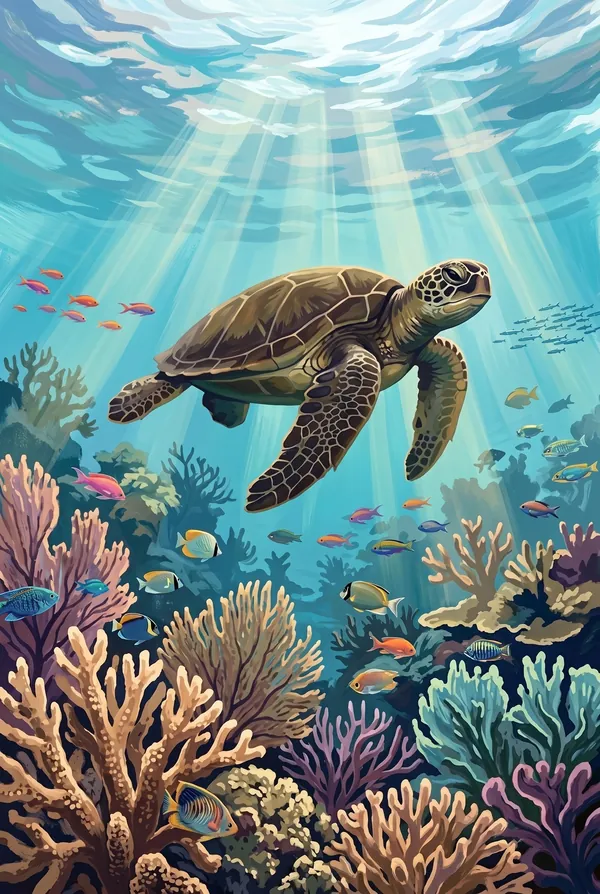
Coral Reef
The 99 percent of the park that is underwater: seagrass beds and patch reefs in shallow, glass-clear water, snorkelable straight off the beach at Garden Key and along the moat wall. Off Loggerhead Key lies the Windjammer wreck, an iron-hulled sailing ship lost in 1901, resting in water shallow enough to explore with a mask and fins.
How to record your Dry Tortugas visit
Free, and it works whether you are standing there now or remembering a trip from years ago.
1
Check In at the park
Open ParkStamp inside the park boundary and check in. The app confirms you are actually there and logs the date.
2
Or Stamp It later
Already been? Pick the date yourself. Trips from decades ago count the same as last weekend.
3
Or scan your photos
Let ParkStamp read the dates and locations off photos already on your phone. Most people find parks they had forgotten.
Dry Tortugas, asked and answered
Quick answers, for people planning a trip and people remembering one.
When is the best time to visit Dry Tortugas?
April and May: the seas are at their calmest for the crossing, the sooty tern colony on Bush Key is in full cry, and spring migration drops songbirds onto the fort parade ground in numbers that make this one of Florida's famous birding spectacles. Winter fronts can roughen the crossing; late summer and fall carry hurricane-season risk and real heat.
How many days do you need at Dry Tortugas?
Most people get about half a day on Garden Key, which honestly covers the fort and a snorkel of the moat wall. The upgrade is a night of camping: the day boats leave, the island empties to a handful of tents, and you get the fort at sunset, a genuinely dark sky seventy miles from the nearest streetlight, and the reef at first light.
How busy is Dry Tortugas?
Dry Tortugas National Park logged 89,355 visits in 2025, the 56th busiest of the 63 national parks. That makes it one of the quieter national parks, and crowds are rarely the problem.
What does the Dry Tortugas stamp show?
The lead Dry Tortugas design is Fort Jefferson. The six-sided fortress that covers nearly all of Garden Key: sixteen million bricks, three gun tiers, and a seawater moat you can walk around on top of the moat wall. Started in 1846, never finished, never attacked. The arched brick casemates run in receding rows like a hall of mirrors, and the whole improbable mass sits on sand in the middle of the sea. The other two designs are Loggerhead Key and Coral Reef.
Is the Dry Tortugas stamp free?
Recording your Dry Tortugas visit is always free: check in at the park, add an old trip, or let the photo scan find it. The full-color art is the paid part, $3.99 one-time with three Dry Tortugas designs to choose from, and the first stamp you collect in ParkStamp is free.
Can I add a Dry Tortugas trip from years ago?
Yes. Open Dry Tortugas in ParkStamp, tap Stamp It, and set the date yourself; a visit from decades ago counts the same as last weekend. If you still have photos from the trip, the photo scan can find and date it from their location tags, without your photos ever leaving your phone.
Do I have to be at Dry Tortugas to get the stamp?
No. Check In is for when you are standing inside Dry Tortugas, and it confirms you are actually there. Stamp It records any past visit on your honor, with your dates. Both are free and put the same stamp in your StampBook.
Start your StampBook with Dry Tortugas
Free on iOS and Android. Your first stamp is on us.