Biscayne is 95 percent water, a national park where the main road is a boat channel. It exists because in the 1960s Miami's neighbors decided the shallow bay south of the city should not become an oil port, a refinery site, or a subdivision called Islandia, all of which were on the table.
Biscayne is one of the 63 national parks in ParkStamp, and like the other 62 it gets original stamp designs in the WPA poster tradition, each one an illustration of a real, specific corner of the park.
Logging the visit costs nothing. Check in from the park, enter an old trip after the fact, or let the app find the dates and places in the photos you already have.
The real NPS boundary, with the roads and towns you would actually use to get there.
Biscayne, for people who count parks
The city that never happened, and the farmer who would not sell.
In the early 1960s this was going to be Islandia. Landowners on the northern keys incorporated a city by that name, complete with plans for a causeway from the mainland, while a separate group proposed an oil refinery on the bay shore with a deep ship channel dredged through the shallows. A local coalition fought both for most of a decade: among them Lloyd Miller of the Izaak Walton League, Miami Herald writer Juanita Greene, and Herbert Hoover Jr. of the vacuum-cleaner fortune, who flew decision-makers over the bay to show them what was at stake. Lyndon Johnson signed Biscayne National Monument into law in 1968; the national park followed on June 28, 1980.
The developers left a scar out of spite. In 1968, with protection closing in, landowners bulldozed a swath six lanes wide down the spine of Elliott Key, miles through the tropical hardwood hammock, reasoning that a wrecked island would be less worth saving. Locals named it Spite Highway. The forest has since closed back over it, and the corridor is now the island's hiking trail; you can walk the length of the sabotage under a canopy.
Lancelot Jones would not sell to them. His father, Israel Lafayette Jones, a Black farmer and boat captain, bought Porgy Key in the 1890s, and the family built one of the region's most productive key lime operations. Lancelot spent his adult life on the islands guiding fishing parties (US presidents among his clients), and when Islandia's promoters came with money, he turned them down and sold to the government instead in 1970, keeping the right to live out his life on the key. Hurricane Andrew took the homestead in 1992; he died five years later, just short of 100.
The result is a park that is 95 percent water. It protects four systems in one frame: the longest stretch of undeveloped mangrove shoreline left on Florida's east coast, the shallow bay itself, the northernmost of the true Florida Keys, and the upper end of the only living coral barrier reef along the continental United States, all of it within sight of downtown Miami.
A reef, a bay, and one of the rarest butterflies in America.
More than 500 fish species have been recorded in park waters. The reefs at the park's seaward edge are the northern end of the Florida reef tract: brain corals, star corals, sea fans, and the constant traffic of parrotfish, angelfish and grunts that goes with them. The park also maintains an underwater Maritime Heritage Trail across six shipwrecks spanning close to a century of sinkings.
The Schaus' swallowtail is holding on here. A big, slow-flying brown-and-yellow butterfly of the tropical hardwood hammocks, federally protected since the 1970s, its world has contracted to Elliott Key and a handful of nearby islands. It flies for a few weeks in late spring, its fortunes swing with every hurricane season, and it is routinely described as one of the rarest butterflies in the United States.
Manatees, sea turtles, crocodiles. Manatees graze the bay's seagrass meadows, sea turtles haul out in summer to nest on the small beaches of the keys, and the American crocodile (shy, fish-eating, and nothing like its reputation) has spent decades quietly recovering along this stretch of coast.
The mangroves are the nursery. The prop roots of the shoreline forest shelter juvenile reef fish, spiny lobster and shrimp until they are big enough for open water, which means the reef's population pipeline runs through the trees. The park's shape (a strip of coast, a bay, keys and reef) protects the whole conveyor, not just the pretty end of it.
The Biscayne designs
Pick the one that matches the park you actually saw.
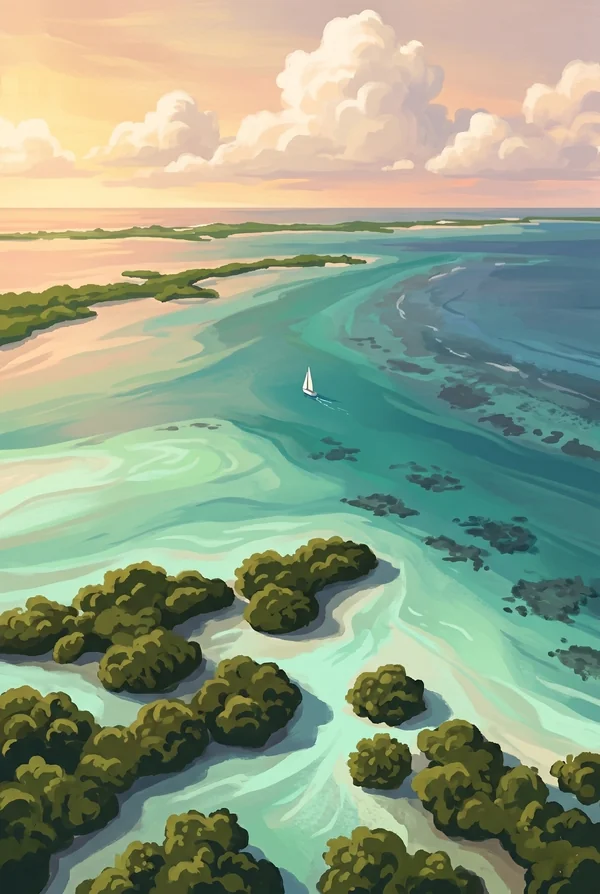
Biscayne Bay
The shallow lagoon that makes up most of the park: seagrass flats a few feet deep between the mainland mangroves and the keys. Manatees graze it, bonefish cruise it, and the Miami skyline sits on its northern horizon, which is the whole point of the story: this much clear, living water this close to a city of millions.
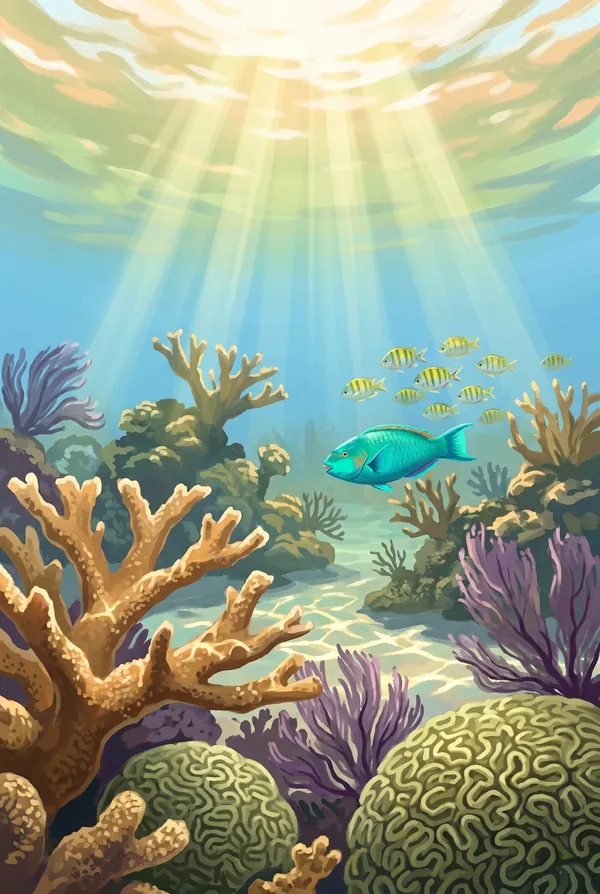
Coral Garden
Patch reefs at the northern end of the Florida reef tract, the only living coral barrier reef along the continental United States: brain and star coral heads, waving sea fans, and a share of the more than 500 fish species recorded in the park. It is snorkel-depth water, and it is the part of the park most visitors never see.
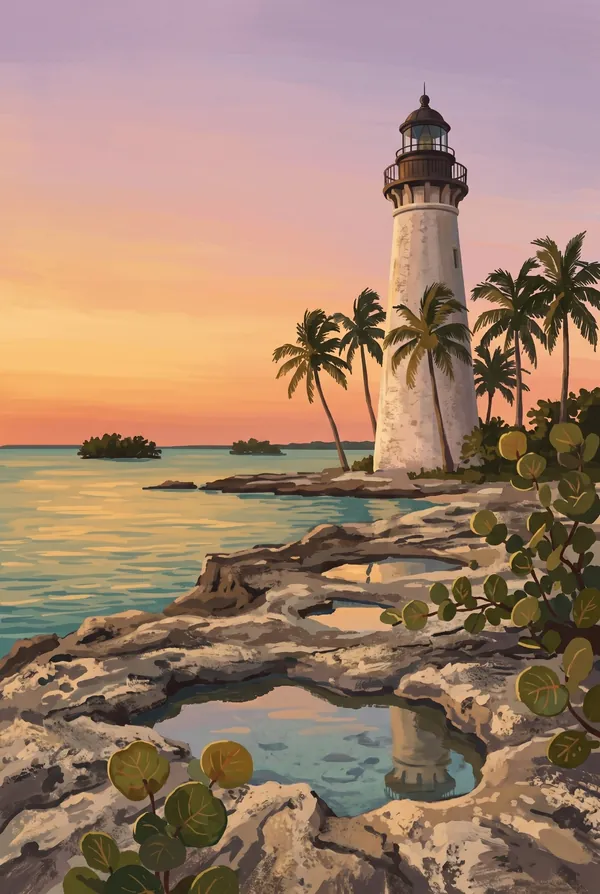
Boca Chita Key
The park's most visited island, bought in the 1930s by industrialist Mark Honeywell, who built its 65-foot lighthouse as ornament; it never served as an aid to navigation. The coral-rock buildings and the lighthouse still stand, and the view from the lawn takes in the whole bay with Miami stacked on the horizon.
How to record your Biscayne visit
Free, and it works whether you are standing there now or remembering a trip from years ago.
1
Check In at the park
Open ParkStamp inside the park boundary and check in. The app confirms you are actually there and logs the date.
2
Or Stamp It later
Already been? Pick the date yourself. Trips from decades ago count the same as last weekend.
3
Or scan your photos
Let ParkStamp read the dates and locations off photos already on your phone. Most people find parks they had forgotten.
Biscayne, asked and answered
Quick answers, for people planning a trip and people remembering one.
When is the best time to visit Biscayne?
The winter dry season, December through April: mild air, low humidity, manageable mosquitoes, and clear water over the bay. Summer is hot, wet and buggy on the islands, but it brings the calmest seas and the warmest, clearest snorkeling of the year if you go early in the day. It is also hurricane season, which shapes everything on this coast, so stay flexible.
How many days do you need at Biscayne?
One day, spent almost entirely on the water, covers a lot: the bay crossing, Boca Chita or Elliott Key, and a snorkel over the reefs or the shipwrecks. A second day suits paddlers, who can work the mangrove shoreline and the lagoons at their own speed. Without time on a boat you will only see the shoreline strip at Convoy Point: a preview, not the park.
How busy is Biscayne?
Biscayne National Park logged 486,567 visits in 2025, the 41st busiest of the 63 national parks. That makes it one of the quieter national parks, and crowds are rarely the problem.
What does the Biscayne stamp show?
The lead Biscayne design is Biscayne Bay. The shallow lagoon that makes up most of the park: seagrass flats a few feet deep between the mainland mangroves and the keys. Manatees graze it, bonefish cruise it, and the Miami skyline sits on its northern horizon, which is the whole point of the story: this much clear, living water this close to a city of millions. The other two designs are Coral Garden and Boca Chita Key.
Is the Biscayne stamp free?
Recording your Biscayne visit is always free: check in at the park, add an old trip, or let the photo scan find it. The full-color art is the paid part, $3.99 one-time with three Biscayne designs to choose from, and the first stamp you collect in ParkStamp is free.
Can I add a Biscayne trip from years ago?
Yes. Open Biscayne in ParkStamp, tap Stamp It, and set the date yourself; a visit from decades ago counts the same as last weekend. If you still have photos from the trip, the photo scan can find and date it from their location tags, without your photos ever leaving your phone.
Do I have to be at Biscayne to get the stamp?
No. Check In is for when you are standing inside Biscayne, and it confirms you are actually there. Stamp It records any past visit on your honor, with your dates. Both are free and put the same stamp in your StampBook.
Start your StampBook with Biscayne
Free on iOS and Android. Your first stamp is on us.