The only national park named for a person, on the ground that arguably produced the most consequential conservationist in American history. Roosevelt came to Dakota Territory in 1883 to shoot a bison before they were gone. What happened to him out here changed what happened to every landscape in this app.
Theodore Roosevelt is one of 63 national parks in ParkStamp, and like the rest it carries original stamp designs drawn in the WPA poster tradition, each one an illustration of a real place in the park rather than a generic badlands scene.
Recording that you were here is free. Check in from the park, enter a trip from any year, or let the app read dates and locations from the photos already stored on your phone.
The real NPS boundary, with the roads and towns you would actually use to get there.
Theodore Roosevelt, for people who count parks
A grieving New Yorker, a failed cattle operation, and the entire conservation movement downstream of both.
He arrived in September 1883, a 24-year-old asthmatic assemblyman, and before the hunting trip ended he had bought into a cattle ranch. Five months later, on February 14, 1884, his wife and his mother died in the same New York house on the same day. Roosevelt wrote a large X in his diary and beneath it: "The light has gone out of my life." He came back to the badlands, built the remote Elkhorn Ranch on the Little Missouri, and spent much of the next three years riding this country.
The ranching failed; the education did not. The brutal winter of 1886-87 destroyed most of his herd along with everyone else's, and he eventually went home. But he had watched the bison all but vanish and the range degrade in real time, and he said later that he would never have become President had it not been for his years in North Dakota. As President he protected roughly 230 million acres of national forests, bird reservations, monuments and parks, a legacy that traces in a straight line back to this valley.
The park itself is a one-off. Truman signed it into being on April 25, 1947 as Theodore Roosevelt National Memorial Park, the only "national memorial park" ever created, and on November 10, 1978 Congress dropped the word and made it a full national park, adding a designated wilderness in the same act. It comes in three pieces: a South Unit at Medora, a North Unit some seventy road miles away, and, alone between them, the site of the Elkhorn Ranch: no buildings left, just foundation stones and cottonwoods, a place admirers treat as something like a shrine.
The badlands themselves are a young accident. The Little Missouri once flowed north toward Hudson Bay; ice-age glaciers blocked that route and forced it east into the Missouri, and the rerouted, steepened river has been slicing through soft sediments ever since. Seams of lignite coal in the exposed layers sometimes ignite and smolder for years, baking the clay above them into the red clinker (locally, scoria) that stripes the hills.
The animal Roosevelt came to shoot is back on the land that made him regret it.
Bison returned in 1956, when 29 animals were trucked in from a Nebraska refuge and released in the South Unit; the North Unit got its own herd a few years later. Hundreds now work the same bottomlands where Roosevelt hunted one of the last of the wild ones, and a bison jam on the loop road is the park's most reliable event.
Feral horses run the South Unit. Descendants of ranch stock, they are one of the very few free-roaming horse populations anywhere in the national park system, kept partly because open-range horses are true to what Roosevelt saw here in the 1880s. The North Unit answers with a small demonstration herd of longhorn steers for the same historical reason.
Prairie dog towns are the infrastructure. Their colonies clip the grass short, turn the soil, and feed or house much of the rest of the cast: badgers, coyotes, golden eagles, burrowing owls, rattlesnakes. Roosevelt found their squeaking maddening; the ecosystem disagrees with him.
The exposed layers hold an older fauna: the park contains one of the larger concentrations of petrified wood in the country, stumps of a swampy forest tens of millions of years old weathering out of the same slopes the bison graze. Elk, pronghorn, bighorn sheep and mule deer fill out the modern lineup.
The Theodore Roosevelt designs
Pick the one that matches the park you actually saw.
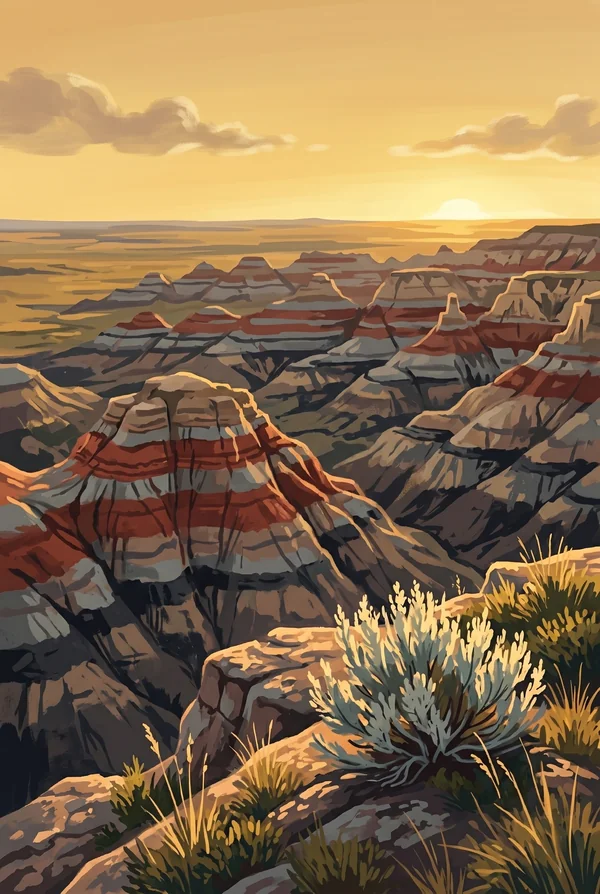
Painted Canyon Overlook
The badlands revealed all at once: banded slopes of gray, brown and clinker-red running to the horizon, from a rim you can reach directly off Interstate 94. It is many travelers' first proof that western North Dakota has been hiding this. The colors shift with every hour of light, which is exactly what a poster artist wants.
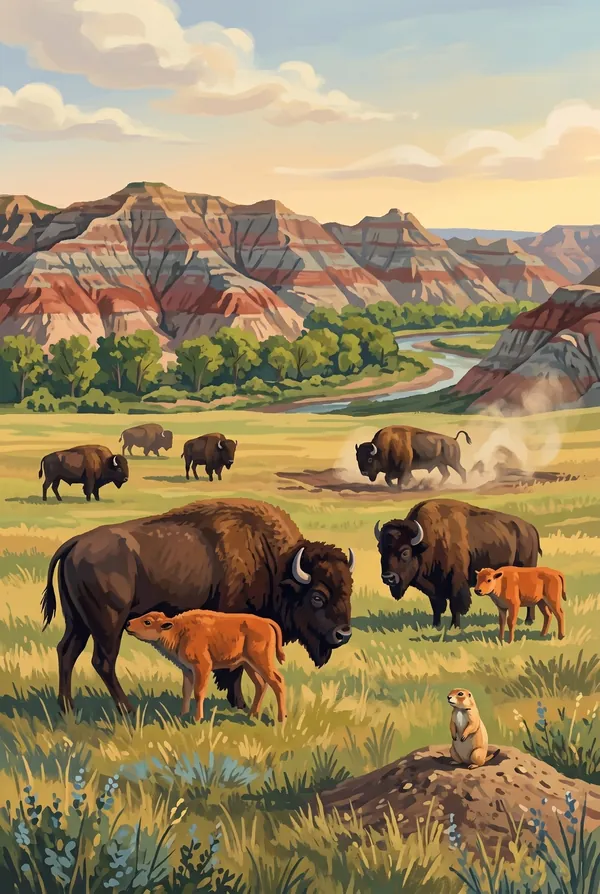
Bison in the Badlands
Twenty-nine bison were released here in 1956; their descendants now range both units in the hundreds, grazing the river bottoms and dusting themselves in the clay. An animal the park's namesake came to shoot before extinction took it, back on his own ranch country. As stamp subjects go, none carries more of the park's point.
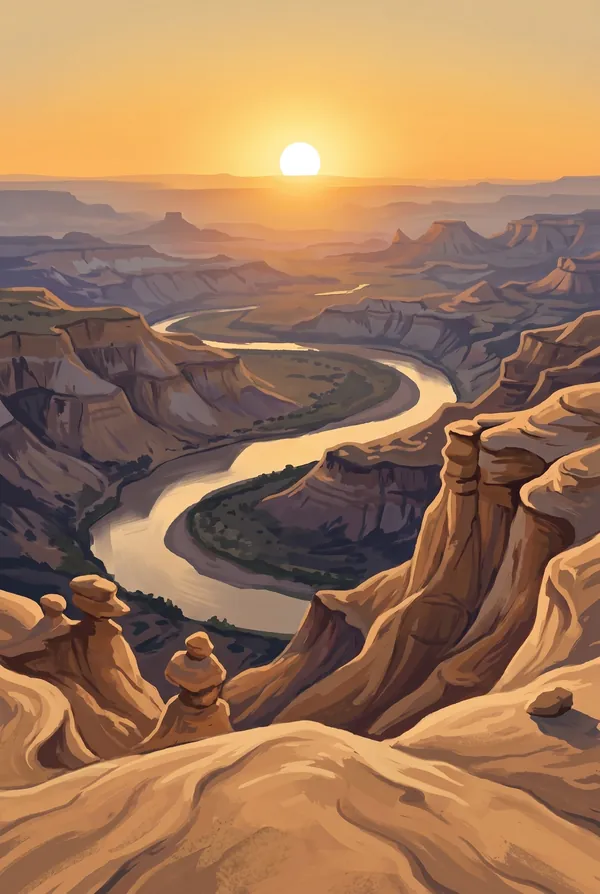
Wind Canyon and Little Missouri River
A short ridge trail to a wind-carved notch above a huge slow bend of the Little Missouri, the river that cut the entire badlands after ice-age glaciers forced it into a new course. It is the South Unit's classic evening view, with bison often scattered on the far bank at sundown.
How to record your Theodore Roosevelt visit
Free, and it works whether you are standing there now or remembering a trip from years ago.
1
Check In at the park
Open ParkStamp inside the park boundary and check in. The app confirms you are actually there and logs the date.
2
Or Stamp It later
Already been? Pick the date yourself. Trips from decades ago count the same as last weekend.
3
Or scan your photos
Let ParkStamp read the dates and locations off photos already on your phone. Most people find parks they had forgotten.
Theodore Roosevelt, asked and answered
Quick answers, for people planning a trip and people remembering one.
When is the best time to visit Theodore Roosevelt?
September, when the cottonwoods along the Little Missouri turn gold, the air cools, and the bison are done with their August rut. June is the green season, with wildflowers on the prairie and foals among the feral horses, before high summer bakes the clay. Winter is harsh, windblown and nearly empty, which some visitors consider exactly the badlands Roosevelt described. Spring arrives late and muddy.
How many days do you need at Theodore Roosevelt?
One day per unit is the honest arithmetic. Give the South Unit a day for the scenic loop, Wind Canyon at sunset, and the prairie dog towns; give the quieter North Unit (some seventy miles up the road) a half day for its river overlooks and cannonball concretions. Pilgrims add a detour to the Elkhorn Ranch site, which is empty, remote, and the point.
How busy is Theodore Roosevelt?
Theodore Roosevelt National Park logged 729,893 visits in 2025, the 33rd busiest of the 63 national parks. That puts it in the middle of the pack: busy at the famous spots, quiet a mile past them.
What does the Theodore Roosevelt stamp show?
The lead Theodore Roosevelt design is Painted Canyon Overlook. The badlands revealed all at once: banded slopes of gray, brown and clinker-red running to the horizon, from a rim you can reach directly off Interstate 94. It is many travelers' first proof that western North Dakota has been hiding this. The colors shift with every hour of light, which is exactly what a poster artist wants. The other two designs are Bison in the Badlands and Wind Canyon and Little Missouri River.
Is the Theodore Roosevelt stamp free?
Recording your Theodore Roosevelt visit is always free: check in at the park, add an old trip, or let the photo scan find it. The full-color art is the paid part, $3.99 one-time with three Theodore Roosevelt designs to choose from, and the first stamp you collect in ParkStamp is free.
Can I add a Theodore Roosevelt trip from years ago?
Yes. Open Theodore Roosevelt in ParkStamp, tap Stamp It, and set the date yourself; a visit from decades ago counts the same as last weekend. If you still have photos from the trip, the photo scan can find and date it from their location tags, without your photos ever leaving your phone.
Do I have to be at Theodore Roosevelt to get the stamp?
No. Check In is for when you are standing inside Theodore Roosevelt, and it confirms you are actually there. Stamp It records any past visit on your honor, with your dates. Both are free and put the same stamp in your StampBook.
Start your StampBook with Theodore Roosevelt
Free on iOS and Android. Your first stamp is on us.